Back to blog
Tax Bracket Management for Business Owners: 2026 Guide
Discover what tax bracket management for business is. Learn how to optimize income and deductions to reduce your tax bill effectively.


Discover what tax bracket management for business is. Learn how to optimize income and deductions to reduce your tax bill effectively.
TL;DR:
- Tax bracket management involves timing income and deductions to lower taxable income within lower federal tax brackets. It helps small business owners reduce their overall tax liability through strategic planning of income, expenses, and entity selection. Regular quarterly reviews and multi-year planning are essential to prevent high-income spikes and maximize tax savings over time.
Tax bracket management for businesses is the deliberate practice of timing income and deductions to keep taxable income in lower federal tax brackets, reducing your total tax bill each year. The IRS uses a progressive tax system, meaning each additional dollar of income gets taxed at a higher marginal rate as you cross bracket thresholds. For small business owners and entrepreneurs, understanding this system is the foundation of every effective tax management strategy. The industry term for this practice is “tax bracket management,” though CPAs and financial planners often call it income smoothing or bracket optimization. Done well, it coordinates entity selection, deduction timing, retirement contributions, and multi-year forecasting to reduce what you owe the IRS, not just this year, but over the life of your business.
Tax bracket management is the process of structuring your business income and expenses so the least amount of money possible gets taxed at the highest rates. It is not tax evasion. It is legal, proactive planning that every CPA recommends.
The U.S. federal tax system is progressive. You do not pay one flat rate on all your income. Instead, income is divided into layers, and each layer is taxed at its own rate. A business owner earning $200,000 does not pay 32% on the full amount. They pay 10% on the first layer, 12% on the next, 22% on the next, and so on up the scale.
The two rates you need to understand are the marginal rate and the effective rate. Your marginal rate is the rate on your last dollar of income. Your effective rate is your total tax divided by your total income. Most business owners are surprised to find their effective rate is several points lower than their marginal rate. That gap is exactly what tax efficiency strategies are designed to widen.
Business structure determines which tax brackets apply to you. Pass-through entities pay personal rates ranging from 10% to 37%, while C corporations pay a flat 21% corporate rate. That difference is significant. A sole proprietor, LLC owner, or S corp shareholder reports business income on their personal return and climbs the individual bracket ladder. A C corp pays 21% regardless of profit level, but shareholders then pay personal rates again on dividends.
Here is a simplified view of how income layers work for a pass-through business owner filing as single in 2026:
| Taxable Income Range | Federal Marginal Rate |
|---|---|
| $0 to $11,925 | 10% |
| $11,926 to $48,475 | 12% |
| $48,476 to $103,350 | 22% |
| $103,351 to $197,300 | 24% |
| $197,301 to $250,525 | 32% |
| $250,526 to $626,350 | 35% |
| Over $626,350 | 37% |
The goal of bracket management is to keep as much income as possible in the lower rows of that table.
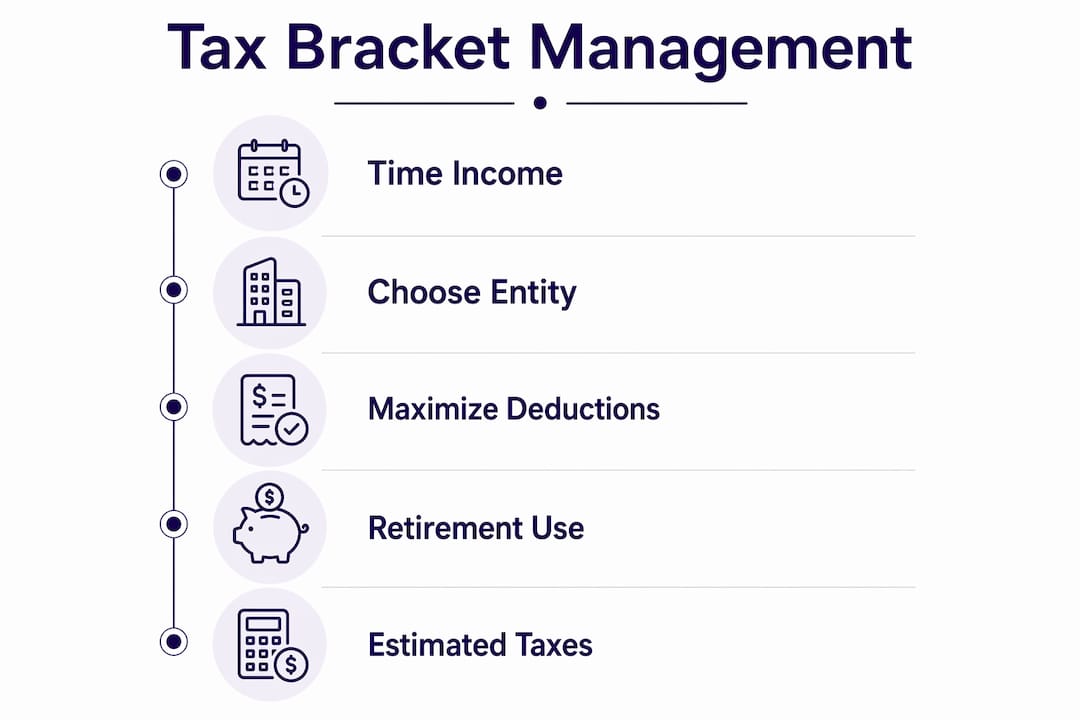
The most effective tax bracket management strategies fall into four categories: timing income and expenses, choosing the right entity, maximizing deductions, and using retirement accounts.
Deferring income or accelerating deductions before year-end is the most direct way to manage your bracket. Delaying a $60,000 invoice from december to january can move that revenue from a 32% bracket into a 24% bracket, saving several thousand dollars in federal tax. That one move requires no new products, no new clients, and no complex legal structure.

The reverse works too. If you expect a lower-income year ahead, accelerate income into the current year to fill up a lower bracket before rates rise.
S corp election can reduce self-employment taxes by splitting income between a reasonable salary and distributions, saving $5,000 to $20,000 or more annually for businesses with net profit above $80,000. That savings comes from the fact that distributions are not subject to the 15.3% self-employment tax that sole proprietors pay on every dollar of profit.
Entity selection is not a one-time decision. As your revenue grows, the right structure changes. An LLC that made sense at $50,000 in profit may cost you significantly more in taxes at $150,000.
The Section 199A qualified business income deduction allows eligible pass-through businesses to deduct up to 20% of qualified business income. That deduction alone can drop your effective marginal rate from 22% to 17.6% or from 24% to 19.2%. Income limits and business type restrictions apply, so confirming eligibility with a CPA is the right move.
Section 179 lets you deduct the full cost of qualifying equipment in the year of purchase rather than depreciating it over several years. Timing that purchase to a high-income year produces the largest tax benefit.
Retirement plan contributions are one of the most powerful tools for managing brackets. Contributing $10,000 to $25,000 to a SEP-IRA, Solo 401(k), or SIMPLE IRA reduces your taxable income dollar for dollar. That reduction can pull you below a bracket threshold entirely.
Roth conversions work in the opposite direction. In a low-income year, converting traditional IRA balances to a Roth IRA fills up lower brackets intentionally, spreading future tax liability at today’s lower rates.
Safe harbor estimated payments require you to pay at least 90% of your current year tax liability or 100% of your prior year liability, whichever is smaller. Meeting that threshold protects you from IRS underpayment penalties. Quarterly planning also forces you to review your bracket position four times per year, which creates natural checkpoints for adjusting income or deductions.
Pro Tip: Set a calendar reminder for september 15 and january 15, the two estimated tax deadlines most business owners miss. Missing them triggers penalties even if you pay in full at filing.
Single-year tax thinking is the most expensive habit a business owner can have. A decision that saves $5,000 this year can cost $15,000 over three years if it pushes income into higher brackets in future years.
Multi-year tax planning involves smoothing taxable income and strategically timing income and deductions across several years to reduce taxes over the long run. The goal is to avoid “bracket cliffs,” which are years where income spikes sharply and a large portion gets taxed at the highest rates.
Small business owners should model tax bracket management strategies over a 3–5 year horizon to smooth income and avoid bracket cliffs. A simple model tracks projected revenue, planned deductions, retirement contributions, and expected entity-level changes year by year. It does not need to be perfect. It needs to be directionally accurate enough to flag when a bracket jump is coming.
Here is what a multi-year plan typically coordinates:
“The business owners who pay the least in taxes over a decade are not the ones who find the best deduction in december. They are the ones who mapped out their income trajectory three years ago and made decisions accordingly. Bracket management is a planning discipline, not a year-end scramble.”
Coordinating entity-level tax decisions with personal finance goals is where proactive tax planning delivers the most value. Your business income does not exist in isolation. It interacts with your spouse’s income, your investment gains, your mortgage interest, and your retirement account balances. A plan that ignores those connections leaves money on the table.
Most tax bracket mistakes come from short-term thinking, not from complex errors. The fixes are straightforward once you know what to watch for.
Pro Tip: Review your year-to-date income against your bracket thresholds every quarter, not just in december. A september review gives you three months to act. A december review gives you three weeks.
Keeping accurate, up-to-date financial records is the foundation of every bracket management strategy. You cannot time income or deductions accurately if your books are three months behind.
Tax bracket management is the most cost-effective tax strategy available to small business owners because it requires no new spending, only better timing and planning.
| Point | Details |
|---|---|
| Marginal vs. effective rate | Your effective rate is always lower than your marginal rate; the gap grows with better planning. |
| Entity structure matters | S corp election can save $5,000–$20,000 annually for businesses with net profit above $80,000. |
| Time income and deductions | Shifting a single invoice across a year-end can move income from a 32% bracket to a 24% bracket. |
| Plan across multiple years | A 3–5 year income model prevents bracket cliffs and coordinates retirement, depreciation, and entity decisions. |
| Quarterly reviews prevent crises | Checking your bracket position four times per year gives you time to act before year-end. |
The business owners I see paying the most in taxes are not the ones with the highest income. They are the ones who treat tax planning as a once-a-year event. They call their accountant in april, sign the return, and move on. That approach guarantees they will always be reacting instead of planning.
The strategies that actually move the needle are not complicated. Timing a large invoice. Buying equipment in a high-revenue year. Electing S corp status at the right income threshold. Making a retirement contribution before december 31. None of these require a law degree. They require knowing your numbers and having someone in your corner who is watching them with you.
What I find underutilized most often is the Section 199A deduction. Eligible pass-through owners can deduct up to 20% of qualified business income, and a large share of small business owners either do not know they qualify or have not structured their entity to maximize it. That is a significant missed opportunity sitting in plain sight.
The other thing worth saying directly: tax bracket management is not a substitute for building a great business. The goal is to keep more of what you earn, not to shrink your income to avoid taxes. The best outcome is a growing business with a well-managed tax position, not a stagnant one with a low tax bill.
Work with a CPA who reviews your books quarterly, not annually. Use a year-round tax planning approach. And build a 3–5 year financial model even if it is rough. The business owners who do this consistently pay far less in taxes over a decade than those who do not.
— Taxbowl
Effective bracket management depends on accurate, current books. If your financials are weeks behind, you cannot time income or deductions with any confidence.
Taxbowl gives small business owners a dedicated team of accountants, real-time financial visibility, and proactive communication so you always know where you stand. Whether you need clean books to support a bracket timing decision or a CPA to model your S corp election, Taxbowl’s small business accounting services are built for exactly this kind of work. If you want strategic financial guidance beyond bookkeeping, Taxbowl’s fractional CFO services bring that multi-year planning perspective directly to your business.
Tax bracket management is the practice of timing business income and deductions to keep taxable income in lower federal tax brackets, reducing your total tax liability each year. It includes strategies like income deferral, entity selection, retirement contributions, and deduction timing.
Pass-through businesses, including sole proprietors, LLCs, and S corps, report income on the owner’s personal return and pay federal rates ranging from 10% to 37%. Only the income within each bracket is taxed at that bracket’s rate, not the total income.
S corp election can save $5,000 to $20,000 or more annually for businesses with net profit above $80,000 by splitting income between a salary and distributions, reducing self-employment tax exposure significantly.
The Section 199A qualified business income deduction allows eligible pass-through business owners to deduct up to 20% of qualified business income, effectively lowering their marginal tax rate. Income limits and business type restrictions apply, so eligibility requires a CPA review.
Business owners should review their bracket position at least quarterly, aligning those reviews with estimated tax payment deadlines. A quarterly review gives you enough lead time to adjust income recognition or accelerate deductions before year-end.