Back to blog
What Is Tax Efficiency in Business: 2026 Guide
Discover what is tax efficiency in business and learn how to minimize tax liabilities. Keep more profit and build real wealth in 2026.

Discover what is tax efficiency in business and learn how to minimize tax liabilities. Keep more profit and build real wealth in 2026.
TL;DR:
- Tax efficiency involves legally structuring business finances to minimize tax liabilities and maximize profit retention. Small businesses should adopt year-round tax planning, optimize entity choices, and leverage credits to reduce taxes effectively. Regular review of tax strategies and business structure helps ensure ongoing financial health and compliance.
Tax efficiency in business is the practice of legally structuring your finances to minimize tax liabilities and keep more profit in your company. For small business owners and entrepreneurs, understanding what is tax efficiency in business is the difference between leaving money on the table and building real wealth. The IRS tax code contains hundreds of legal tools, from the Qualified Business Income deduction under Section 199A to retirement account contributions, that reward business owners who plan ahead. The businesses that win financially are not the ones that earn the most. They are the ones that keep the most.

Tax efficiency, also called tax optimization, is the process of arranging your business income, expenses, and structure to pay the lowest legal tax amount. The goal is not tax avoidance in the illegal sense. The goal is using every rule the IRS allows to your full advantage.
For small business owners, this matters more than it does for large corporations. A Fortune 500 company has a full tax department. You have a spreadsheet and a deadline. Every dollar you overpay in taxes is a dollar that cannot go toward payroll, equipment, or growth.
Proactive, year-round tax planning consistently outperforms reactive, last-minute filing. Waiting until April to think about taxes means missing deductions, credits, and timing opportunities that expired months earlier. The businesses that build real tax efficiency treat it as a continuous practice, not an annual event.
The U.S. federal income tax system uses seven marginal brackets ranging from 10% to 37% in 2026. Each rate applies only to the income within that bracket, not your total income. Understanding this structure is the foundation of every tax efficiency strategy.
Your business entity is the single biggest lever in your tax picture. The structure you choose determines how income flows, what taxes you owe, and which deductions you can access.
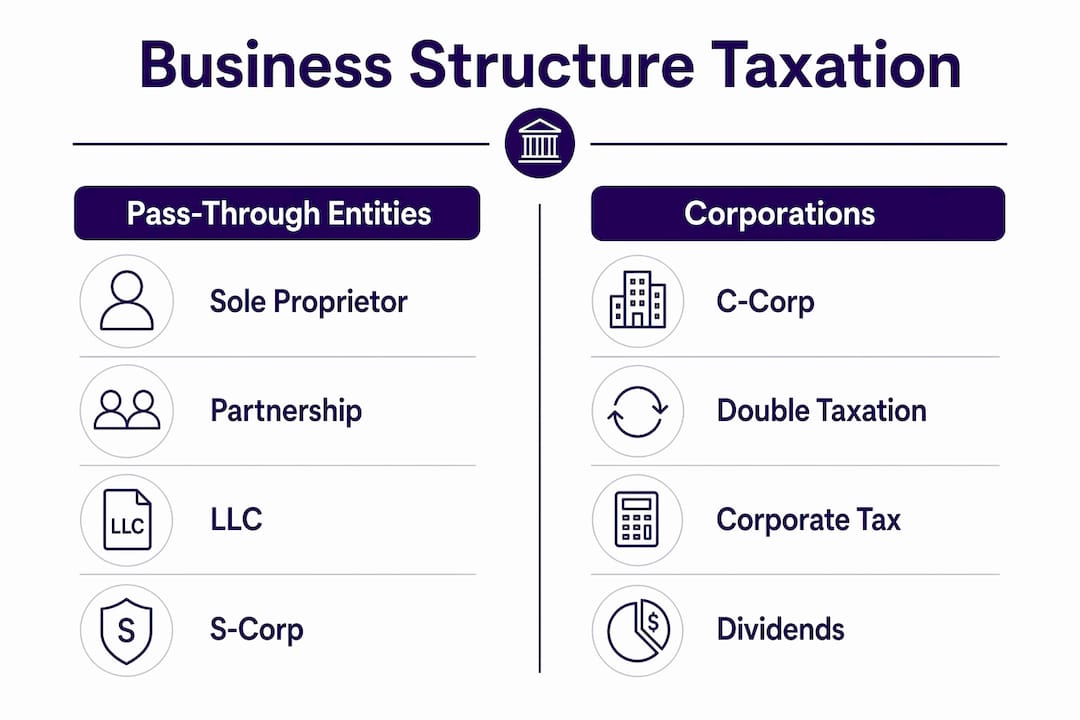
Here is how the most common structures compare:
| Business structure | Taxation type | Self-employment tax | QBI deduction eligible | Double taxation risk |
|---|---|---|---|---|
| Sole proprietorship | Pass-through | Yes, on all net income | Yes | No |
| Partnership | Pass-through | Yes, on distributive share | Yes | No |
| LLC (single-member) | Pass-through (default) | Yes | Yes | No |
| S corporation | Pass-through | Only on salary portion | Yes | No |
| C corporation | Corporate (21% flat rate) | No | No | Yes |
Pass-through entities, including sole proprietorships, partnerships, LLCs, and S corporations, report income on the owner’s personal return. That means the business itself pays no federal income tax. The owner does. C corporations pay the 21% corporate rate, and shareholders pay again on dividends. That double taxation is a real cost.
The S corporation structure is popular for a specific reason. Owners pay themselves a reasonable salary, which is subject to payroll taxes. Distributions above that salary are not. This can reduce self-employment tax meaningfully compared to a sole proprietorship where all net income is taxed.
The Qualified Business Income deduction allows eligible pass-through owners to deduct up to 20% of their qualified business income under Section 199A. That deduction alone can shift your effective tax rate significantly. A business earning $200,000 in qualified income could deduct $40,000 before calculating tax owed.
Business entity selection is not a one-time decision. As your revenue grows, the structure that worked at $80,000 may cost you money at $300,000. Review your entity type at least once a year with a qualified CPA.
Pro Tip: If your net profit consistently exceeds $50,000 per year as a sole proprietor or single-member LLC, run the numbers on an S corp election. The payroll tax savings often outweigh the added administrative cost.
Tax planning is where theory becomes money. The strategies below apply to most small businesses and can be implemented without a large accounting team.
A tax deduction reduces your taxable income. A tax credit reduces your actual tax bill. A $1,000 tax credit saves you $1,000 in taxes. A $1,000 deduction saves you $220 if you are in the 22% bracket. That difference is not subtle. It is the reason you should exhaust every available credit before focusing on deductions.
Credits worth pursuing include the Research and Development (R&D) credit, the Work Opportunity Tax Credit (WOTC), and energy efficiency credits. The tax credit market also allows buying, selling, or transferring credits in some cases, which creates arbitrage opportunities for businesses with the right profile. This area requires careful due diligence, but the upside is real.
Understanding the full range of business tax deductions available to your entity type is a foundational step. Most owners leave money behind simply because they do not know what they can legally claim.
Pro Tip: Schedule a quarterly tax review with your accountant, not just an annual one. Year-round tax planning catches expiring credits and deduction windows that disappear before April.
You cannot manage what you do not measure. Two metrics define your tax position: your marginal tax rate and your effective tax rate.
Your marginal tax rate is the rate applied to your last dollar of income. If you earn $200,000 as a single filer in 2026, your marginal rate is 32%. Your effective tax rate is your total tax paid divided by your total income. That same filer might have an effective rate of 22% because lower brackets apply to the first portions of income. The gap between those two numbers is where tax planning lives.
| Metric | Definition | What to watch for |
|---|---|---|
| Effective tax rate | Total tax paid ÷ total income | Compare year-over-year and against industry peers |
| Marginal tax rate | Rate on the last dollar earned | Signals when income timing strategies become valuable |
| QBI deduction usage | % of eligible income deducted | Should be maximized annually for pass-through entities |
| Retirement contribution rate | Contributions as % of net income | Low rate signals missed tax-advantaged savings |
| Tax refund size | Refund amount at filing | Large refunds indicate over-withholding |
Benchmarking your effective tax rate against peers in your industry gives you a realistic target. If your rate is significantly higher than comparable businesses, you are likely missing deductions or using the wrong entity structure.
Over-withholding is a quiet cash flow problem. A large refund feels like a win, but it means you gave the IRS an interest-free loan for months. The goal is to owe close to zero at filing, which means your cash stayed in your business all year earning or working.
Taxbowl provides real-time financial visibility that makes tracking these metrics straightforward. Instead of waiting for year-end reports, you see your tax position as it develops, which gives you time to act.
Several widely held beliefs about business taxes actively cost small business owners money. Knowing what is wrong is as useful as knowing what is right.
Tax efficiency is not a project you complete. It is a practice you maintain. That distinction matters more than most business owners realize until they have paid a costly tax bill that proper planning would have prevented.
The businesses I see struggle most with taxes share one trait: they treat their accountant like a filing service rather than a planning partner. They hand over documents in april and accept whatever number comes back. That approach works fine when a business is small and simple. It stops working the moment the business grows, hires employees, or starts generating real profit.
The 2026 tax environment adds urgency to this. The QBI deduction under Section 199A remains one of the most powerful tools available to pass-through business owners, but it has income thresholds and phase-outs that require active management. Retirement contribution limits have increased. Energy and R&D credits are more accessible than ever. None of these benefits arrive automatically. You have to go get them.
Technology changes the equation significantly. Real-time bookkeeping means you know your tax position in october, not april. That two-month window is where the real savings happen. You can still make retirement contributions, time a large purchase, or adjust your salary-to-distribution ratio before the year closes.
Tax efficiency also signals business health to outside parties. Investors and acquirers look at effective tax rates as a proxy for financial management quality. A business that consistently pays more tax than necessary raises questions about what else might be mismanaged.
The owners who build lasting financial health treat tax planning as part of running the business, not a separate annual chore. That mindset shift, more than any single deduction, is what separates businesses that grow from businesses that grind.
— Taxbowl
Small business owners who work with Taxbowl stop guessing about their tax position and start managing it with real numbers.
Taxbowl combines dedicated accountants, real-time bookkeeping, and proactive communication to keep your finances clean and your tax exposure visible year-round. The team tracks your effective tax rate, flags missed deductions, and reviews your entity structure as your business grows. You get the kind of tax planning that used to require a large accounting firm, delivered through a model built for small businesses. If you are ready to stop overpaying and start planning, talk to a Taxbowl expert or explore Taxbowl’s bookkeeping services to see how clean financials make every tax decision easier.
Tax efficiency in business requires year-round planning, the right entity structure, and active use of deductions, credits, and tax-advantaged accounts to minimize legal tax liability.
| Point | Details |
|---|---|
| Entity structure drives outcomes | Choosing between LLC, S corp, and C corp directly affects self-employment tax and double taxation exposure. |
| Credits outperform deductions | A $1,000 tax credit saves $1,000 in taxes; a $1,000 deduction saves only $220 in the 22% bracket. |
| Measure your effective tax rate | Divide total tax paid by total income and benchmark against peers to identify planning gaps. |
| Year-round planning beats April filing | Quarterly reviews catch expiring deductions and credit windows before they close. |
| Over-withholding costs you cash | A large refund means your money sat with the IRS instead of working in your business. |
Tax efficiency in business is the practice of legally minimizing your tax liability through entity selection, deductions, credits, and income timing. The goal is to retain more profit without violating tax law.
The Qualified Business Income deduction allows eligible pass-through business owners to deduct up to 20% of their qualified business income under Section 199A. Sole proprietors, partners, LLC members, and S corp shareholders may qualify, subject to income thresholds.
Your effective tax rate equals your total tax paid divided by your total income. Tracking this number year-over-year and comparing it to industry peers reveals whether your tax planning is working.
A deduction reduces your taxable income, while a credit reduces your actual tax bill dollar-for-dollar. Credits are more valuable because they directly cut what you owe rather than lowering the income that gets taxed.
Review your entity structure at least once a year, and specifically when annual net profit crosses major thresholds or when you hire employees. Shifting from a sole proprietorship to an S corp at the right revenue level can reduce self-employment tax significantly.