Back to blog
Year-Round Tax Planning for Small Businesses: 2026
Discover effective year-round tax planning for small businesses in 2026. Maximize savings and compliance by planning ahead with IRS deadlines.

Discover effective year-round tax planning for small businesses in 2026. Maximize savings and compliance by planning ahead with IRS deadlines.
Year-round tax planning for small businesses is defined as a proactive, ongoing approach to managing tax obligations across every month of the calendar year, not just during filing season. The IRS Taxpayer Advocate Service confirms that sole proprietors, S-corp shareholders, and other self-employed owners must make quarterly estimated payments if they expect to owe $1,000 or more after credits and withholding. Mercer Advisors draws a clear line between tax compliance, which is backward-looking, and tax planning, which is forward-looking and creates decisions while options are still open. The difference matters because the biggest tax outcome changes for small businesses happen outside tax season. Building a year-round tax planning small business strategy means using IRS quarterly deadlines as your planning calendar, not just your payment calendar.
Effective tax planning does not start with a strategy meeting. It starts with clean books. Without accurate, up-to-date financial records, every estimate you make is a guess, and guesses lead to penalties.

Your books need to reflect real numbers every single month. That means reconciling bank accounts, categorizing expenses correctly, and keeping receipts organized. Accounting platforms like QuickBooks, Xero, and FreshBooks make this manageable for small teams. The goal is simple: when a quarterly deadline approaches, you should be able to pull a profit and loss statement in minutes, not days.
Beyond bookkeeping, you need a basic forecasting model. This does not have to be complicated. A spreadsheet that projects your revenue and expenses for the next 90 days is enough to estimate your tax liability before each IRS deadline. More advanced tools like Float or Fathom connect directly to your accounting software and generate rolling cash flow forecasts automatically.
You also need to be set up on IRS.gov/payments before your first quarterly deadline. The IRS online payment portals let you schedule payments, view payment history, and avoid the delays that come with mailing checks. Setting up an IRS online account takes about 15 minutes and removes a significant source of deadline risk.
Here is what your foundational setup should include before you execute any tax strategy:
Pro Tip: Set up a separate business savings account labeled “Tax Reserve.” Transfer a fixed percentage of every deposit into it automatically. Most small business owners find that setting aside 25–30% of net profit covers federal and state obligations without surprises.
Tying your planning setup to the IRS estimated payment calendar keeps your bookkeeping current and surfaces tax opportunities before deadlines close them.
The IRS operates on a pay-as-you-go system, which means your tax obligation does not wait until April. For 2026, the quarterly estimated tax payment deadlines are:
| Quarter | Period Covered | Due Date |
|---|---|---|
| Q1 | January 1 – March 31 | April 15, 2026 |
| Q2 | April 1 – May 31 | June 15, 2026 |
| Q3 | June 1 – August 31 | September 15, 2026 |
| Q4 | September 1 – December 31 | January 15, 2027 |
These four dates are your planning milestones. Each one is a checkpoint, not just a payment event.
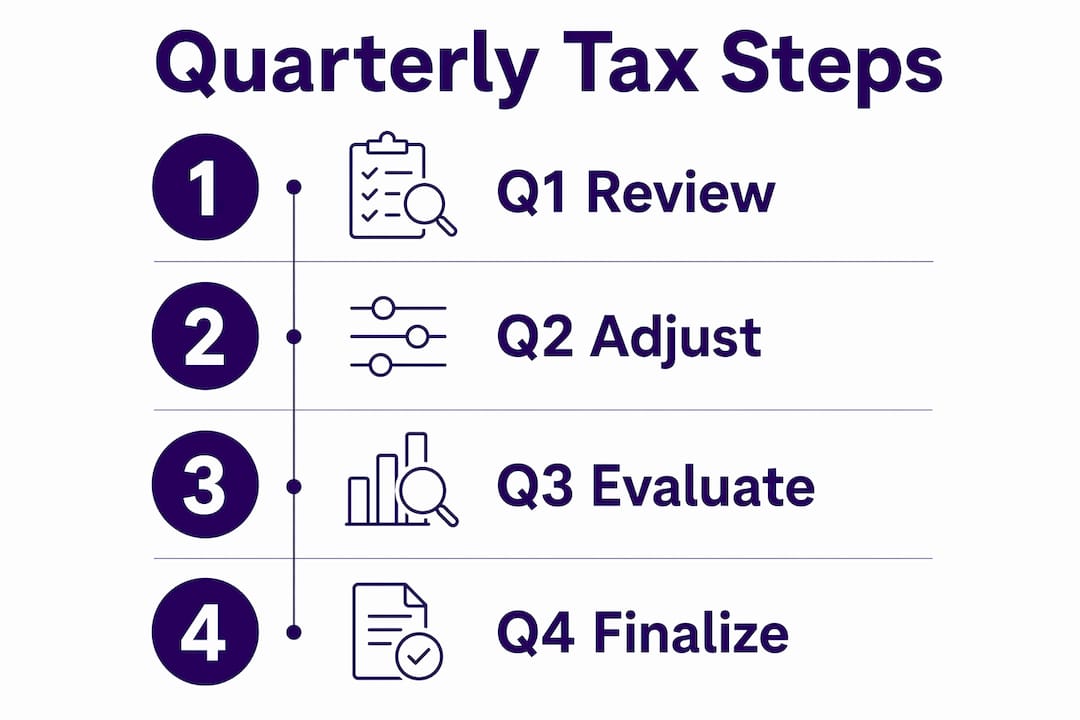
Follow this sequence for each quarter:
This process distributes your tax workload evenly across the year. Quarterly tax planning also improves bookkeeping currency, keeps payroll compliance on track, and uncovers planning opportunities before they expire.
Between quarterly deadlines, three monthly habits keep your plan on track. First, reconcile your books within the first week of each new month. Second, review your tax reserve account balance and confirm it aligns with your projected liability. Third, flag any major financial events, such as a large equipment purchase or a new contract, that could shift your tax position before the next deadline.
Pro Tip: If your income is highly variable, use the “annualized income installment method” when calculating estimated payments. This IRS-approved method lets you base each payment on actual income earned in that period rather than a flat annual projection. It can significantly reduce overpayments in slow quarters.
Tax planning upfront gives you flexibility to shape outcomes before deadlines close your options on income timing, deductions, and other decisions.
Most small business owners do not fail at tax planning because they lack knowledge. They fail because they delay action until the pressure of a deadline forces a rushed decision.
“Year-round tax planning controls your tax liability, improves cash flow, and eliminates unexpected year-end bills through proactive forecasting and strategy adjustment.” — Avocet International CPA
Pro Tip: Reconcile your books in the first week of each new quarter, before you calculate your estimated payment. Clean numbers at the start of the process prevent errors that compound over the year.
Tax planning is not a standalone financial task. Every major business decision you make has a tax consequence, and the best time to account for that consequence is before you make the decision.
Your business entity determines how your income is taxed. A sole proprietor pays self-employment tax on all net profit. An S-corporation allows you to split income between salary and distributions, which can reduce self-employment tax exposure as your income grows. If your net profit has crossed $80,000 annually and you are still operating as a sole proprietor, a conversation with your CPA about entity structure is worth scheduling now.
Contributions to retirement accounts like a SEP-IRA, Solo 401(k), or SIMPLE IRA reduce your taxable income dollar for dollar. A sole proprietor earning $120,000 in net profit can contribute up to 25% of compensation to a SEP-IRA, which directly lowers the income subject to both income tax and self-employment tax. These contributions must be made before your filing deadline, but the planning decision should happen in the middle of the year, not in March.
Hiring your first employee or purchasing major equipment both carry significant tax implications. Section 179 of the IRS tax code allows you to deduct the full cost of qualifying equipment in the year of purchase rather than depreciating it over time. Timing that purchase before December 31 versus after January 1 can shift a large deduction between tax years. Your year-round planning process is what gives you the visibility to make that call deliberately.
Here is how to connect tax planning with your broader business decisions:
Working with a tax advisor who understands your growth trajectory makes these decisions more precise and less reactive. The goal is to have your tax strategy and your business strategy moving in the same direction at all times.
Year-round tax planning for small businesses works because it converts IRS quarterly deadlines into proactive decision points, distributing both the financial and administrative burden evenly across the calendar year.
| Point | Details |
|---|---|
| Start with clean books | Reconcile accounts monthly so every quarterly estimate is based on accurate data. |
| Use IRS deadlines as checkpoints | April 15, June 15, September 15, and January 15 are planning milestones, not just payment dates. |
| Reserve cash every quarter | Set aside 25–30% of net profit in a dedicated tax account to avoid year-end cash shortfalls. |
| Connect tax to business decisions | Time hiring, equipment purchases, and retirement contributions with tax impact in mind. |
| Avoid the lump-sum trap | Missing quarterly payments triggers IRS underpayment penalties and disrupts cash flow at filing. |
Most small business owners I work with come in having treated taxes as an annual event. They file in April, feel relieved, and then do not think about taxes again until the following March. That cycle is expensive.
The shift that changes everything is simple: start treating each IRS quarterly deadline as a business review meeting, not just a payment obligation. When you sit down to calculate your Q2 estimated payment in early June, you are also reviewing your first half of the year. You are asking whether your revenue is tracking to plan, whether your expenses are in line, and whether any major decisions are coming up that could affect your tax position. That 30-minute review is where real financial control happens.
I have seen business owners reduce their April tax bills significantly, not by finding aggressive deductions, but simply by making accurate quarterly payments throughout the year and adjusting them as their income changed. The stress reduction alone is worth the effort. There is a real difference between writing a $3,000 check four times a year and writing a $12,000 check once in April when you were not expecting it.
The other thing I consistently recommend is pairing your tax planning with your retirement funding decisions. Most small business owners leave significant deductions on the table every year because they wait until filing season to think about SEP-IRA or Solo 401(k) contributions. By that point, the cash is often already committed elsewhere. Planning those contributions mid-year, when you can see your income trajectory clearly, makes them far more likely to actually happen.
Tax planning is not a specialty skill reserved for large companies with finance teams. It is a habit. And like most habits, it gets easier and more valuable the earlier you build it into your regular business rhythm.
— Taxbowl
Running a small business means your time is already stretched. Tax planning only works consistently when your books are clean, your numbers are current, and you have someone in your corner who knows your financial picture.
Taxbowl provides bookkeeping and accounting services built specifically for startups and small businesses. The team keeps your books reconciled monthly, aligns your financial reviews with IRS quarterly deadlines, and gives you real-time visibility into your cash position through direct communication channels like Slack. With an average of $53,399 in outstanding receivables tracked per client, Taxbowl gives you the financial clarity to make tax decisions with confidence, not guesswork. If you are ready to move from reactive filing to proactive planning, talk to an expert at Taxbowl and get your 2026 tax strategy in place now.
Year-round tax planning is a proactive approach to managing tax obligations across every month of the year rather than only during filing season. It involves quarterly estimated payments, regular financial reviews, and strategic decisions on deductions, retirement funding, and business structure.
The 2026 estimated tax deadlines are April 15, June 15, September 15, and January 15, 2027. Missing these dates can trigger IRS underpayment penalties.
Most small business owners should reserve 25–30% of net profit for federal and state tax obligations. The exact amount depends on your entity type, deductions, and state tax rate, so confirm the figure with your CPA each quarter.
The IRS charges an underpayment penalty when required estimated payments are missed or insufficient. Sole proprietors and S-corp shareholders who expect to owe $1,000 or more after credits must make quarterly payments to avoid this penalty.
Tax filing is a backward-looking compliance activity that reports what already happened. Tax planning is forward-looking and shapes outcomes before deadlines close your options on income timing, deductions, and business structure decisions.