Back to blog
What Is Proactive Tax Planning for Small Businesses?
Discover what is proactive tax planning and how it can save small businesses up to $50,000 annually. Take control of your taxes today!

Discover what is proactive tax planning and how it can save small businesses up to $50,000 annually. Take control of your taxes today!
Proactive tax planning is the continuous practice of making strategic financial decisions throughout the year to minimize your business’s tax liability before taxes are filed. Unlike reactive tax preparation, which simply records what already happened, proactive tax planning, known in professional circles as forward-looking tax strategy, gives you control over your outcomes. Research shows it can save business owners $35,000 to $50,000 annually, with potential to retain $115,000 to $210,000 over five years. Tools like Holistiplan and TaxPlanIQ now make this level of planning accessible to small businesses, not just large corporations.
Proactive tax planning is a year-round process of aligning your financial decisions with tax advantages before the tax year closes. The IRS tax code rewards timing, structure, and documentation. Business owners who plan ahead capture those rewards. Those who wait until april to file simply accept whatever bill arrives.
The core difference between proactive and reactive approaches comes down to control. Proactive planning engineers decisions aligned with tax savings before the year ends. Reactive preparation only reconciles decisions afterward. By then, most opportunities are gone.

Tax optimization, the industry term for this process, is not about eliminating taxes. Tax planning means paying taxes intentionally, at the right times and rates, for financial advantage. That mindset shift alone changes how you run your business finances.
Reactive tax preparation puts you in a passive position. You gather receipts in march, hand them to your CPA, and hope for the best. Proactive tax strategy flips that entirely. You make decisions in real time, with tax consequences in mind, throughout the entire year.
The financial gap between the two approaches is significant. Business owners using proactive strategies retain substantially more wealth over time because small annual tax reductions compound when reinvested. That is not a rounding error. That is the difference between a business that builds equity and one that stays flat.
Here is what proactive tax planning gives you that reactive filing never can:
“Viewing tax planning as an ongoing strategy rather than a last-minute sprint is key to minimizing tax bills and engineering a better financial future.” — jwtaxandconsulting.com
The audit risk point deserves emphasis. Proactive strategies reduce audit risk by building a chronological, well-documented trail of business logic. Reactive last-minute deductions or structural changes raise flags precisely because they lack that context.
Effective proactive tax planning for individuals and small businesses runs on four core levers: income timing, deduction optimization, account selection, and credit capture. Working all four throughout the year produces the best results. Ignoring any one of them leaves money on the table.
Quarterly reviews are the engine that keeps all four levers working. A quarterly cadence helps you catch and act on opportunities before they expire. Here is how each strategy works in practice:
Income timing and deferral. If your business is having a strong year, defer invoicing on december work into january to push that income into the next tax year. Service businesses, consultants, and freelancers use this regularly. The goal is to stay in the lowest bracket possible without sacrificing cash flow.
Deduction optimization. Time large purchases before year-end when you need the deduction most. Section 179 of the tax code lets you deduct the full cost of qualifying equipment in the year of purchase rather than depreciating it over time. A product-based business buying new machinery in december instead of january captures that deduction a full year earlier. Use Taxbowl’s 2026 deductions checklist to make sure nothing gets missed.
Account selection and entity structuring. Maxing out a SEP-IRA or Solo 401(k) reduces your taxable income dollar for dollar. Electing S corp status at the right revenue threshold can cut self-employment taxes significantly. These are not one-time decisions. They require annual review as your income grows.
Credit capture. The R&D tax credit, the Work Opportunity Tax Credit (WOTC), and the Small Business Health Care Tax Credit are all underused by small businesses. Credits reduce your tax bill directly, not just your taxable income. A proactive review in Q3 gives you time to qualify and document before the year closes.
Quarterly review process. Schedule a 60-minute review with your CPA or tax advisor every quarter. Review income projections, pending expenses, and any tax law changes. Adjust your strategy based on what you find.
Pro Tip: Set a recurring calendar reminder for the 15th of the month following each quarter end: april 15, july 15, october 15, and january 15. Use those dates to review your financials and update your tax strategy before the next quarter locks in.
For a full framework on scheduling these reviews, Taxbowl’s guide on year-round tax planning covers the cadence in detail.
Tax planning software has changed what is possible for small businesses. The best proactive tax planning software in 2026 automates scenario modeling, tracks legislative updates in real time, and integrates directly with accounting platforms. That used to require a full-time tax team. Now it is accessible to a two-person operation.
Two platforms lead the category. Holistiplan focuses on tax return analysis and scenario planning, making it popular with financial advisors and CPAs who serve small business clients. TaxPlanIQ is built for CPA firms and focuses on identifying and presenting tax strategies to clients with clear dollar-value projections. Both tools reduce planning time by 30–40% through automation and scenario modeling.
| Feature | Holistiplan | TaxPlanIQ |
|---|---|---|
| Primary use case | Tax return analysis and scenario planning | Strategy identification and client presentation |
| AI-driven recommendations | Yes | Yes |
| Legislative update integration | Yes | Yes |
| CRM and accounting integration | Limited | Broad |
| Annual cost per user | $950–$2,200 | $950–$2,200 |
| Best for | Financial advisors and CPAs | CPA firms with multiple clients |
Advanced tax planning software integrates with major tax prep suites and financial tools, offering AI-driven recommendations and real-time legislative updates. That means when Congress changes a depreciation rule or adjusts bracket thresholds, your tax plan updates automatically rather than waiting for your CPA to catch it at year-end.
Firms using these tools report a 40% reduction in planning time and a 25% increase in average client fees. That efficiency gain matters because it means your CPA spends less time on data entry and more time on strategy. You get better advice for the same cost.
The cost consideration for small businesses is real. At $950 to $2,200 per user annually, these tools are typically purchased by your CPA or tax advisor, not directly by you. When evaluating a tax professional, ask whether they use planning software. If they do not, they are likely still working reactively.
Starting proactive tax planning is straightforward. The biggest barrier is not complexity. It is timing. Starting in Q1 maximizes your flexibility to adjust income, expenses, and investments before deadlines arrive. Late-year planning restricts your options and forces reactive measures.
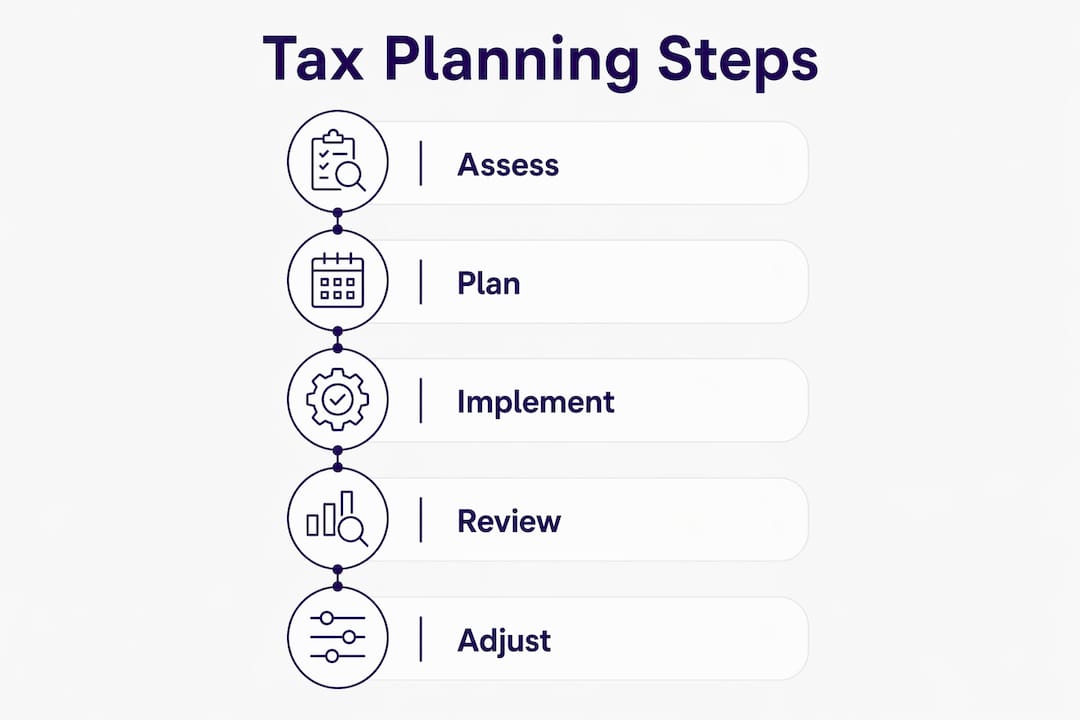
Follow this five-step process to build a proactive tax planning system that runs year-round:
Assess your current tax position in Q1. Pull your prior year return and identify your effective tax rate, your bracket, and any unused credits or carryforwards. This is your baseline. Your CPA should walk you through this in january or february, not april.
Set income and expense projections for the year. Estimate your revenue by quarter. Identify planned capital purchases, hiring decisions, and any major business changes. These projections feed your tax strategy for the entire year.
Establish a quarterly review rhythm. Meet with your tax advisor every quarter to compare actuals against projections. Adjust your strategy based on what changed. This is where most of the real tax savings happen, not in the annual filing.
Communicate clearly with your accountant. Effective tax planning requires your accountant to know about business changes before they happen, not after. A new hire, a large equipment purchase, or a change in business structure all have tax implications. Use platforms like Slack or email to keep your advisor in the loop in real time. Taxbowl’s guide on accountant communication covers exactly how to do this.
Track and document everything. Every deduction you claim needs documentation. Every structural decision needs a business rationale on record. This protects you in an audit and makes your quarterly reviews faster and more accurate.
Pro Tip: Do not wait for your accountant to reach out. Send a brief monthly summary of major financial events: large purchases, new contracts, hiring changes, or unexpected income. That one habit keeps your tax strategy current and prevents year-end surprises.
Common pitfalls to avoid include ignoring estimated quarterly tax payments, missing S corp election deadlines, and failing to document home office or vehicle use throughout the year. Each of these is easy to fix when caught early and expensive when discovered in april.
Proactive tax planning is the most direct path for small business owners to reduce tax liability, build documented compliance, and retain significantly more wealth over time.
| Point | Details |
|---|---|
| Proactive vs. reactive | Proactive planning controls tax outcomes before year-end; reactive filing only records what already happened. |
| Financial impact | Proactive strategies can save $35,000–$50,000 annually and retain up to $210,000 over five years. |
| Four core strategies | Income timing, deduction optimization, account selection, and credit capture drive the most savings. |
| Quarterly reviews | A quarterly review cadence catches opportunities before they expire and keeps your strategy current. |
| Software advantage | Tools like Holistiplan and TaxPlanIQ cut planning time by 30–40% and surface savings your CPA might otherwise miss. |
Most small business owners we work with at Taxbowl come to us after years of reactive filing. They are not making bad decisions. They simply never had a system that flagged tax opportunities before the year closed. The shift from reactive to proactive is less about complexity and more about timing and communication.
The most common misconception we see is that proactive tax planning is only for high earners or large businesses. That is wrong. A $300,000 revenue business has just as much to gain from income deferral, entity structuring, and credit capture as a $3 million one. The strategies scale down perfectly.
What actually surprises business owners is how much cash flow improves when tax liability is planned rather than discovered. When you know your estimated tax bill in Q2, you can manage cash reserves accordingly. When you find out in april, you scramble. That scramble is what causes cash flow crises, not the tax bill itself.
The mindset shift we push for is this: stop thinking about taxes as something that happens to you and start treating them as a financial variable you control. That is not tax avoidance. That is intentional financial management. The tax code is full of legal incentives for business owners who plan ahead. The only question is whether you use them.
— Taxbowl
Small business owners who want to move from reactive filing to a real proactive tax strategy need more than software. They need a team that stays engaged year-round.
Taxbowl provides bookkeeping services built for growing businesses, integrated tax planning and preparation, and fractional CFO support for owners who want strategic financial guidance without a full-time hire. Every client gets real-time financial visibility and direct access to their accounting team via Slack, so tax decisions happen when they matter, not after the fact. If you are ready to stop filing reactively and start building a tax strategy that works all year, talk to a Taxbowl expert and get started today.
Tax preparation records what already happened in your finances. Tax planning shapes financial decisions throughout the year to reduce what you owe before the return is filed.
The best time to start is Q1 of each year. Starting early gives you maximum flexibility to adjust income, expenses, and investments before year-end deadlines restrict your options.
Proactive strategies can save business owners $35,000 to $50,000 annually, with the potential to retain $115,000 to $210,000 over five years when savings are reinvested.
Yes. Strategies documented and implemented throughout the year create a clear, defensible paper trail. Last-minute deductions or structural changes made at year-end attract significantly more IRS scrutiny.
You do not need to purchase software yourself. Ask your CPA or tax advisor whether they use tools like Holistiplan or TaxPlanIQ. These platforms automate scenario modeling and flag opportunities your advisor can act on throughout the year.