Back to blog
What Is a Tax Strategy for Business? 2026 Guide
Learn what is a tax strategy for business and how it can save you money. Discover methods to optimize your tax planning for 2026.

Learn what is a tax strategy for business and how it can save you money. Discover methods to optimize your tax planning for 2026.
TL;DR:
- A business tax strategy is a proactive, year-round plan that leverages IRS provisions to lower tax liabilities and support growth.
- Treating taxes as an ongoing process helps small businesses maximize deductions, minimize liabilities, and avoid surprises.
A tax strategy for business is a proactive, year-round plan that aligns your financial decisions with tax law to reduce what you owe and support growth. It is not the same as filing your return in april. Investment in tax strategy can yield returns of 5x to 20x the money spent in reduced tax liability. That ratio alone explains why small business owners who treat taxes as a once-a-year task consistently leave money on the table. The IRS tax code contains hundreds of legal provisions designed to reward businesses that plan ahead. This guide breaks down what a real tax strategy looks like, which specific methods work best for small businesses in 2026, and how to build one that runs all year.
A business tax strategy is a documented, forward-looking plan that shapes how and when you earn income, spend money, and structure your company to minimize your legal tax burden. The industry term for this practice is tax planning, and it covers far more ground than annual tax preparation. Where tax preparation asks “What do we owe?”, tax planning asks “What should we do, and when, to preserve cash and support growth?” That shift in question changes everything about how you manage your finances.
Tax planning is a capital allocation decision. Every dollar you keep through legal tax savings is a dollar you can reinvest in hiring, equipment, or inventory. For small businesses operating on tight margins, that distinction is not academic. It is the difference between a profitable year and a cash flow crisis.
The IRS tax code provides the framework. Entities like the Taxpayer Advocate Service and the Internal Revenue Service publish guidance that small business owners can use to stay compliant while taking full advantage of available deductions, credits, and elections. A solid tax strategy uses that framework intentionally, not reactively.
An effective tax strategy for a small business rests on six interconnected components. Each one builds on the others, and skipping any one of them creates gaps that cost you money.
Pro Tip: Set a recurring calendar reminder for the 15th of each quarter to review your year-to-date income, expenses, and estimated tax payments. Thirty minutes four times a year prevents most tax surprises.
Each component works because it forces you to make deliberate decisions rather than reactive ones. Tax planning affects decisions about buying, selling, and expanding your company. When you treat tax as a variable you can influence, your entire financial decision-making improves.
Tax preparation is retrospective. A preparer takes your records from the prior year, enters them into a return, and files it. The decisions that determined your tax bill were made months or years earlier. By the time you sit down with a preparer, your options are almost entirely fixed.
Tax strategy is the opposite. It is forward-looking and integrated with how you run your business day to day. Here is how the two approaches differ in practice:
The risk of treating tax as an annual event is real. Business owners who skip proactive planning often face large, unexpected tax bills in the spring that disrupt operations. Tax planning is not about loopholes but about using legal opportunities in the tax code responsibly. The IRS expects accuracy, and you remain responsible for your return regardless of who prepares it.
The 2026 tax environment includes several provisions that small business owners should use deliberately. The strategies below are legal, documented, and available to most small businesses right now.
The table below summarizes the key strategies and their primary benefit:
| Strategy | Primary benefit |
|---|---|
| QBI deduction | Reduces federal taxable income by up to 23% for pass-through entities |
| S corp election | Lowers self-employment tax for profitable small business owners |
| Accelerated expenses | Moves deductions into the current tax year to reduce this year’s liability |
| OBBBA R&D expensing | Allows immediate deduction of domestic R&D costs in 2026 |
| Retirement contributions | Reduces taxable income while building long-term owner wealth |
| Estimated tax safe harbor | Avoids IRS penalties while preserving cash flow during slow periods |
You can find a detailed breakdown of available deductions in the 2026 business tax deductions checklist published by Taxbowl.
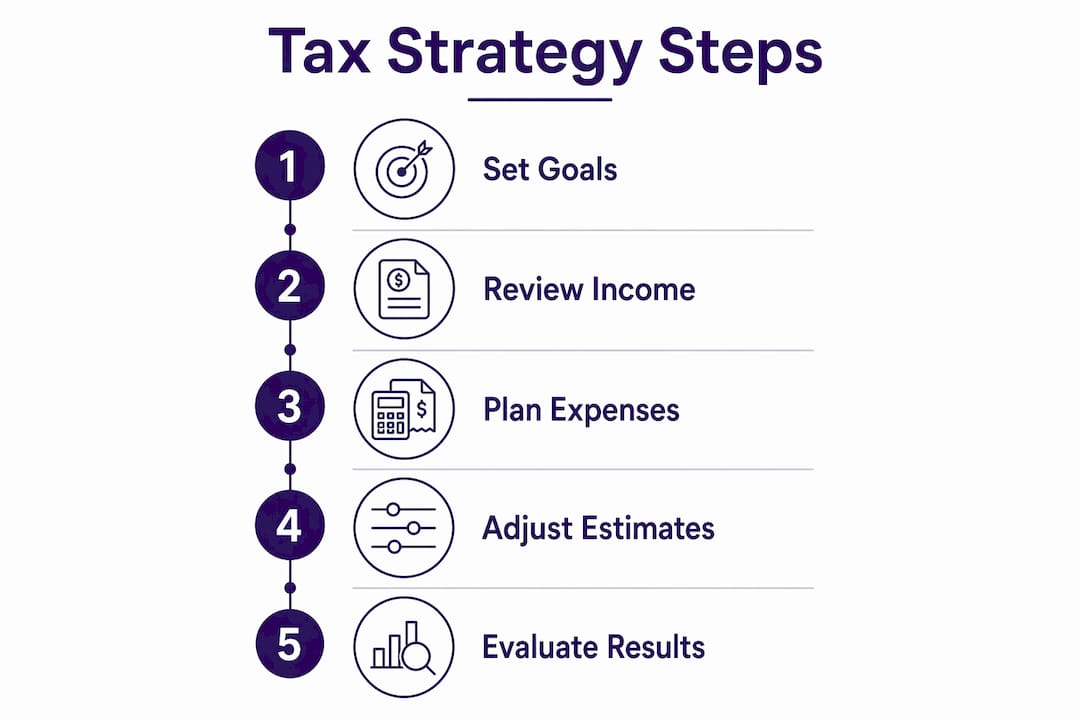
Building a tax strategy is not a one-time project. It is a process you run continuously alongside your business. The owners who get the best results treat tax planning the way they treat sales forecasting: as a regular, scheduled activity with clear inputs and outputs.

Pro Tip: Review your profit and loss statement every quarter with your tax advisor, not just your bookkeeper. A CPA who sees your numbers in real time can recommend adjustments before the tax year closes.
The practical steps for maintaining an ongoing strategy look like this:
The owners who treat tax strategy as an ongoing process rather than an annual event consistently pay less in taxes and carry less financial risk. The process does not require hours of your time each week. It requires a reliable system and a qualified advisor who communicates proactively.
A business tax strategy is the single most cost-effective financial tool available to small business owners, delivering legal tax savings that compound year after year when applied consistently.
| Point | Details |
|---|---|
| Tax strategy vs. preparation | Tax strategy is forward-looking and year-round; tax preparation is retrospective and annual. |
| QBI deduction opportunity | Eligible pass-through entities can deduct 23% of qualified business income, saving thousands annually. |
| Estimated tax safe harbor | Pay 90% of current year’s tax or 100% of prior year’s tax to avoid IRS penalties. |
| 2026 OBBBA provision | Immediate R&D expensing is restored, reducing effective tax rates for qualifying businesses. |
| Ongoing process required | Quarterly reviews, organized records, and a year-round advisor relationship maximize tax savings. |
Most small business owners I work with come to Taxbowl after a painful tax season. They filed their return, saw the bill, and felt blindsided. The frustrating part is that the number on that bill was largely determined by decisions made six to twelve months earlier. By the time the return is filed, there is almost nothing left to do.
The shift I push every owner to make is this: stop thinking about taxes as something that happens to you once a year, and start treating your tax position as something you manage actively. That does not mean obsessing over every receipt. It means building a rhythm where you check in on your numbers quarterly, talk to your advisor before making big financial decisions, and use the legal provisions in the tax code that were written specifically for businesses like yours.
The QBI deduction, the OBBBA R&D expensing rules, retirement plan contributions, and S corp elections are not obscure strategies. They are mainstream provisions that millions of small businesses underuse simply because no one walked them through the math at the right time of year. A consulting firm earning $120,000 in net profit can save $6,000–$9,000 on federal taxes through the QBI deduction alone. That is a real number that funds real decisions.
The owners who build the most financial resilience are not the ones who earn the most. They are the ones who keep the most of what they earn by planning ahead. Tax strategy is how you do that.
— Taxbowl
Your tax strategy is only as strong as the financial records behind it. Clean, accurate books give your tax advisor the data they need to make the right calls at the right time.
Taxbowl combines a dedicated team of accountants with real-time financial visibility and proactive communication, so you are never caught off guard by a tax bill. From bookkeeping services that keep your records audit-ready to tax planning and advisory support built specifically for small businesses, Taxbowl gives you the infrastructure to run a real tax strategy year-round. You can also connect directly with a Taxbowl expert to build a plan tailored to your business at taxbowl.com/talk-to-expert.
A tax strategy for a small business is a proactive, year-round plan that uses legal IRS provisions to reduce tax liability, manage cash flow, and support growth decisions. It differs from tax preparation, which is retrospective and focused only on filing accuracy.
Investment in tax strategy can return 5x to 20x the cost in reduced tax liability. Actual savings depend on business structure, income level, and which provisions apply to your situation.
The Qualified Business Income deduction allows eligible pass-through entities to deduct 23% of qualified business income from federal taxes. In 2026, phase-out thresholds begin at $75,000 for single filers and $150,000 for joint filers.
Review your tax position at least quarterly. Quarterly reviews let you adjust estimated payments, time expenses, and catch planning opportunities before the tax year closes.
Accurate, organized records including receipts, bank statements, contracts, and payroll documentation are required. Digital recordkeeping throughout the year reduces audit risk and makes tax planning faster and more accurate.