Back to blog
Reduce Taxable Income Legally: 2026 Small Business Guide
Unlock strategies to reduce taxable income legally with our 2026 small business guide. Maximize deductions and improve your cash flow!


Unlock strategies to reduce taxable income legally with our 2026 small business guide. Maximize deductions and improve your cash flow!
TL;DR:
- Legally reducing taxable income involves using IRS-approved deductions, credits, and business structures to lower tax liability. For small businesses and freelancers, strategic expense tracking, QBI deductions, and S-corp elections can significantly reduce taxes and improve cash flow. Proper documentation and year-round planning are essential to maximize savings and stay compliant.
Legally reducing taxable income means applying IRS-approved deductions, credits, and business structures to lower the amount of income subject to tax, without crossing into fraud or aggressive sheltering. For small business owners and freelancers, this is the core of sound tax planning strategies. The 2026 tax year brings specific provisions worth knowing: the Qualified Business Income (QBI) deduction under Section 199A, above-the-line deductions for health insurance and retirement contributions, and structural options like S-corp elections. Used together, these tools form a complete reduce taxable income legally guide that can meaningfully cut your annual tax bill and improve cash flow year-round.
The most direct way to lower your taxable income is to maximize every legitimate business deduction before calculating what you owe. Ordinary business expenses reduce your net self-employment income, which lowers both your income tax and your self-employment tax simultaneously. That double benefit makes expense tracking one of the highest-return habits you can build.
Freelancers and sole proprietors report income and expenses on Schedule C. The IRS allows deductions for any expense that is ordinary and necessary for your business. Common qualifying expenses include:
Each deduction reduces your net profit, which is the number the IRS taxes. Tracking these expenses in real time, rather than reconstructing them at year-end, prevents missed deductions.

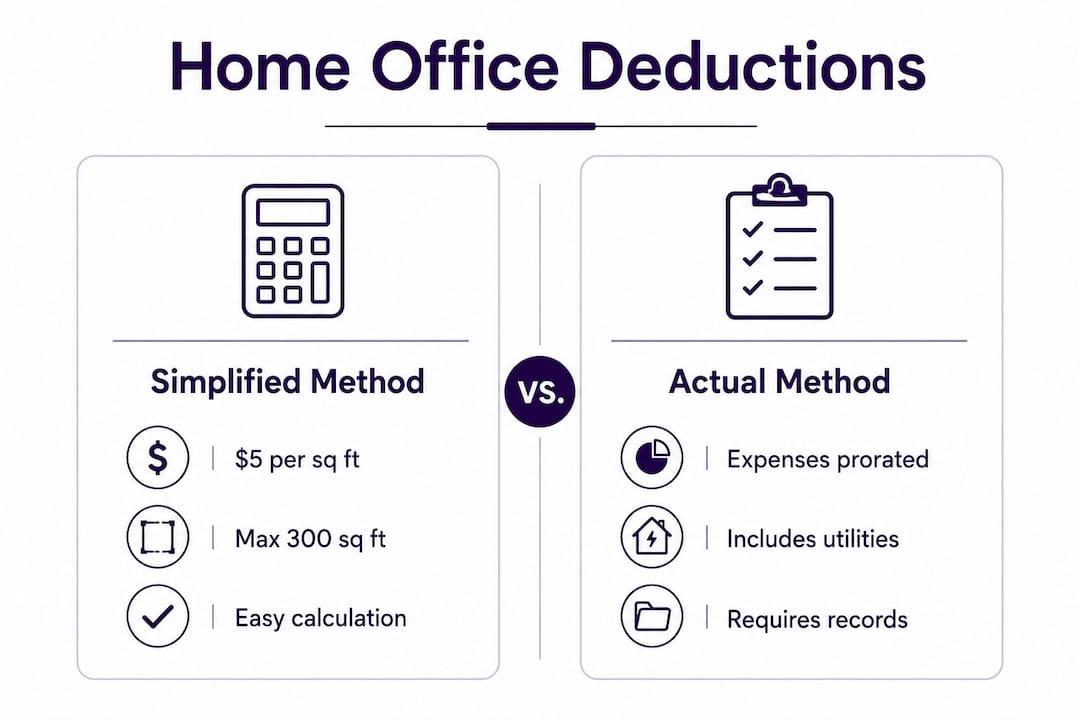
The home office deduction applies when you use a space exclusively and regularly for business. The IRS offers two calculation methods. The simplified method allows $5 per square foot up to 300 square feet, giving a maximum deduction of $1,500. The actual method calculates the percentage of your home used for business and applies that percentage to real expenses like rent, utilities, and insurance. The actual method produces a larger deduction for most owners with significant home costs, but it requires more documentation.
Self-employed owners can deduct 100% of health insurance premiums for themselves, their spouse, and their dependents as an above-the-line adjustment. This deduction reduces your adjusted gross income directly, which also improves eligibility for other income-based deductions. You cannot claim this deduction for any month you were eligible for employer-sponsored coverage through a spouse’s job.
Tax-advantaged retirement accounts are among the most powerful legal tax deduction tips available. The 2026 traditional IRA limit sits at $7,500, but a Solo 401(k) or SEP-IRA allows significantly larger contributions based on earned income. A SEP-IRA lets you contribute up to 25% of net self-employment income. A Solo 401(k) allows both employee and employer contributions, pushing the ceiling even higher. Every dollar contributed reduces your taxable income dollar for dollar.
Pro Tip: Max out your Solo 401(k) or SEP-IRA before december 31 to capture the full deduction for the current tax year. Contributions to a SEP-IRA can be made up to the tax filing deadline, including extensions, giving you extra flexibility.
The QBI deduction is defined as a deduction of up to 20% of qualified business income for eligible pass-through business owners under Section 199A of the tax code. It applies to sole proprietors, partnerships, S-corps, and some trusts. For a freelancer earning $150,000 in qualified business income, the deduction is $30,000, which saves approximately $5,280 at a 22% tax rate. That is a significant reduction with no additional spending required.
The full 20% deduction is available when your taxable income falls below specific thresholds. For 2026:
Once your income exceeds the threshold, the deduction does not disappear entirely. It becomes limited to the greater of 50% of W-2 wages paid by the business, or 25% of W-2 wages plus 2.5% of the unadjusted basis of qualified property. This is where the math gets complex and professional guidance pays for itself.
Specified Service Trade or Business (SSTB) owners face additional restrictions. An SSTB includes fields like law, health, consulting, financial services, and performing arts. If your taxable income exceeds the phase-out threshold and you operate an SSTB, your QBI deduction is eliminated entirely. This is one of the most misunderstood limits in the tax code. Many consultants and coaches assume they qualify for the full deduction, then discover at filing time that they do not.
| Income level | Non-SSTB business | SSTB business |
|---|---|---|
| Below $201,750 (single) | Full 20% deduction | Full 20% deduction |
| Phase-out range | Partial deduction with W-2/property limits | Partial deduction, phasing to zero |
| Above phase-out | W-2 wage or property limit applies | No QBI deduction available |
The most effective approach is to keep taxable income below the threshold. Contributing to a Solo 401(k) or SEP-IRA reduces taxable income directly, which can push you under the limit. Timing large deductible expenses to the current year achieves the same effect. If you are close to the threshold, working with a tax professional to model the impact of each strategy before year-end is the clearest path to capturing the full deduction.
Pro Tip: If you are an SSTB owner approaching the income threshold, a large retirement contribution in december can drop your taxable income below the cutoff and restore your full QBI deduction. Run the numbers before the year closes.
An S-corp election changes how the IRS taxes your business income by splitting it into two categories: W-2 salary and shareholder distributions. Only the W-2 salary is subject to payroll taxes, including Social Security and Medicare. Distributions pass through to your personal return without triggering self-employment tax. This split is the mechanism that generates real tax savings for many small business owners. You can read a detailed breakdown of when S-corp election makes sense for your specific situation.
Self-employment tax is 15.3% on 92.35% of net self-employment income. On $120,000 of net income, that produces roughly $14,130 in SE tax. With an S-corp, if you pay yourself a reasonable salary of $60,000 and take $60,000 as a distribution, you pay payroll taxes only on the $60,000 salary. The distribution avoids SE tax entirely. The savings on $60,000 of income shifted to distributions can exceed $9,000 annually, depending on your total income.
The IRS requires S-corp owners to pay themselves a “reasonable salary” before taking distributions. Reasonable salary is defined as what you would pay a third party to perform the same work. Paying yourself $1 in salary and $200,000 in distributions is a clear audit trigger. The IRS actively scrutinizes S-corp returns where salary appears artificially low. Salary benchmarks vary by industry, so documenting your reasoning with market data protects you if questioned.
The S-corp election makes the most financial sense when:
The administrative overhead is real. You need payroll processing, separate business bank accounts, and annual corporate filings. For owners earning well above $50,000 in profit, the SE tax savings typically outweigh those costs. Below that level, the savings rarely justify the added complexity.
Clean recordkeeping is the foundation of every legal tax reduction strategy. Without documentation, even legitimate deductions become indefensible in an audit. The IRS requires you to maintain receipts, invoices, and mileage logs and keep records for at least three years. Three years is the standard audit window, though the IRS can go back six years if it suspects substantial underreporting.
The best system is the one you will actually use consistently. Dedicated bookkeeping software captures expenses as they happen, categorizes them automatically, and generates reports your accountant can use directly. Mixing personal and business expenses in one account is the single most common mistake that leads to missed deductions and audit headaches. A dedicated business checking account and business credit card eliminate that problem immediately.
Key habits that protect your deductions:
Pro Tip: Set a recurring 30-minute calendar block every Friday to review and categorize that week’s transactions. This weekly habit takes less time than a single year-end reconciliation session and catches errors before they compound.
Freelancers and small business owners must pay estimated taxes four times per year. Missing or underpaying these installments triggers an underpayment penalty from the IRS, even if you pay the full balance by april 15. The standard safe harbor is paying 100% of last year’s tax liability in equal quarterly installments, or 110% if your prior-year adjusted gross income exceeded $150,000. Scheduling these payments as automatic transfers removes the risk of forgetting them.
The IRS flags returns that show patterns inconsistent with industry norms. Claiming a home office deduction on a rented apartment where you also have a separate office location raises questions. Deducting 100% of a vehicle used partly for personal trips is another common error. Client meals without documented business purpose are routinely disallowed. The 2026 tax deductions checklist from Taxbowl covers the most frequently misapplied deductions and how to document them correctly.
Legally reducing taxable income requires combining foundational deductions, the QBI deduction, and structural strategies like S-corp election, all supported by clean recordkeeping throughout the year.
| Point | Details |
|---|---|
| Maximize Schedule C deductions | Deduct all ordinary business expenses before calculating net SE income to reduce both income and SE tax. |
| Use the QBI deduction | Eligible owners deduct up to 20% of qualified business income; keep taxable income below $201,750 (single) to get the full benefit. |
| Consider S-corp election | Splitting income into salary and distributions eliminates SE tax on the distribution portion for profitable businesses. |
| Contribute to retirement accounts | Solo 401(k) and SEP-IRA contributions reduce taxable income dollar for dollar and exceed standard IRA limits. |
| Document everything consistently | Maintain receipts, mileage logs, and invoices for at least three years to defend every deduction claimed. |
Tax planning works best when it happens throughout the year, not in april. The owners who save the most are the ones who review their numbers quarterly and make decisions before december 31, when most options close. Waiting until tax season means you are reporting history, not shaping it.
The combination of deductions and structure is where real savings live. A freelancer who maximizes their Solo 401(k), claims the home office deduction, and deducts health insurance premiums can reduce taxable income by tens of thousands of dollars before touching the QBI deduction. Add an S-corp election at the right income level, and the SE tax savings stack on top of that. These strategies are not exotic. They are the standard toolkit for any well-advised small business owner.
The caution I would offer is this: over-aggressive deduction claims create more risk than they are worth. Claiming a deduction you cannot document, or one that does not clearly meet the IRS definition of ordinary and necessary, puts your entire return at risk. The audit process is time-consuming and stressful, and the penalties for disallowed deductions include interest charges that compound. The goal is to claim every dollar you legitimately deserve, with clean documentation to back it up.
Professional guidance matters more as your income grows. The QBI phase-out rules, SSTB limitations, and S-corp reasonable salary requirements all involve judgment calls that depend on your specific numbers. A CPA or dedicated accounting team that knows your business can model these decisions before you commit to them.
— Taxbowl
Small business owners and freelancers who work with Taxbowl get more than bookkeeping. They get a dedicated team that tracks deductions in real time, flags opportunities before year-end, and keeps their books audit-ready every month.
Taxbowl’s small business accounting services cover everything from expense categorization and payroll to QBI deduction modeling and S-corp compliance. If you are not sure whether your current setup is capturing every legal deduction available to you, the clearest next step is a direct conversation with a Taxbowl expert. You can talk to a Taxbowl expert to review your tax position and build a plan that fits your income level and business structure.
Legally reducing taxable income means using IRS-approved deductions, credits, and business structures to lower the income amount subject to tax. It does not involve hiding income or inflating expenses beyond what you can document.
A freelancer with $150,000 in qualified business income can deduct $30,000 under Section 199A, saving approximately $5,280 at a 22% tax rate. The full deduction is available when taxable income stays below $201,750 for single filers in 2026.
An S-corp election typically makes sense when your net business profit exceeds $50,000 annually and you can pay yourself a defensible reasonable salary. The SE tax savings on distributions must outweigh the added administrative costs of running payroll and filing corporate returns.
Solo 401(k) and SEP-IRA plans allow significantly larger contributions than a traditional IRA, whose 2026 limit is $7,500. A SEP-IRA allows contributions up to 25% of net self-employment income, making it one of the most effective ways to lower taxable income legally.
The IRS standard audit window is three years from the filing date, so keeping records for at least three years is the minimum. If the IRS suspects substantial underreporting, it can audit up to six years back, so many tax professionals recommend keeping records for six years as a precaution.