Back to blog
Why S-Corp Election Saves Taxes for Small Business Owners
Discover why S-corp election saves taxes for small business owners. Learn about substantial savings on self-employment taxes and how to benefit.

Discover why S-corp election saves taxes for small business owners. Learn about substantial savings on self-employment taxes and how to benefit.
S-corp election is defined as a federal tax status that lets a business pass profits directly to its owners, avoiding corporate-level income tax while also reducing self-employment tax liability. That second benefit is why s-corp election saves taxes in a way that sole proprietorships and standard LLCs simply cannot match. The mechanism is straightforward: you pay yourself a reasonable W-2 salary, which is subject to payroll taxes, and take the remaining profit as a distribution that is not subject to the 15.3% self-employment tax. Tools like Xero, Wolters Kluwer, and Gusto all document this split as the core advantage of the S-corporation structure. The IRS formalizes the election through Form 2553, and once approved, the savings can be substantial for any owner clearing meaningful profit.
The self-employment tax rate is 15.3%, covering Social Security and Medicare. Every dollar a sole proprietor or single-member LLC owner earns is subject to that rate in full. An S-corp changes the math by splitting income into two buckets.
The first bucket is your W-2 salary. The IRS requires this to be a “reasonable compensation” for the work you perform. Payroll taxes apply to this amount, just as they would for any employee. The second bucket is your profit distribution. Distributions avoid self-employment tax entirely, which is where the real savings come from.
Here is a concrete example. Say your S-corp earns $150,000 in profit. You pay yourself a reasonable salary of $80,000. Payroll taxes apply to the $80,000. The remaining $70,000 flows to you as a distribution. You still pay income tax on that $70,000, but you do not pay the 15.3% self-employment tax on it. That difference adds up fast.

S-corp election also opens doors to additional tax planning. Retirement plan contributions such as Solo 401(k) employer contributions and Accountable Plan reimbursements are calculated on your W-2 wage base, giving you more planning flexibility than a standard LLC structure allows.
One critical point: S-corp election does not eliminate self-employment tax entirely. It only reduces it on the portion of profit above your reasonable salary. Income tax still applies to all profits at the shareholder level.
Pro Tip: Use a payroll service like Gusto or Rippling to automate W-2 processing. Consistent payroll records are your first line of defense if the IRS ever questions your salary level.
The election process starts with IRS Form 2553. You file it by march 15 of the tax year you want the election to take effect. Miss that deadline and you generally wait until the following year, though late election relief exists under Rev. Proc. 2013-30 for up to 3 years and 75 days retroactively if you meet specific conditions.
The IRS does not just approve the election and walk away. Ongoing compliance requirements are real and non-negotiable.
Reasonable salary documentation is the most scrutinized part of the election. The IRS can reclassify distributions as wages if it decides your salary is too low. That reclassification triggers back taxes, interest, and penalties. The fix is a documented analysis using market salary data, comparable job roles, and a record of your actual time and responsibilities.
Pro Tip: Pull salary benchmarks from sources like the Bureau of Labor Statistics or Robert Half salary guides annually. Keep that research in your tax file alongside your payroll records. A one-page memo explaining your salary rationale is cheap insurance against an audit.
S-corp election is not free. You pay for payroll processing, additional tax preparation, and state filing fees that do not exist for a simple LLC. Those costs typically run $1,500–$3,000 per year depending on your CPA and payroll provider. That means the tax savings need to exceed those costs before the election makes financial sense.
Savings become meaningful around $60,000 in annual profit. Below that threshold, the compliance costs often eat the benefit. Above it, the math shifts in your favor quickly.
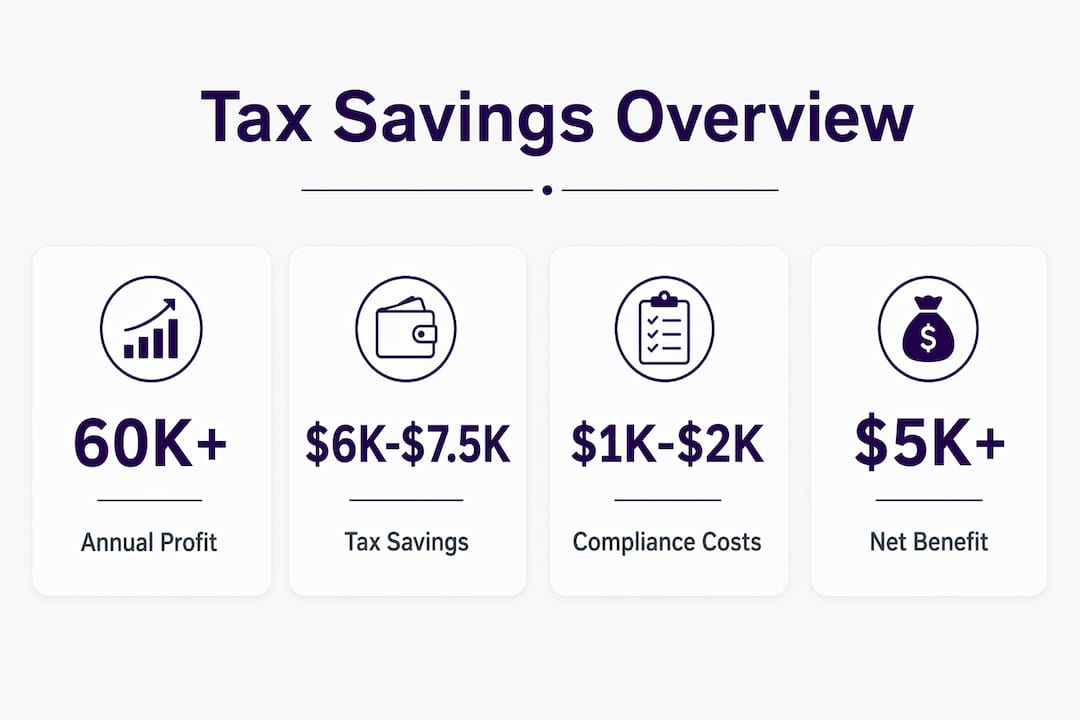
| Annual Profit | Estimated Tax Savings | Estimated Compliance Costs | Net Benefit |
|---|---|---|---|
| $50,000 | Minimal | $1,500–$2,000 | Likely negative |
| $80,000 | $2,000–$3,500 | $1,500–$2,500 | Near breakeven |
| $150,000 | $6,000–$7,500 | $2,000–$3,000 | Clearly positive |
| $300,000 | $12,000–$15,000 | $2,500–$3,500 | Strong positive |
The savings estimates above reflect the net benefit after payroll and CPA costs at each profit level. The $150,000 row is where most CPAs say the election becomes a clear win.
Business type also matters. Service-based businesses with high profit margins and low overhead, such as consultants, designers, and coaches, tend to benefit most. Businesses with thin margins or significant employee payroll already in place see smaller relative gains.
Year-round tax planning alongside your S-corp structure compounds the benefit. Pairing the election with a solid deductions strategy and retirement contributions can push total annual savings well above the election costs alone.
The biggest risk is setting your salary too low. The IRS actively monitors this. Failure to pay reasonable compensation can result in the IRS reclassifying your distributions as wages, which triggers back payroll taxes, interest, and penalties. That outcome wipes out years of savings in one audit.
Beyond audit risk, the operational requirements are real. Running an S-corp means running payroll every pay period, not just at tax time.
“The S-corp election is one of the highest-leverage federal tax tools available to profitable owner-managed businesses, but it must be used correctly.” — AccountsOS
The owners who get into trouble are the ones who set a $20,000 salary on a $200,000 profit business and never document why. The IRS does not need to prove bad intent. It just needs to show the salary is unreasonably low relative to your role and the business’s income.
Ongoing payroll workflow is not a one-time setup task. It is a recurring compliance obligation that requires attention every pay period. Outsourcing payroll to a dedicated service removes most of the operational burden and creates the paper trail you need.
Pro Tip: Review your reasonable salary figure every year, not just at election time. If your business grows significantly, your salary should reflect that growth. Keeping a static salary while profits triple is exactly the pattern the IRS looks for.
S-corp election saves taxes primarily by shifting profit above a reasonable salary into distributions that avoid the 15.3% self-employment tax, but the benefit only outweighs compliance costs when annual profit exceeds roughly $60,000.
| Point | Details |
|---|---|
| Core tax mechanism | Distributions above your W-2 salary avoid the 15.3% self-employment tax entirely. |
| Profit threshold | Savings typically exceed compliance costs once annual profit reaches $60,000 or more. |
| IRS compliance | File Form 2553 by march 15 and pay a documented reasonable salary every pay period. |
| Audit risk | Low salary relative to profit is the top IRS trigger; document your salary rationale annually. |
| Additional benefits | W-2 wages unlock Solo 401(k) contributions and Accountable Plan reimbursements. |
At Taxbowl, we work with small business owners across dozens of industries, and the pattern we see most often is not owners who elected too early. It is owners who waited too long because the election felt complicated, then lost two or three years of meaningful savings.
The compliance side is real, but it is manageable. The owners who struggle are the ones trying to handle payroll, bookkeeping, and tax prep in three separate systems that do not talk to each other. When your books are clean and your payroll runs on a consistent schedule, the S-corp structure works exactly as designed.
The misconception we push back on hardest is that the reasonable salary requirement is a trap. It is not. It is a documentation exercise. If you can describe your role, pull a comparable salary from a public source, and show you ran payroll consistently, you have a defensible position. The IRS is not looking for perfection. It is looking for effort and consistency.
One thing we tell every client considering the election: the business tax deductions checklist you use as an LLC does not disappear when you elect S-corp status. You keep all those deductions and add the payroll tax savings on top. That combination is where the real financial impact shows up.
The owners who get the most from S-corp election are not the ones with the highest profits. They are the ones with the most organized financial operations. Clean books, consistent payroll, and a CPA who reviews the salary figure annually. That is the whole playbook.
— Taxbowl
Running an S-corp the right way requires clean books, consistent payroll, and a tax team that understands the compliance requirements before they become problems.
Taxbowl provides dedicated bookkeeping services built specifically for small businesses managing S-corp compliance. Your books stay accurate, your payroll runs on schedule, and your salary documentation is always audit-ready. The Taxbowl team communicates in real time via Slack, so you get answers when decisions need to be made, not days later. If you want expert guidance on whether S-corp election makes sense for your business or need support managing the ongoing requirements, talk to a Taxbowl expert and get a clear picture of your potential savings.
An S-corp election is a tax status request filed with the IRS using Form 2553. It allows a corporation or eligible LLC to pass income directly to shareholders and avoid corporate-level income tax while reducing self-employment tax on distributions.
At $150,000 in annual profit, an S-corp typically generates $6,000–$7,500 in net tax savings after payroll and CPA costs. Savings grow as profit increases because a larger share of income flows as distributions exempt from self-employment tax.
A reasonable salary is the amount a comparable employee would earn for the same work in the same industry. The IRS evaluates duties, time spent, and market wage data, so owners must document their salary rationale with external benchmarks each year.
S-corp election makes financial sense when your business generates at least $60,000 in annual profit. Below that level, payroll and compliance costs typically exceed the tax savings the structure provides.
No. S-corp election reduces self-employment tax by applying it only to your W-2 salary, not your full profit. The portion of profit taken as distributions avoids the 15.3% self-employment tax, but income tax still applies to all earnings at the shareholder level.