Back to blog
Sales Tax Compliance for Small Businesses: 2026 Guide
Understand what is sales tax compliance for small businesses. Learn how to avoid costly mistakes and ensure timely tax reporting in 2026.

Understand what is sales tax compliance for small businesses. Learn how to avoid costly mistakes and ensure timely tax reporting in 2026.
TL;DR:
- Sales tax compliance involves registering, collecting, and remitting taxes based on complex state and local rules. Small businesses must proactively manage nexus, exemption certificates, and filing schedules to avoid costly penalties and back taxes. Building a systematic approach with support from professionals helps ensure ongoing compliance in a multi-jurisdictional landscape.
Sales tax compliance is the complete process of identifying your tax obligations, registering with state authorities, collecting the correct tax amounts, filing returns, and remitting payments on time to state and local tax authorities. Most small business owners treat it as a once-a-year task. That is the first and most expensive mistake you can make. The US sales tax system spans thousands of jurisdictions, each with its own rates, rules, and deadlines. Getting it right requires understanding nexus, exemptions, and filing schedules before your first sale crosses a threshold.
Sales tax compliance is defined as the full process of identifying nexus, registering, calculating correct tax, collecting, filing returns, and timely remitting to state and local tax authorities. The IRS does not administer sales tax. Each state, county, city, and special district sets its own rules. That decentralized structure is what makes compliance genuinely difficult for small business owners.
The US sales tax system only taxes final sales to consumers, unlike global VAT systems that tax each step of the supply chain. That sounds simpler. In practice, thousands of changing local rules create real complexity for any business selling across state lines or online. A business selling in a single state still faces county and city rate variations on top of the state base rate.
The stakes are real. Missing a registration deadline, filing at the wrong rate, or skipping a return can trigger back taxes, interest, and penalties. For a sole proprietor or small business owner, those costs can wipe out months of profit. Understanding your sales tax obligations is not optional once your sales reach certain thresholds.
Nexus is the legal connection between your business and a state that requires you to collect and remit sales tax there. Two types of nexus apply to small businesses: physical nexus and economic nexus.
Physical nexus exists when your business has a tangible presence in a state. That includes:
Economic nexus is triggered purely by sales volume, even without a physical presence. Most states set economic nexus thresholds at $100,000 in annual sales or 200 transactions, though California and Texas use a $500,000 threshold. That means a small online retailer shipping products nationwide can owe sales tax in dozens of states without ever setting foot there.
The consequences of missing nexus are severe. Failure to register after crossing a threshold means the statute of limitations never starts running. Your liability accumulates indefinitely until you file. States can audit years of back sales and assess taxes, interest, and penalties on every uncollected dollar.
Pro Tip: Track your sales by state monthly, not annually. Nexus thresholds reset each calendar year in most states, but some use a rolling 12-month window. Catching a threshold crossing in real time prevents a surprise registration obligation.
Nexus rules also vary by product type and sales channel. Selling through a marketplace like Amazon or Etsy shifts some collection responsibilities to the platform under marketplace facilitator laws, but you still need to track your own direct sales separately.
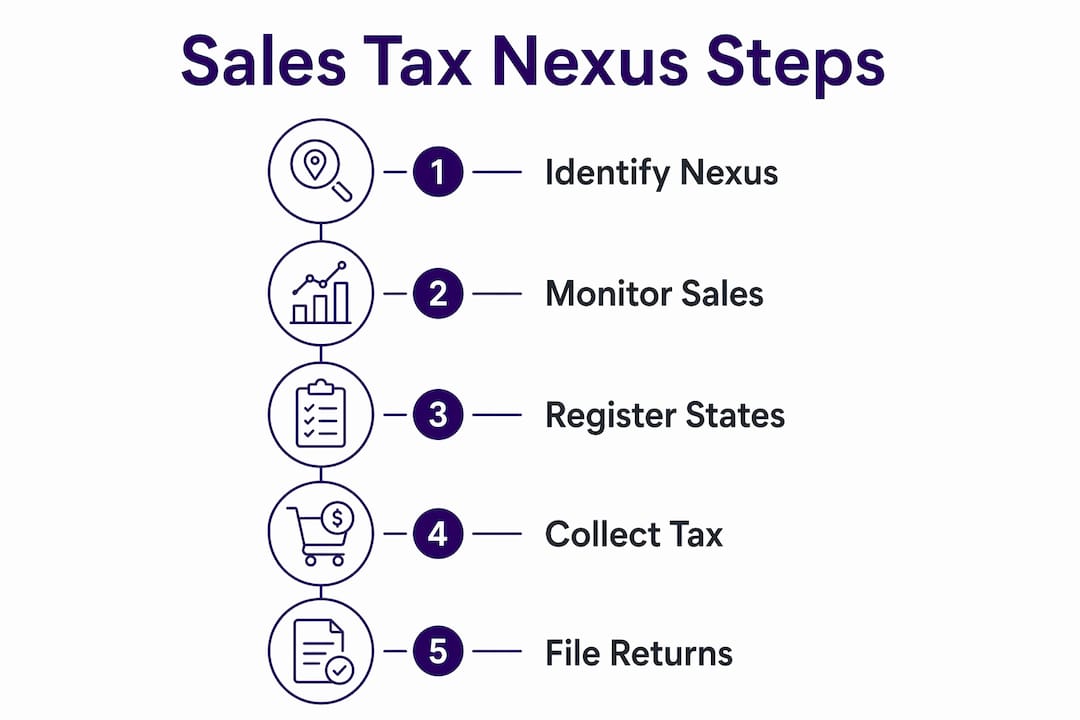
Once you confirm nexus in a state, the compliance process follows a clear sequence. Skipping any step creates liability.
Register with the state tax authority. Each state has its own registration portal. Most require a business name, federal EIN, and a description of what you sell. Some states charge a registration fee. Registration deadlines vary widely by state, and missing them is a common and costly error for out-of-state sellers.
Determine the correct tax rate for each sale. Sales tax rates combine state, county, city, and special district taxes. Combined rates can exceed 10% in some areas. Most states use destination-based sourcing, meaning you charge the rate for the buyer’s location, not your business location. A sale shipped to a customer in Chicago carries a different rate than one shipped to a suburb.
Collect tax at the point of sale. Your invoicing or point-of-sale system must apply the correct rate automatically. Manual rate lookups invite errors. Review your system’s rate tables regularly, since local rates change frequently.
File returns on the schedule your state assigns. Most states assign filing frequency based on your tax liability, shifting businesses to monthly filings as sales volume grows. Low-volume sellers often file quarterly or annually. Missing a filing date triggers penalties even if you owe zero tax.
Remit the collected tax by the due date. Payment and return filing are often separate steps. Some states require electronic funds transfer above certain dollar thresholds. Confirm your state’s payment method requirements when you register.
Pro Tip: Set calendar reminders for every filing deadline the moment you register in a new state. A missed return costs more in penalties than the tax itself in most states.
Staying current with quarterly tax obligations is one of the most common areas where small business owners fall behind. Building a simple compliance calendar for each state where you have nexus keeps you ahead of due dates.

Not every sale triggers a tax obligation. Understanding what is taxable and what is exempt protects you from both over-collecting and under-collecting.
General taxability rules:
Common exemption categories:
| Exemption type | Documentation required | Audit risk if missing |
|---|---|---|
| Resale certificate | State-issued resale certificate | High: back taxes plus penalties |
| Nonprofit exemption | State exemption letter | High: full tax liability assessed |
| Manufacturer exemption | Exemption certificate by state | Medium: depends on purchase volume |
| Government purchase | Government purchase order | Low to medium |
Handling exemption certificates properly is critical. Failure to maintain these documents during B2B sales can result in your business owing back taxes plus penalties. Auditors treat a missing certificate as proof that the sale was taxable. Keeping exemption certificates up to date and on file protects you from personal liability if an audit finds gaps in your records.
The safest practice is to collect a new exemption certificate from each exempt customer at least every three years, or whenever their business information changes. Store them digitally with a clear naming system tied to each customer account.
Small business owners make the same compliance errors repeatedly. Knowing them in advance saves you money and stress.
The most frequent mistakes include:
Pro Tip: Review your nexus status at the start of each quarter. Sales patterns shift, and a new state threshold crossing can sneak up on you mid-year if you only check annually.
Good recordkeeping is the foundation of clean compliance. Maintain organized sales records by state, keep all exemption certificates in one place, and reconcile your collected tax against your filed returns every period. Outsourced bookkeeping services built for small businesses can automate much of this tracking, reducing the manual work and the risk of errors.
Working with an accountant who understands multi-state tax rules also pays off. Clear accountant communication practices around your sales data and filing schedule prevent the gaps that lead to penalties. The businesses that stay compliant are not necessarily the ones with the most complex systems. They are the ones with consistent habits and reliable support.
Sales tax compliance requires registering in every state where you have nexus, collecting destination-based rates, filing on your assigned schedule, and maintaining complete exemption certificate records to avoid penalties and back-tax liability.
| Point | Details |
|---|---|
| Nexus triggers registration | Physical presence or crossing $100,000 in sales or 200 transactions in most states requires registration. |
| Destination-based rates apply | Charge the tax rate for the buyer’s location, not your business address, in most states. |
| Filing frequency scales with volume | States assign monthly, quarterly, or annual filing based on your total tax liability. |
| Exemption certificates protect you | Missing certificates during a B2B audit can result in back taxes and personal liability for owners. |
| Missed deadlines compound liability | Statutes of limitation do not start until you file, so unregistered liability grows indefinitely. |
Sales tax compliance in the US is genuinely harder than it looks from the outside. I have worked with small business owners who assumed that because they operate in one state, they only have one set of rules to follow. Then they start selling online, ship to customers in five new states, and suddenly face five separate registration deadlines, five different rate structures, and five filing calendars.
The part that catches most owners off guard is not the tax itself. It is the administrative volume. Tracking nexus thresholds, managing exemption certificates, reconciling collected tax against filed returns, and staying current with local rate changes is a real ongoing workload. Most small business owners did not start their company to become tax administrators.
What actually works is treating compliance as a system, not a task. Build a simple state-by-state compliance tracker. Set filing reminders the day you register in a new state. Store exemption certificates digitally with a consistent naming convention. Review your nexus status every quarter without exception.
Technology helps, but it does not replace judgment. Automated rate tools can apply the wrong rate if your product classification is off. A human who understands your business catches those errors before they become audit findings. The combination of good software and an experienced accountant is more reliable than either one alone.
The business owners I have seen handle this well share one trait. They ask for help early, before a problem develops, not after a state sends a notice. Proactive compliance is always cheaper than reactive compliance.
— Taxbowl
Sales tax compliance is manageable when you have the right support behind you. Taxbowl’s bookkeeping services for small businesses keep your sales records clean, organized, and ready for every filing deadline. Our dedicated team of accountants monitors your nexus exposure, tracks rate changes, and flags compliance gaps before they become penalties.
Small business owners who work with Taxbowl get real-time financial visibility and direct access to their accounting team through Slack. No waiting for quarterly check-ins. No scrambling before a filing deadline. If you are ready to take the complexity out of sales tax, talk to a Taxbowl expert and get a clear picture of where you stand today.
Sales tax compliance is the process of registering with state tax authorities, collecting the correct tax on taxable sales, filing returns, and remitting collected taxes on time. Every business with nexus in a state must follow that state’s specific rules.
You have nexus if you have a physical presence in a state or if your sales exceed that state’s economic nexus threshold, which is $100,000 in annual sales or 200 transactions in most states.
Missing a filing deadline triggers penalties and interest in most states, even if you owe no tax for that period. Unregistered liability also has no statute of limitations, meaning it accumulates until you begin filing.
No. Tangible personal property is taxable by default in most states, but groceries, prescription drugs, and many services carry full or partial exemptions. Digital goods and software taxability varies significantly by state.
Filing frequency depends on your total sales tax liability in each state. Low-volume sellers typically file quarterly or annually, while higher-volume businesses are assigned monthly filing schedules by the state tax authority.