Back to blog
Tax Loss Harvesting for Small Business: 2026 Guide
Discover how tax loss harvesting for small business can reduce taxable income. Learn effective strategies to optimize your tax planning in 2026.

Discover how tax loss harvesting for small business can reduce taxable income. Learn effective strategies to optimize your tax planning in 2026.
TL;DR:
- Tax loss harvesting involves selling investments at a loss to offset capital gains and reduce taxable income. Small business owners should conduct year-round account reviews to maximize benefits while carefully following IRS rules. Proper record keeping and strategic timing prevent disallowed losses and build a valuable carryforward balance for future tax savings.
Tax loss harvesting is the deliberate sale of investments at a loss to reduce taxable income by offsetting capital gains and, within IRS limits, ordinary income. For small business owners, this strategy sits at the intersection of personal investment management and tax planning for small business, making it both powerful and easy to misapply. The IRS allows capital losses to offset gains dollar for dollar, with a $3,000 annual cap on deductions against ordinary income. Understanding how this applies to your specific situation as a business owner, not just as an individual investor, is what separates a smart tax move from a costly mistake.
Tax loss harvesting applies specifically to investments held in taxable brokerage accounts, not retirement accounts. Losses inside IRAs or 401(k)s do not generate annual tax benefits because those accounts are not taxed on an ongoing basis. That distinction matters enormously for small business owners who often hold both types of accounts.

The mechanics are straightforward. You sell an investment that has dropped below its adjusted cost basis, realizing a capital loss. That loss then offsets any capital gains you have in the same tax year. If your losses exceed your gains, the IRS lets you deduct up to $3,000 of the remaining loss against ordinary income. Any amount beyond that carries forward to future tax years indefinitely.
A critical distinction separates business operating losses from investment capital losses. Business losses may create net operating losses (NOLs) with their own carryover rules, which are entirely separate from capital loss rules. An NOL from your S corp or LLC does not combine with a capital loss from selling a stock position. They live in different parts of your tax return.
Capital losses flow through Schedule D on your personal return. IRS Publication 550 is the authoritative guide for investment income and capital loss reporting, including how to calculate carryovers. If you have K-1 income from a partnership or S corp, that income may create capital gains that your harvested losses can offset directly.
A clear process protects you from errors and IRS scrutiny. Follow these steps to harvest losses correctly.
Review your taxable accounts throughout the year. Pull up your brokerage statements quarterly, not just in december. Market dips create harvesting opportunities at any point in the calendar year.
Identify positions with unrealized losses. Compare each holding’s current market value against its adjusted cost basis. Your broker’s platform typically shows this, but verify against your own records.
Check the wash-sale rule before selling. The wash-sale rule disallows your loss if you buy a substantially identical security within 30 days before or after the sale. That is a 61-day window total. Selling a stock and buying it back two weeks later wipes out your deduction.
Execute the sale and document it. Record the sale date, proceeds, cost basis, and resulting loss. Your broker will issue a Form 1099-B, but your own records serve as a backup and catch errors.
Replace the position if you want to stay invested. You can buy a similar but not substantially identical investment immediately after selling. For example, selling one S&P 500 index fund and buying a different broad market fund maintains your market exposure without triggering the wash-sale rule.
Report losses on Schedule D. Short-term losses (assets held under one year) offset short-term gains first. Long-term losses offset long-term gains first. The IRS applies a specific netting order, so accurate categorization matters.
Track your carryforward balance. If your losses exceed gains plus the $3,000 ordinary income cap, the remainder carries forward. Record this number carefully because it directly reduces your tax bill in future years.
Pro Tip: Keep a dedicated spreadsheet or use your bookkeeping system to log every investment transaction, including the date purchased, cost basis, and sale date. Accurate records are the foundation of a defensible tax position.
The table below shows how different loss scenarios affect your tax outcome in a given year.
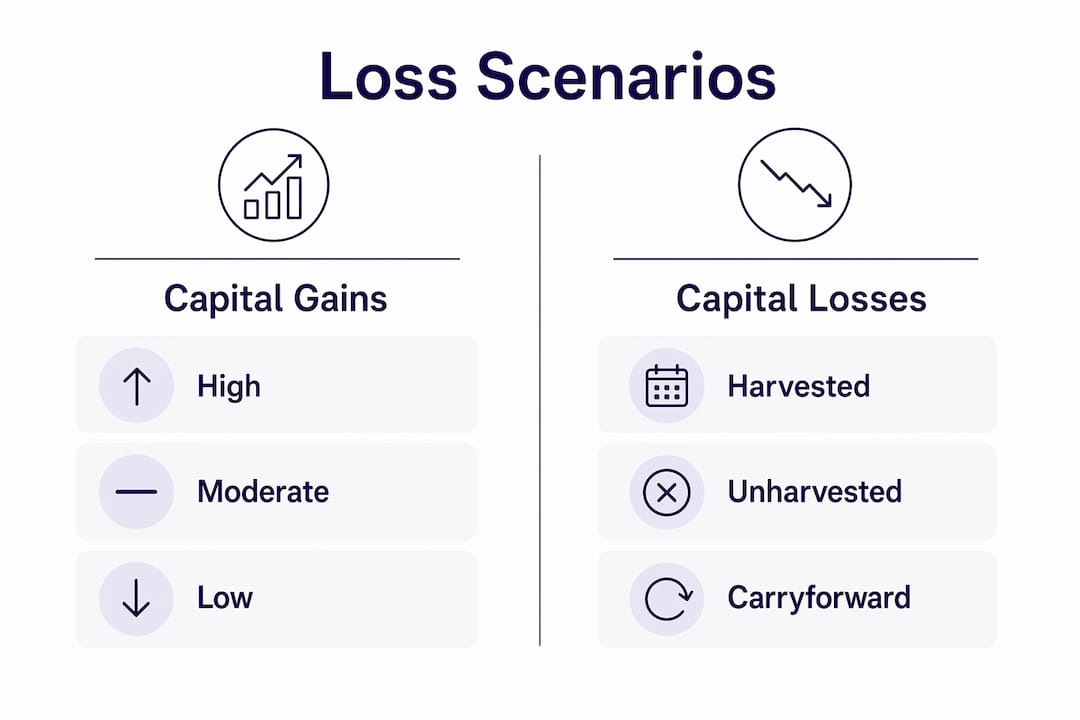
| Scenario | Capital Gains | Capital Losses | Net Taxable Gain | Ordinary Income Deduction |
|---|---|---|---|---|
| Gains exceed losses | $10,000 | $6,000 | $4,000 | $0 |
| Losses exceed gains | $4,000 | $9,000 | $0 | $3,000 (max) |
| No gains, only losses | $0 | $5,000 | $0 | $3,000 (max) |
| Losses equal gains | $7,000 | $7,000 | $0 | $0 |
The wash-sale rule is the most common reason harvested losses get disallowed. The 61-day window applies across all accounts, including your spouse’s accounts and any accounts at different brokerages. Many business owners miss this because they track each account separately. The IRS does not care which account made the repurchase. If the purchase happened within the window, the loss is disallowed.
“A loss is only triggered when you sell a capital asset below its adjusted basis. Unrealized losses provide no tax benefit until you actually sell.” — IRS Topic 409
The $3,000 annual cap creates a second trap. If you have no capital gains in a given year, you can only deduct $3,000 of losses against ordinary income. The rest carries forward. Business owners who harvest large losses expecting a big immediate deduction are often disappointed when they realize the benefit is spread across multiple years.
Here are the most common pitfalls to watch for:
Coordinated record keeping across every account you and your household own is not optional. It is the only way to confirm you have not accidentally triggered a wash-sale violation.
Most business owners think of tax moves as a december activity. That mindset leaves money on the table. Losses can be realized at any time during the year and still offset capital gains or up to $3,000 of ordinary income, with any excess carrying forward indefinitely.
Market volatility creates harvesting windows throughout the year. A sector downturn in march or a correction in august may present better opportunities than the typical year-end review. Waiting until december means you may miss the best entry points for replacement investments and rush decisions that deserve careful thought.
Year-round harvesting also aligns better with your overall proactive tax planning calendar. If you sell a business asset or receive a large K-1 distribution mid-year, you can harvest investment losses in the same quarter to offset that gain immediately. This real-time approach prevents a surprise tax bill in april.
Pro Tip: Set a calendar reminder each quarter to review your taxable investment accounts. A 15-minute review four times a year catches more opportunities than a single year-end scramble.
Carryforward losses are another reason to act early and often. Losses harvested this year that exceed your current gains do not disappear. They reduce your taxable gains in future years, which is especially valuable if you anticipate a large liquidity event, a business sale, or a significant capital gain down the road. Building a carryforward balance is a long-term tax asset.
The tax benefits for small business owners who harvest losses consistently compound over time. Each year of disciplined harvesting adds to a carryforward balance that can absorb future gains from business growth, real estate sales, or investment exits.
Tax loss harvesting for small business owners works best when it is treated as a year-round discipline, not a year-end afterthought, with careful attention to IRS rules on wash sales, account types, and the $3,000 ordinary income cap.
| Point | Details |
|---|---|
| Capital losses offset gains first | Harvested losses reduce capital gains dollar for dollar before touching ordinary income. |
| $3,000 annual cap on ordinary income | Losses beyond your capital gains only reduce ordinary income by $3,000 per year; the rest carries forward. |
| Taxable accounts only | Tax loss harvesting provides no benefit inside IRAs or 401(k)s. |
| Wash-sale rule spans all accounts | The 61-day window applies across every account in your household, including a spouse’s accounts. |
| Year-round harvesting beats year-end | Quarterly reviews capture more opportunities and allow better timing of replacement purchases. |
Working with small business owners every day, the gap between knowing about tax loss harvesting and executing it correctly is wider than most people expect. The concept is simple. The execution requires discipline that most busy owners do not have bandwidth for on their own.
The most common failure pattern is not the wash-sale rule or the $3,000 cap. It is fragmented records. An owner has a brokerage account, a spouse has a separate account, and there is an old rollover IRA sitting at a third institution. Nobody is tracking all three together. A loss gets harvested in one account, and a replacement purchase happens in another account within the 30-day window. The deduction disappears, and nobody catches it until the IRS does.
The second issue is treating loss harvesting as separate from the rest of your tax picture. A harvested loss is most valuable when it offsets a real gain. If you have a K-1 showing a large capital gain from a partnership, or you sold a piece of equipment, or you are planning a business sale, those are the moments to aggressively harvest losses. Doing it in isolation, without knowing your full gain profile for the year, often produces a smaller benefit than expected.
Schedule D worksheets and IRS Publication 550 are the tools that validate your carryforward balance. Do not rely solely on your broker’s year-end statement. Brokers report what happened in their account. They do not know about the loss you carried forward from three years ago or the wash-sale violation that happened in your spouse’s account. That reconciliation is your responsibility, and it belongs in your bookkeeping system, not a spreadsheet you update once a year.
The owners who get the most out of this strategy work with a tax professional who reviews their investment accounts alongside their business financials. That integrated view is what turns a theoretical tax benefit into a real one.
— Taxbowl
Tracking investment transactions accurately is the foundation of any effective loss harvesting plan. Without clean records, you cannot confirm your cost basis, validate your carryforward balance, or defend your deductions if the IRS asks questions.
Taxbowl’s team of dedicated accountants works alongside small business owners to keep financial records clean, current, and organized across all accounts. From professional bookkeeping that captures every transaction to tax planning support that aligns your investment losses with your business’s full tax picture, Taxbowl gives you the real-time visibility you need to act when opportunities arise. You get proactive guidance through direct communication, not a once-a-year conversation. If you are ready to make loss harvesting part of a coordinated tax strategy, talk to a Taxbowl expert and get started.
Tax loss harvesting is the practice of selling investments at a loss to realize capital losses that offset capital gains and, up to $3,000 per year, ordinary income. Small business owners apply this strategy through their personal taxable investment accounts, not through their business entity directly.
Yes. The wash-sale rule applies across every account in your household, including accounts held by a spouse and accounts at different brokerages. Repurchasing a substantially identical security within 30 days before or after a sale disallows the loss regardless of which account made the purchase.
No. The IRS caps the deduction of capital losses against ordinary income at $3,000 per year. Losses beyond that amount carry forward to future tax years and can offset future capital gains without limit.
No. Business operating losses may generate net operating losses with their own carryover rules, which are separate from capital loss rules. Only the sale of a capital asset below its adjusted cost basis creates a capital loss eligible for harvesting.
Losses can be harvested at any point during the year, not just in december. Reviewing your taxable accounts quarterly lets you capture opportunities created by market volatility and align loss realization with your actual gain profile for the year.