Back to blog
Why Reactive Tax Filing Costs Small Businesses More
Discover why reactive tax filing costs more. Learn about penalties, lost deductions, and strategies to reduce tax bills effectively.


Discover why reactive tax filing costs more. Learn about penalties, lost deductions, and strategies to reduce tax bills effectively.
TL;DR:
- Reactive tax filing increases costs due to penalties, missed deductions, and costly cleanup efforts. Proactive bookkeeping and quarterly planning reduce these expenses by preventing backlog, errors, and surprise penalties. Acting now by filing early, paying what you can, and connecting your accounts saves money and mitigates risk.
Reactive tax filing typically costs more because IRS penalties and interest compound monthly, missed deductions and deferral strategies raise your actual tax bill, and catch-up bookkeeping adds a separate, billable cleanup project before your return can even be prepared. The short version: waiting until you’re behind doesn’t just mean a late fee. It means paying more on every front at once.
The five main cost drivers:
If you’re already behind, jump to the triage plan below. If you want to understand the full cost picture first, read on.
IRS penalties and interest can easily exceed what you’d pay for a full year of proactive bookkeeping. Two penalties hit simultaneously when you file and pay late.
The Failure to File penalty charges 5% of unpaid tax per month (or partial month), capped at 25% of the unpaid balance. The Failure to Pay (FTP) penalty runs at 0.5% per month, also capped at 25%. When both apply in the same month, the FTF rate drops to 4.5%, but the combined effect still adds up fast. On top of that, the IRS charges interest on penalties until you pay the balance in full.
| Months Late | FTF Penalty (5%/mo) | FTP Penalty (0.5%/mo) | Combined on $10,000 Owed |
|---|---|---|---|
| 1 month | 5% | 0.5% | — |
| 3 months | 15% | 1.5% | — |
| 5 months (cap) | 25% | 2.5% | — |
| 10 months | 25% (capped) | 5% | $3,000 |
Key figure: The FTF penalty alone can reach a capped maximum percentage of unpaid tax within a few months, resulting in substantial additional charges before interest or any professional fees.
Missing quarterly estimated tax payments adds an Underpayment of Estimated Tax penalty on top of these, calculated based on the underpayment amount and the applicable federal rate for each quarter.
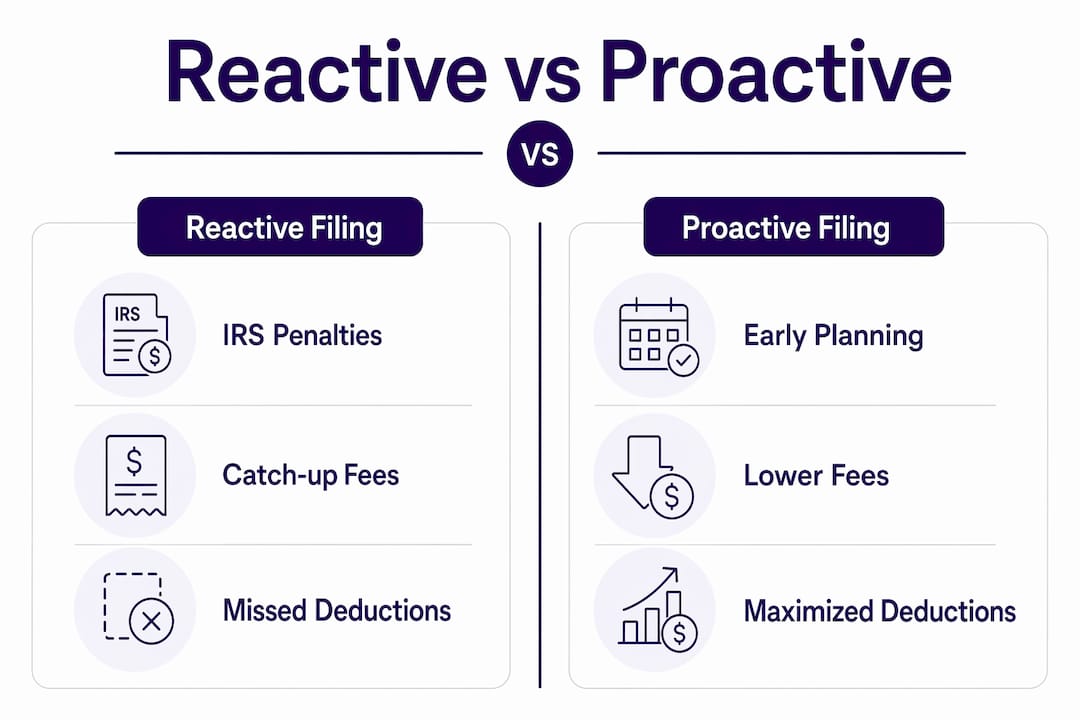
Reactive filing often means missed deductions, credits, and deferral strategies that can only be used before the tax year closes. Once December 31 passes, most of those windows are gone.
Common missed opportunities for small businesses include:
A sole proprietor who misses a $15,000 SEP-IRA contribution because they didn’t engage their accountant until March could easily owe $3,300–$5,250 more in federal tax alone, depending on their bracket. That’s a one-time miss. Repeat it over three years and the compounding opportunity cost dwarfs any savings from skipping quarterly advisory. For a deeper look at what’s commonly overlooked, the business tax deductions guide covers the most frequently missed items.
Cleanup is a separate, billable project, and it often drives the largest single fee increase in a reactive filing scenario. Before your accountant can prepare your return, they need clean, reconciled books. If yours aren’t, they bill for the reconstruction first.
Catch-up bookkeeping typically adds $750 to $3,500 or more to your bill depending on how far behind you are. Greater complexity, such as multiple bank and credit card accounts or high transaction volumes, can increase that cost further. The reconstruction tasks themselves include:
Reactive engagement also creates a psychological avoidance cycle. Owners who treat their accountant as a year-end resource tend to delay contact, which increases urgency and can raise fees by as much as 47% as the work becomes rushed and complex. The real cost formula isn’t just your return type. It’s return complexity + book quality + cleanup backlog + client responsiveness.
Pro Tip: Connect your business bank accounts to your accounting software today. Even basic auto-categorization rules cut cleanup hours significantly and give your accountant a usable starting point instead of a blank ledger.

Clean books also shift expensive hourly reviewer time toward actual tax decisions rather than ledger reconstruction, which is where the real savings show up.
Rushed preparation increases mistakes, and mistakes increase audit risk, amended returns, and the additional fees and interest that follow. The IRS can assess an accuracy-related penalty of 20% on any portion of underpayment attributable to negligence or disregard of rules and regulations. Interest accrues on that penalty too.
Scenarios that commonly trigger audits or amended returns for small businesses:
Stat callout: The IRS accuracy-related penalty is 20% of the underpayment amount. On a $20,000 understatement, that’s $4,000 in penalties before interest.
An amended return also requires professional time to prepare, with costs varying depending on complexity, and it reopens the period under review.
Proactive bookkeeping and quarterly planning turn expensive cleanup money into predictable, lower ongoing costs. Instead of one chaotic sprint at year-end, the work is distributed across the year at a lower per-hour cost.
The core features that reduce costs:
Proactive tax planning programs typically cost $8,000–$15,000 annually for complex situations but routinely yield larger tax savings and avoided penalties. Year-end-only prep for a complex return runs $3,000–$8,000 with no strategic benefit. Taxbowl’s Tax Planning Calculator lets you estimate the gap between what reactive filing costs you today versus a proactive approach, so you can see the numbers before committing.
Proactive planning also requires less total owner time across the year. Spreading quarterly check-ins across 12 months is far less disruptive than a compressed, chaotic filing season.
Reactive filing costs add up faster than most owners expect. Here’s how two realistic scenarios compare.
Scenario 1: Sole proprietor, $10,000 tax owed, filed 5 months late
Scenario 2: Small service business with payroll, $25,000 tax owed, filed 3 months late
| Scenario | Penalties | Cleanup Fees | Missed Deduction Cost | Total |
|---|---|---|---|---|
| Sole proprietor | — | $1,500 | $2,800 | ~$7,050 |
| Service biz w/ payroll | — | $3,200 | $4,500 | ~$11,825 |
Cleanup fees in these real-world scenarios align with the typical $750–$3,500+ range for catch-up bookkeeping, though payroll reconciliation and complexity factors can push costs higher.
To run your own estimate: take your estimated tax owed, multiply by the applicable penalty rates for months late, add your cleanup fee estimate, then add the tax cost of your largest missed deduction. That total is your reactive filing cost.
Three immediate actions reduce your near-term risk: file or extend today, pay what you can now, and connect your accounts to accounting software before another month passes.
Annual checklist:
Timeline:
If you’re more than three months behind on books, escalate to a professional immediately. The tax strategy checklist covers the full annual cycle in detail.
Quick triage reduces cost. Start with filing, pay what you can, then prioritize cleanup.
Paying something now and filing immediately is almost always cheaper than waiting for a perfect set of books.
Reactive tax filing costs more because penalties, missed planning, and cleanup fees hit simultaneously. Switching to proactive bookkeeping and quarterly planning eliminates most of these costs before they start.
| Point | Details |
|---|---|
| IRS penalties compound fast | The FTF penalty reaches 25% of unpaid tax in five months; interest accrues on top. |
| Missed deductions are permanent | Retirement contributions, Section 179, and timing strategies close at year-end with no retroactive fix. |
| Cleanup is a separate fee | Catch-up bookkeeping adds $750–$3,500+ before your return can even be prepared. |
| Audit risk adds hidden costs | The accuracy-related penalty is 20% of any negligent underpayment, plus interest. |
| Taxbowl prevents all five drivers | Monthly reconciliations, quarterly tax reviews, and a dedicated accountant eliminate the reactive cost cycle. |
Most owners underestimate reactive filing costs because they only count the penalty line on the IRS notice. They miss the cleanup invoice, the missed deduction they’ll never recover, and the cash-flow hit from a surprise tax bill in April. Those three costs together routinely exceed what a full year of proactive bookkeeping would have cost.
The deeper issue is behavioral. Treating your accountant as a once-a-year resource creates the avoidance cycle that makes everything worse. Regular, low-friction touchpoints, whether monthly check-ins or a quick Slack message to your Taxbowl team, break that cycle before it compounds. The businesses that pay the least in taxes and fees aren’t the ones with the most complex strategies. They’re the ones whose books are clean, whose estimates are current, and whose accountant has enough lead time to actually help.
If you’re behind right now, the best move isn’t to wait until you have everything organized. File, pay what you can, and get a professional involved today.
Reactive filing is expensive. Taxbowl’s bookkeeping and tax services are built specifically to prevent every cost driver covered in this article.
Here’s what you get with Taxbowl:
Taxbowl’s small business accounting support is designed for owners who want clean books, lower taxes, and no year-end chaos. Ready to stop paying the reactive premium? Talk to a Taxbowl expert and get a clear picture of where you stand today.
The Failure to File penalty is 5% of unpaid tax per month, capped at 25% after five months. Filing on time, even without full payment, stops this penalty immediately.
Catch-up bookkeeping commonly adds $750 to $3,500 or more depending on how many months of records need reconstruction. Multiple accounts and high transaction volumes can increase that cost.
Yes. Year-end-only preparation for a complex return typically costs several thousand dollars with no strategic benefit, while proactive advisory programs can cost more annually but often result in larger tax savings through deductions, credits, and deferral strategies.
The IRS accuracy-related penalty is 20% of the underpayment amount attributable to negligence or disregard of rules, and interest accrues on that penalty until paid in full.
Taxbowl provides monthly reconciliations, quarterly tax planning calls, and a dedicated accountant year-round, eliminating the cleanup backlog, missed deductions, and surprise tax bills that make reactive filing expensive.
This article is general information, not professional tax or legal advice. Confirm current IRS rates, thresholds, and your specific situation with a qualified tax professional or directly at irs.gov.