Back to blog
Tax Planning vs Tax Preparation: A Small Business Guide
Learn what is tax planning vs tax preparation and how mastering both can save your small business money and aid future growth.


Learn what is tax planning vs tax preparation and how mastering both can save your small business money and aid future growth.
TL;DR:
- Tax planning is a proactive process that aims to reduce future tax liabilities through year-round decision-making. Tax preparation, on the other hand, reports past financial activity accurately to meet IRS compliance within a specific window. Both are essential for a small business to maximize savings and avoid costly mistakes.
Tax planning is defined as a proactive, year-round strategy to legally reduce your future tax liability, while tax preparation is the annual process of accurately reporting past financial activity to meet IRS compliance requirements. Understanding what is tax planning vs tax preparation is the single most important distinction a small business owner can make to protect profits and avoid costly surprises. Most business owners focus entirely on preparation and leave 5%–30% of potential tax savings on the table depending on business complexity. That gap represents real money you could keep, reinvest, or use to grow your team.
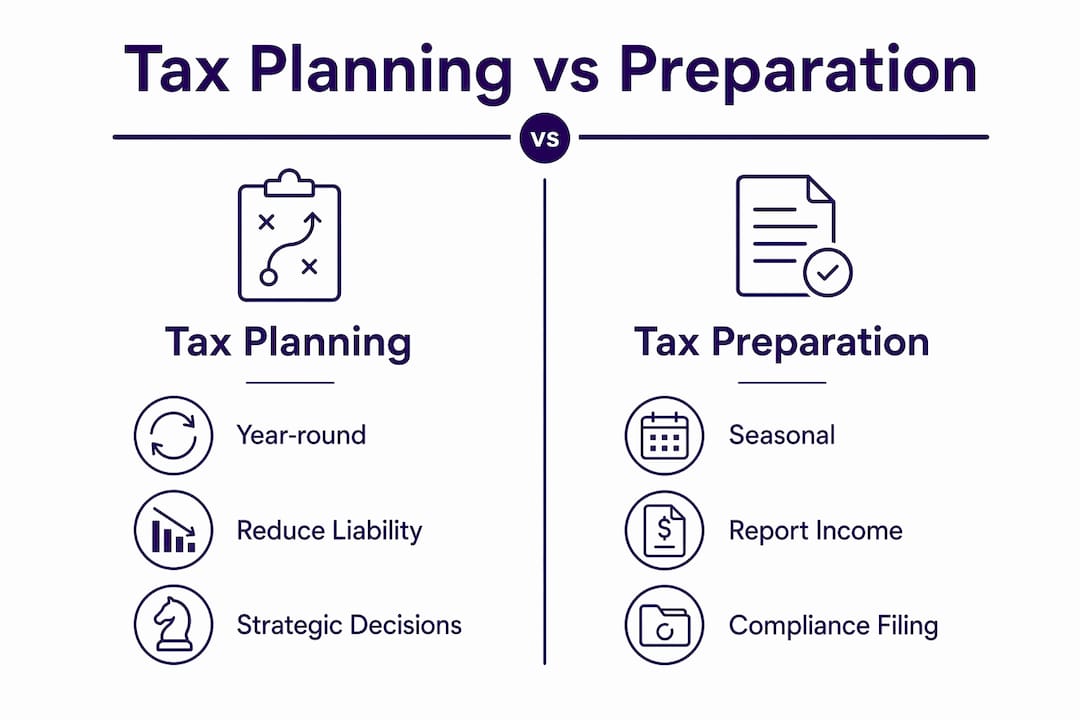
Tax preparation and tax planning are not the same service. They operate at different times, serve different purposes, and produce different financial outcomes. Confusing the two is one of the most common and expensive mistakes small business owners make.
Tax preparation is a backward-looking, compliance-driven process. It happens between january and april each year. A CPA or tax preparer collects your financial records, organizes them, and files accurate returns with the IRS. The goal is to report what already happened, correctly and on time.
Tax planning is a forward-looking, strategic process. It happens year-round, before financial decisions are made. A tax advisor works with you to structure income, deductions, entity type, and retirement contributions in ways that legally reduce what you owe. Tax planning changes decisions before they are made, resulting in potentially tens of thousands saved annually for business owners earning above $150,000.

The core insight: preparation reports your tax bill. Planning reduces it.
Tax preparation explained simply: it is the process of gathering your financial records from the prior year and filing accurate tax returns by IRS deadlines. For most small business owners, that window runs from january through april 15, with extensions available through october.
A qualified CPA or enrolled agent handles the following during tax preparation season:
The median CPA fee for a 1040 preparation is approximately $280, though business returns are more complex and cost more. Combined planning and preparation services command higher fees because they include advisory expertise on top of compliance work.
Tax preparation cannot change your tax outcome. Once december 31 passes, your income is fixed, your deductions are set, and your entity structure is locked in for that year. A preparer can only report what happened. They cannot go back and restructure a transaction, accelerate a deduction, or shift income to a lower-tax year.
Pro Tip: Before hiring a tax preparer, ask directly: “Do you also offer tax planning, or only preparation?” Many preparers handle compliance only. Knowing the difference upfront saves you from assuming your preparer is also reducing your future tax bill.
Tax planning is a proactive strategy that shapes your financial decisions before they happen. It is not a once-a-year conversation. Effective tax planning requires year-round access to your books, usually reviewed quarterly, to capture every available opportunity.
A tax advisor working on planning will focus on these areas throughout the year:
Major tax-saving strategies like entity restructuring or retirement contributions have firm year-end deadlines. Delayed planning locks in higher tax liabilities with no way to recover them after december 31.
Every business benefits from planning, but the return on investment grows sharply with revenue. For entrepreneurs earning above $150,000, investment in tax planning advisory returns tens of thousands saved annually, far outweighing the added planning fees. If your business is growing, adding employees, or considering a structural change, proactive tax planning is not optional. It is the difference between paying what you legally owe and paying far more than you should.
Pro Tip: Start tax planning conversations with your advisor in Q2 or Q3, not Q4. By october, many of the best opportunities, like retirement account setup or entity elections, are already closing.
The differences between tax planning and preparation go beyond timing. They reflect entirely different mindsets about taxes.
| Attribute | Tax preparation | Tax planning |
|---|---|---|
| Timing | January–April (after year-end) | Year-round, before decisions are made |
| Focus | Compliance and accurate reporting | Reducing future tax liability |
| Outcome | Reports your tax bill | Lowers your tax bill |
| Frequency | Once per year | Quarterly reviews, ongoing |
| Who leads | Tax preparer or CPA | Tax advisor or CPA with planning expertise |
| Can it change your taxes? | No, only reports past events | Yes, through proactive decisions |
Tax preparation alone is non-negotiable for compliance but cannot reduce taxes. Filing accurately keeps you out of trouble with the IRS. It does not keep more money in your business. Many small business owners mistakenly believe their tax preparer is also doing planning. In reality, most preparers focus on compliance only during tax season, not on shaping decisions throughout the year.
The practical result: you pay your preparer to report what happened, then overpay the IRS because no one helped you plan what would happen. Both services are necessary. Neither replaces the other.
Timing is everything in tax strategy. Treating taxes as a 12-month operational discipline yields the best financial results, according to the AICPA, with consultations recommended early to account for frequent tax law changes.
Q1 (January–March): File prior-year returns or extensions. Review what changed. Identify missed opportunities from the prior year.
Q2 (April–June): Begin planning for the current year. Review entity structure. Set up or maximize retirement accounts. Assess estimated tax payments.
Q3 (July–September): Mid-year check-in with your advisor. Review year-to-date income. Adjust estimated payments. Evaluate equipment purchases or deferred expenses.
Q4 (October–December): Final planning window. Execute deduction strategies. Make retirement contributions. Lock in any structural changes before december 31.
Clean books are the foundation of both good preparation and good planning. Quarterly book reviews give your advisor the real-time data they need to make planning decisions before deadlines pass. If your books are a mess in march, your preparer spends their time cleaning records instead of finding savings.
Pro Tip: Use a year-round tax planning checklist to track planning milestones alongside your regular business operations. Treating tax tasks like operational tasks prevents last-minute scrambles.
Late engagement with tax planning services results in missed opportunities and higher taxes paid. The most common mistakes small business owners make include:
Effective accountant communication throughout the year prevents all of these. The goal is a continuous relationship with your tax professional, not a once-a-year transaction.
Tax planning permanently reduces your future tax liability through proactive decisions, while tax preparation accurately reports past activity for IRS compliance. Both are necessary, and neither replaces the other.
| Point | Details |
|---|---|
| Planning vs. preparation | Planning reduces your tax bill; preparation reports it. They serve different purposes. |
| Timing matters | Tax planning works year-round; preparation happens january–april after the year ends. |
| Cost of inaction | Business owners without proactive planning may leave 5%–30% of potential savings unclaimed. |
| Revenue threshold | Owners earning above $150,000 annually gain the most from dedicated tax planning advisory. |
| Clean books are critical | Quarterly reconciled financials give your advisor the data needed to act before deadlines close. |
The most common pattern we see at Taxbowl is this: a business owner works hard all year, earns solid revenue, and then sits down with a preparer in february only to discover a tax bill they were not expecting. They feel blindsided. The frustrating part is that the bill was preventable.
The problem is not the preparer. Preparers do exactly what they are hired to do: report what happened accurately. The problem is that no one was in the room earlier in the year asking, “What if we structured this differently?” That question, asked in june or september, is worth far more than any deduction found in march.
Viewing taxes as a year-round discipline changes how you run your business. You start making decisions with tax consequences in mind. You time equipment purchases. You fund retirement accounts before the window closes. You evaluate whether your entity structure still fits your revenue level.
The ROI on tax planning is real and measurable. For a business earning $200,000 in net profit, a well-executed planning strategy can shift tens of thousands of dollars from the IRS column to the reinvestment column. That is not a minor accounting detail. That is capital you can use to hire, grow, or build a financial cushion.
My honest advice: stop treating tax season as a deadline and start treating tax strategy as a discipline. The business owners who do this consistently build more predictable cash flow, make better financial decisions, and rarely face surprise tax bills. The ones who do not keep paying for it, year after year.
— Taxbowl
Small business owners who want both accurate filing and proactive tax reduction need a team that handles both, not just one.
Taxbowl combines dedicated accountants, real-time financial visibility, and proactive communication to give you year-round tax support. From clean bookkeeping that feeds your planning strategy to expert preparation that meets every IRS deadline, the team works as your ongoing financial partner. You get quarterly check-ins, clear advice before decisions are made, and no surprises at filing time. Explore small business tax and accounting support to see how Taxbowl structures planning and preparation together for businesses at every stage of growth.
Tax planning is a proactive, year-round strategy to reduce future tax liability through decisions made before year-end. Tax preparation is a compliance process that accurately reports past financial activity to the IRS, typically between january and april.
Not automatically. Most tax preparers focus on compliance and filing during tax season. Tax planning requires a separate, ongoing advisory relationship with a CPA or tax advisor who reviews your books quarterly and shapes decisions throughout the year.
Start in Q2 or Q3 of the current tax year. Many planning strategies, including entity elections, retirement account setup, and income deferral, have firm year-end deadlines that close before you can act if you wait until Q4.
Business owners without proactive planning may leave 5%–30% of potential tax savings unclaimed depending on business complexity. For owners earning above $150,000, dedicated planning advisory can return tens of thousands in annual savings.
Tax preparation is required for IRS compliance regardless of how much planning you do. Planning reduces your tax bill. Preparation files it accurately and on time. Both services work together and neither replaces the other.