Back to blog
Why Clean Books Improve Tax Outcomes for Small Businesses
Discover why clean books improve tax outcomes for small businesses. Learn how accurate records maximize deductions and reduce liabilities.

Discover why clean books improve tax outcomes for small businesses. Learn how accurate records maximize deductions and reduce liabilities.
TL;DR:
- Maintaining clean, accurate, and organized financial records helps small businesses maximize deductions and reduce audit risk.
- Consistent bookkeeping practices, like monthly reconciliation and period locking, support real-time tax planning and operational decisions.
Clean books are defined as up-to-date, accurate, and well-organized financial records that form the direct foundation for better tax outcomes. When your records are accurate, you capture every deductible expense, calculate your tax liability correctly, and avoid the penalties that come from errors. The IRS expects businesses to maintain reliable documentation, and accounting best practices reinforce that standard year-round. Understanding why clean books improve tax outcomes is not just a compliance exercise. It is the single most effective thing a small business owner can do to reduce what they owe and stay out of trouble with tax authorities.
Accurate, organized books prevent missing legitimate deductions and stop you from paying excess taxes. Every dollar you fail to record is a dollar that inflates your taxable profit. That means you pay tax on money you effectively spent running your business.
The most common bookkeeping errors that hurt deductions include:
Clean records make the following deductions reliably claimable:
Proper revenue recognition matters just as much as expense tracking. Under-reporting income creates legal exposure. Over-reporting it means you pay tax you do not owe. Both problems trace back to disorganized records.
Pro Tip: Reconcile your bank and credit card statements every month. Any transaction that appears in your bank feed but not in your books is a potential missed deduction or an unrecorded liability.
Clean records provide an audit trail that turns an IRS audit from a crisis into a routine administrative check. When every transaction has a corresponding document, a clear category, and a consistent record, you can respond to any documentation request quickly and confidently. That readiness is itself a form of protection.
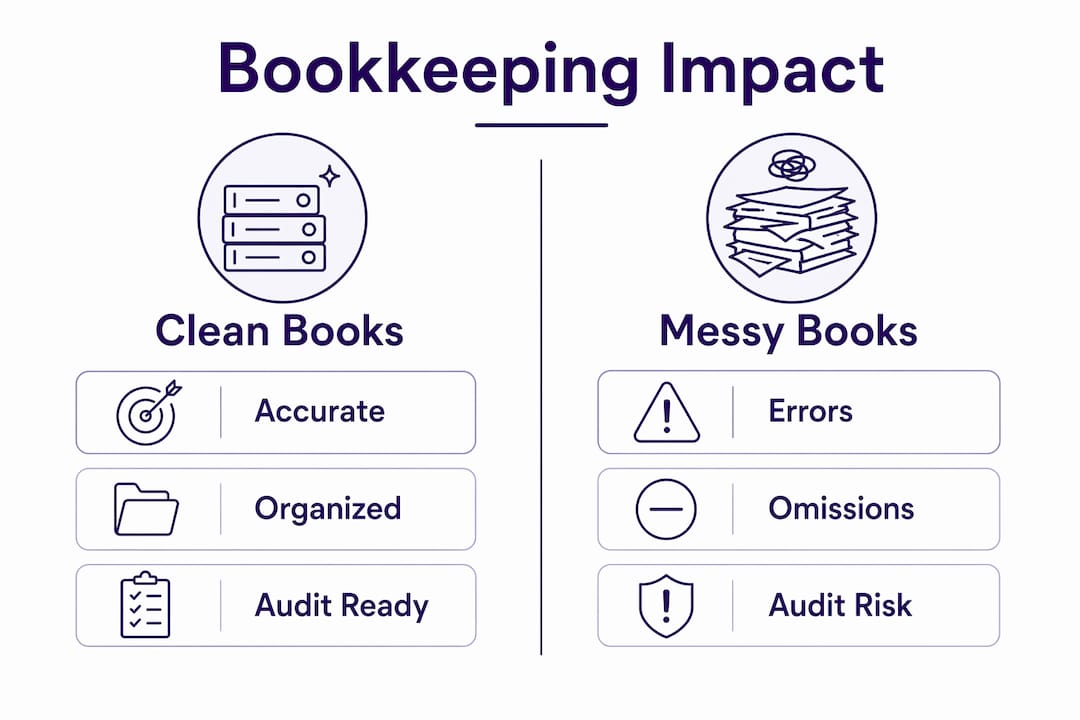
Messy books create the opposite situation. Errors and omissions in disorganized financials increase the likelihood of filing a return that contains inconsistencies. Inconsistencies attract scrutiny. And when an audit does happen, cleanup requires premium accountant rates for hunting missing transactions and reclassifying entries. You pay twice: once for the original disorganization and again for the emergency repair.
Two controls that most small business owners overlook are the “locked close” and “flux review.” Locked close periods prevent inadvertent changes to prior accounting periods, which preserves the integrity of historical data. Without a locked close, a well-meaning employee or an automated sync can alter a prior month’s figures without anyone noticing. A flux review compares account balances month over month and flags unusual movements. Together, these controls maintain the audit trail that protects you.
| Scenario | Clean Books | Messy Books |
|---|---|---|
| IRS document request | Fulfilled within days using organized records | Requires weeks of reconstruction at high accountant rates |
| Tax return accuracy | High, with reconciled figures and categorized expenses | Low, with risk of errors, omissions, and inconsistencies |
| Audit outcome | Routine review, minimal penalties | Extended examination, potential penalties and interest |
| Accountant fees | Predictable and lower | Unpredictable, inflated by cleanup hours |
| Business owner stress | Low, with confidence in the numbers | High, with uncertainty about what the records actually show |
Pro Tip: Ask your accountant or bookkeeper to lock each accounting period at month-end. This single step prevents the most common source of audit trail breaks in small business books.
Bookkeeping is the backbone of year-round tax strategy, shifting owners from reactive to proactive tax management. Most small business owners think about taxes in march or april. The owners who pay the least tax think about it in every month of the year.

Real-time financial data supports better timing of income and expenses, which is one of the most powerful and legal tools available to reduce your tax bill. When you know your profit in real time, you can make decisions before december 31 that change your tax outcome.
Proactive tax planning enabled by clean books includes:
Cash flow visibility is equally critical. Many small business owners are surprised by their tax bill in april because they had no running view of their liability. Clean books let you set aside the right amount each month, so the payment does not create a cash crisis. Year-round tax planning for small businesses is far more effective than a single year-end scramble.
The contrast between continuous bookkeeping and reactive yearly cleanup is stark. Owners who reconcile monthly and review financials quarterly arrive at tax season with a number they already know. Owners who clean up in march arrive with uncertainty, missed deductions, and a compressed timeline that forces errors.
Keeping your books clean is not a one-time project. It is a rhythm. The following practices, applied consistently, keep your records ready for tax filing at any point in the year.
Reconcile bank and credit card statements monthly. Match every transaction in your accounting software to your bank statement. Any discrepancy is a signal that something is missing or recorded incorrectly. Do not let reconciliations pile up. Three months of unreconciled accounts takes far longer to fix than one month at a time.
Record transactions promptly and with full detail. Enter every income and expense as it happens, not in batches at the end of the quarter. Include the vendor name, the business purpose, and the correct category. Vague entries like “miscellaneous” are red flags in an audit and useless for tax planning.
Use accounting software with bank feed integration. Connecting your bank accounts directly to your accounting software reduces manual entry errors. Automation handles the routine transactions, and you review and categorize the exceptions. This is the most reliable way to maintain accuracy without spending hours on data entry.
Lock each accounting period at month-end. Once you have reconciled a month and reviewed the figures, lock that period in your software. This prevents any future changes from altering historical data, which protects your audit trail and the integrity of your tax filings.
Conduct a quarterly review with your accountant or bookkeeper. A quarterly check-in catches categorization errors before they compound. It also gives you a current view of your tax liability, so you can adjust estimated payments or make strategic decisions before the quarter closes.
Organize and store receipts digitally. Attach digital copies of receipts directly to transactions in your accounting software. The IRS accepts digital records. Physical receipts fade, get lost, and create chaos during an audit. A receipt attached to a transaction is a deduction that cannot be disputed.
Separate business and personal finances completely. Maintain a dedicated business checking account and a dedicated business credit card. Commingled accounts are the single most common source of bookkeeping errors in small businesses. Separation makes categorization automatic and clean.
Pro Tip: Set a recurring calendar reminder on the first business day of each month to reconcile the prior month. Treat it like a bill payment. It takes 30 minutes when done monthly and 30 hours when deferred for a year.
Accurate financial records improve business decisions, reduce tax season stress, and support financing and compliance. The tax benefits are the most visible, but they are not the only reason to keep your books in order.
Lenders and investors require reliable financial statements before committing capital. A bank reviewing a loan application for a small business will request profit and loss statements, balance sheets, and cash flow reports. If your books are disorganized or inconsistent, the application stalls or fails. Clean records make due diligence fast and credible. They signal that you run a business with discipline, which is exactly what a lender wants to see.
Operational decisions also depend on accurate data. Knowing your gross margin by product line, your largest expense categories, and your month-over-month revenue trend lets you make pricing, hiring, and spending decisions with confidence. Owners who rely on rough estimates make expensive mistakes. Owners who read accurate monthly reports make better calls.
| Business Benefit | What Clean Books Make Possible |
|---|---|
| Tax accuracy | Correct deductions, correct liability, no overpayment |
| Audit readiness | Documentation available on demand, minimal disruption |
| Loan and investment access | Credible financial statements that satisfy due diligence |
| Operational decisions | Accurate margin and expense data for pricing and hiring |
| Reduced stress | Confidence in the numbers eliminates year-end panic |
The importance of organized accounts extends to compliance as well. Payroll tax filings, sales tax returns, and contractor 1099 forms all depend on accurate underlying records. Errors in any of these carry penalties. Clean books make every compliance deadline manageable instead of stressful.
Clean books directly lower your tax bill by capturing every deduction, preventing errors, and giving you the real-time data needed to make tax-smart decisions before the year ends.
| Point | Details |
|---|---|
| Deductions depend on accuracy | Every unrecorded expense is a lost deduction that inflates your taxable profit. |
| Clean records reduce audit risk | A reliable audit trail turns IRS scrutiny into a routine check with minimal disruption. |
| Year-round bookkeeping beats year-end cleanup | Real-time data lets you time income, expenses, and contributions for maximum tax benefit. |
| Locked close periods protect your records | Locking prior periods prevents accidental changes that break your audit trail. |
| Benefits extend beyond taxes | Clean books support loan applications, operational decisions, and long-term compliance. |
The most expensive mistake I see small business owners make is treating bookkeeping as a year-end task. By the time they hand a shoebox of receipts to their CPA in march, the decisions that could have lowered their tax bill are six months in the past. The deduction window has closed. The retirement contribution deadline has passed. The estimated tax underpayment penalty is already accruing.
The owners who consistently pay less tax are not doing anything exotic. They are not using aggressive strategies or gray-area deductions. They are simply keeping accurate records every month and reviewing them with a professional every quarter. That rhythm gives them the information they need to make legal, well-timed decisions. It is not complicated. It is just consistent.
The hidden cost of messy books is also larger than most owners realize. When your accountant has to reconstruct three months of transactions before they can even start your return, you are paying for that time at CPA rates. That is money that could have funded a better tax outcome instead of cleaning up a preventable mess.
The shift from reactive to proactive is not about working harder. It is about working on the right thing at the right time. Monthly reconciliation, quarterly reviews, and a locked close at month-end are not burdensome. They take less total time than a single year-end cleanup, and they produce far better results. If you are not sure where to start, connecting with a dedicated bookkeeping and tax partner is the fastest way to build the right habits from the ground up.
— Taxbowl
Small business owners who maintain clean records throughout the year consistently pay less tax, face fewer audits, and make better financial decisions. Taxbowl provides dedicated bookkeeping and accounting support designed specifically for small businesses, with real-time financial visibility and proactive communication built into every engagement.
Taxbowl’s team handles monthly reconciliation, period locking, and quarterly reviews so your books are always ready. When tax season arrives, your numbers are already accurate and your deductions are already captured. No scramble, no cleanup fees, no surprises. Explore Taxbowl’s bookkeeping services or talk to a Taxbowl expert to get started with books that work for your tax strategy year-round.
Clean books are financial records that are current, accurate, and fully categorized, with every transaction reconciled to your bank statements. They give you a reliable picture of your income, expenses, and tax liability at any point in the year.
Every unrecorded or miscategorized expense is a missed deduction that raises your taxable profit. Accurate bookkeeping captures every eligible expense, which directly reduces the income the IRS taxes.
Yes. Errors, omissions, and inconsistencies in your records increase the likelihood of filing a return that triggers IRS scrutiny. Clean records with a clear audit trail make any review faster and less disruptive.
Monthly reconciliation is the standard best practice. Reconciling each month keeps discrepancies small, prevents errors from compounding, and ensures your tax liability estimate stays accurate throughout the year.
Accurate financial statements are a core requirement for most small business loan applications. Lenders review profit and loss statements and balance sheets to assess risk, and disorganized records slow or block approval.