Back to blog
Why Tax Penalties Happen to Small Businesses
Discover why tax penalties happen to small businesses and learn how to prevent them. Protect your finances and stay compliant today!

Discover why tax penalties happen to small businesses and learn how to prevent them. Protect your finances and stay compliant today!
Tax penalties for small businesses are defined as financial charges the IRS imposes when a business fails to file accurate returns, pay owed taxes on time, or submit required information returns by their deadlines. The three core penalty categories are failure to file, failure to pay, and information return penalties. Each one triggers automatically when a specific obligation is missed. Understanding why tax penalties happen to small businesses is the first step toward avoiding them. Left unaddressed, these penalties compound daily through interest charges that continue until the full balance is paid.
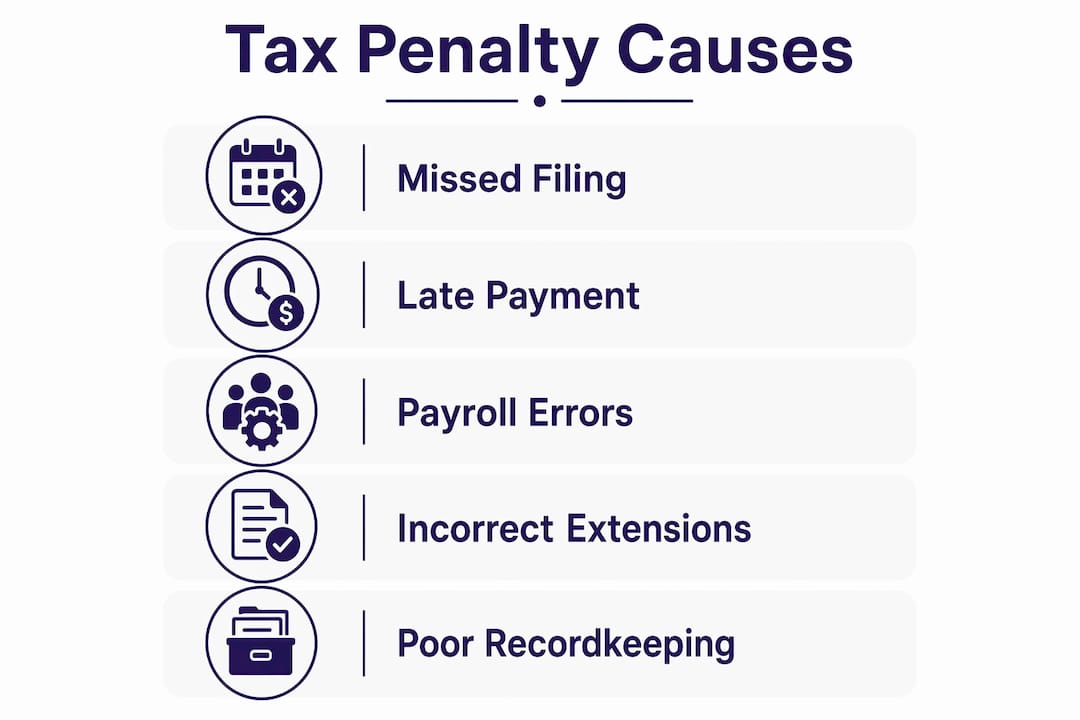
Penalties are not random. They are tied to specific failures, and most small businesses run into the same handful of triggers year after year.
The most frequent causes are:
Pro Tip: Set a calendar reminder 10 days before each quarterly estimated tax due date. Missing just one quarter can trigger a penalty that grows every day until you pay.
The failure-to-file penalty is the most costly of the group. That single fact should push filing to the top of your priority list, even if you cannot pay the full balance right away. Filing on time and paying what you can reduces total exposure significantly.
The IRS uses fixed percentage rates to calculate penalties, and those rates apply every month until the balance is resolved.
| Penalty Type | Rate | Maximum Cap |
|---|---|---|
| Failure to file | 5% per month of unpaid taxes | 25% of unpaid taxes |
| Failure to pay | 0.5% per month of unpaid taxes | 25% of unpaid taxes |
| Interest on unpaid balance | Federal short-term rate + 3% | No cap, compounded daily |
The failure-to-file penalty runs at 5% per month, capped at 25% of unpaid taxes. The failure-to-pay penalty runs at 0.5% per month, also capped at 25%. That means a business that both files late and pays late can face a combined penalty load of up to 50% of the original tax owed before interest is even counted.
Interest is calculated at the federal short-term rate plus 3%, compounded daily. That compounding is what makes delay so costly. A $5,000 tax balance left unpaid for 12 months does not simply grow by a flat percentage. It grows on itself every single day.
Interest may also accrue on the penalties themselves, not just the original tax balance. This means the longer you wait, the more you owe on top of what you already owe. Paying even a partial amount sooner reduces the base on which interest compounds, which directly lowers your total cost.
IRS penalty notices identify the specific penalty type, the reason it was assessed, and the next steps required. Notices distinguish between failure-to-file, failure-to-pay, and information-return issues. Treating each notice as a diagnostic document, rather than an alarming letter to set aside, is the right approach.
Most small business tax penalties trace back to a short list of operational errors. Knowing them by name makes them easier to prevent.

Mixing personal and business expenses is one of the most common errors. When personal charges run through a business account, bookkeeping becomes inaccurate. Inaccurate books lead to inaccurate returns. Mixing personal and business expenses triggers IRS red flags and increases audit risk on top of penalty exposure. Keeping a dedicated business checking account and business credit card eliminates this problem at the source.
Misreading a filing extension as a payment extension is the single most expensive misunderstanding in small business tax compliance. The IRS grants extensions to file, not extensions to pay. If you owe $8,000 and file in october instead of april under an extension, the failure-to-pay penalty has been running since april. That is six months of accruing charges on a balance you thought was protected.
Payroll tax mistakes carry their own penalty structure. Employers must deposit payroll taxes, including federal income tax withheld and FICA taxes, on a specific schedule. Missing a deposit deadline or depositing the wrong amount triggers a separate set of penalties. Payroll tax errors are particularly serious because the IRS treats withheld employee taxes as trust fund money. Mishandling them can result in personal liability for business owners.
Skipping quarterly estimated tax payments is another frequent trigger. Sole proprietors, S corp shareholders, and partners in partnerships generally must pay estimated taxes four times a year. Skipping a quarter does not mean the tax disappears. It means the underpayment penalty starts running immediately.
Pro Tip: Work with your accountant to build a year-round tax planning calendar that maps every filing and payment deadline for the year. One document, reviewed monthly, prevents most penalty triggers.
Accurate record-keeping is the foundation of all of this. When your books are clean and current, your accountant can file accurate returns on time and flag any cash flow issues before a payment deadline arrives. Manual bookkeeping practices increase the risk of errors that lead directly to penalties. Switching to a reliable bookkeeping system, whether in-house or outsourced, is a direct investment in penalty prevention.
The IRS does offer penalty relief, but it is not automatic. You have to request it, document your case, and meet specific criteria.
Reasonable cause relief. The IRS may remove a penalty if you can show that you acted in good faith and that the failure was due to circumstances beyond your control. Examples include a serious illness, a natural disaster, or the death of an immediate family member. Vague explanations do not qualify. Reasonable cause relief is evidence-based, and the IRS reviews the specific facts of your situation.
First-time penalty abatement. The IRS offers administrative relief to taxpayers with a clean compliance history. If you have no penalties in the prior three years and are otherwise current on filings and payments, you may qualify to have a penalty removed without proving reasonable cause. This is one of the most underused relief options available to small businesses.
Statutory exceptions. Certain situations, like a written advice error from the IRS itself, qualify for penalty removal under specific statutory provisions. These cases are less common but worth reviewing with a tax professional.
Submitting a penalty abatement request. You can request relief by responding directly to the IRS notice, calling the number on the notice, or submitting Form 843 (Claim for Refund and Request for Abatement). Include all supporting documentation with your first submission. Incomplete requests slow the process and leave penalties accruing in the meantime.
Paying the balance while requesting relief. Interest accrues until full payment is made, even if a penalty abatement request is pending. Tax professionals typically advise paying the balance or setting up an installment agreement while the relief request is reviewed. This stops the daily compounding and reduces total cost regardless of the outcome.
One critical limitation: interest cannot be reduced unless the underlying penalty is also removed. If your abatement request is denied, the interest stays. This is why the sequence matters. Seek professional help early, document everything, and pay what you can while the process moves forward.
Tax penalties for small businesses are predictable, preventable, and resolvable when you understand the specific triggers, the IRS calculation method, and the relief options available to you.
| Point | Details |
|---|---|
| Penalties follow specific failures | The IRS charges penalties for late filing, late payment, underpaid estimates, and inaccurate returns. |
| Filing late costs more than paying late | The failure-to-file penalty runs at 5% per month versus 0.5% for failure to pay. Always file on time. |
| Interest compounds daily | Interest accrues on both the tax balance and the penalties themselves, making early payment critical. |
| Extensions do not extend payment | An IRS filing extension does not delay the payment due date. Penalties and interest start on the original deadline. |
| Relief is available but requires documentation | Reasonable cause and first-time abatement are real options, but you must request them with supporting evidence. |
The business owners who end up with the largest penalty bills are rarely the ones who made the biggest mistakes. They are the ones who waited the longest to deal with them.
A $3,000 tax balance left unresolved for two years does not stay at $3,000. With failure-to-pay penalties capped at 25% and daily compounding interest on top of that, the total can grow by 30% to 40% or more before the IRS sends a final notice. By that point, the original tax is almost a secondary concern.
What I see consistently is that small business owners treat IRS notices like parking tickets. They set them aside, intend to deal with them later, and then find themselves in a much more expensive situation three months down the road. The notice itself is not the problem. Ignoring it is.
The other pattern worth naming is the cash flow trap. A business has a strong quarter, spends the revenue on operations, and then faces a tax bill it cannot cover. That is not a tax problem. That is a bookkeeping problem. When your books reflect real-time cash flow and your accountant is communicating proactively with you throughout the year, you see the tax liability coming. You plan for it. You set the cash aside.
Penalty prevention is not complicated. It requires accurate books, a clear deadline calendar, and someone in your corner who flags problems before they become penalties. The businesses that avoid IRS trouble are not the ones with the most sophisticated tax strategies. They are the ones with the most consistent habits.
— Taxbowl
Tax penalties are expensive, but they are also largely avoidable with the right support in place.
Taxbowl works with small business owners to keep books accurate, filings timely, and tax obligations visible year-round. From bookkeeping services that catch errors before they reach your return, to proactive tax planning that maps every quarterly deadline, Taxbowl gives you a dedicated team that stays ahead of IRS requirements on your behalf. You get real-time financial visibility and direct access to your accountants, so nothing slips through. If you are ready to stop reacting to IRS notices and start preventing them, talk to a Taxbowl expert and get a clear picture of where your business stands today.
The IRS charges penalties when a business misses filing or payment obligations, including late returns, late payments, underpaid estimated taxes, and inaccurate information returns. Each failure type generates a separate penalty.
A filing extension gives you more time to submit your return, but it does not extend your payment deadline. Taxes owed are still due on the original date, and failure-to-pay penalties begin accruing immediately after that date passes.
The failure-to-file penalty is 5% per month of unpaid taxes, capped at 25%. It is ten times more expensive per month than the failure-to-pay penalty, which runs at 0.5% per month.
Yes. The IRS offers penalty abatement through reasonable cause relief and first-time abatement for eligible taxpayers. Documentation of good faith and circumstances beyond your control is required for reasonable cause requests.
Interest stops accruing only when the full tax balance, including penalties, is paid. Paying sooner always reduces total cost because interest compounds daily on the unpaid amount.