Back to blog
Payroll Tax Obligation: A Clear Guide for Small Businesses
Discover what is payroll tax obligation for small businesses. Learn what taxes to withhold, pay, and avoid costly mistakes. Read now!

Discover what is payroll tax obligation for small businesses. Learn what taxes to withhold, pay, and avoid costly mistakes. Read now!
TL;DR:
- Employers must withhold, deposit, and report payroll taxes such as FICA, federal income tax, and unemployment taxes. Compliance involves timely deposits, proper worker classification, and accurate recordkeeping to avoid penalties and personal liability. Taxbowl offers support to small businesses in managing payroll tax obligations effectively.
A payroll tax obligation is the legal requirement for employers to withhold, deposit, and report specific taxes on employee wages, covering Social Security, Medicare, federal income tax, and unemployment taxes. Every business with at least one employee carries this responsibility from the first paycheck. The IRS enforces these rules under the Federal Insurance Contributions Act (FICA) and the Federal Unemployment Tax Act (FUTA), and the penalties for getting it wrong are severe. Understanding what is payroll tax obligation means knowing exactly which taxes you owe, when to pay them, and how to keep your records clean.
A payroll tax obligation covers four distinct tax types, each with its own rate, wage base, and payer responsibility. Confusing them is one of the most common and costly mistakes small business owners make. Getting the breakdown right from the start protects your cash flow and keeps the IRS off your back.

Federal income tax withholding is not technically a payroll tax, but it is part of your payroll tax responsibilities. You withhold this amount from each employee’s paycheck based on the information they provide on Form W-4. The amount varies by employee, so no single rate applies across your entire team.
FICA totals 15.3% of wages, split evenly between employer and employee. That means you pay 6.2% for Social Security and 1.45% for Medicare, and your employee pays the same rates. Social Security applies only up to a wage base limit set annually by the IRS. Medicare has no wage cap, so it applies to every dollar an employee earns.
There is one more layer. The Additional Medicare Tax of 0.9% applies to employee wages above $200,000. You withhold this from the employee only. You do not match it as the employer. Missing this threshold is a common compliance trap that triggers penalties.
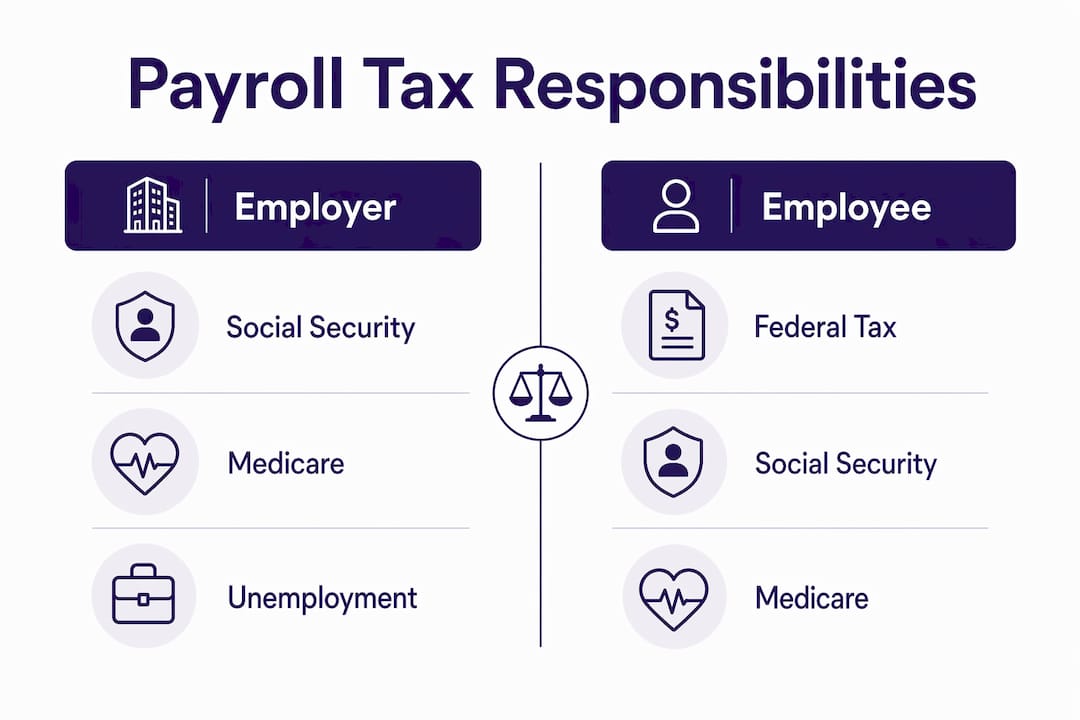
FUTA is strictly employer-paid, meaning you never withhold it from employee wages. State Unemployment Tax (SUTA) also falls on the employer in most states, though a small number of states require employee contributions. FUTA and SUTA work together, and paying SUTA on time can reduce your FUTA liability.
Here is a quick reference for the core payroll tax components:
| Tax type | Rate (employer) | Rate (employee) | Wage cap |
|---|---|---|---|
| Social Security (FICA) | 6.2% | 6.2% | Annual IRS wage base |
| Medicare (FICA) | 1.45% | 1.45% | None |
| Additional Medicare Tax | None | 0.9% | Wages above $200,000 |
| FUTA | 6% (before credits) | None | First $7,000 per employee |
| SUTA | Varies by state | Varies by state | Varies by state |
Pro Tip: Set a calendar alert for each january to check the IRS’s updated Social Security wage base. It changes most years, and missing the new limit means either over-withholding or under-withholding from day one.
Payroll taxes fund Social Security and Medicare, while income taxes fund general government operations. Employers manage withholding and payment for both, but the accounting treatment is completely different. Keeping these two categories separate in your books is not optional. It is the foundation of accurate payroll management.
Your responsibilities as an employer fall into two buckets:
The financial distinction matters for your taxes too. The employer’s share of payroll taxes is deductible as a business expense. The amounts you withhold from employees are not deductible for your business. They belong to the government the moment you take them out of the employee’s check.
That last point is critical. Withheld payroll taxes are “trust fund taxes,” meaning those funds legally belong to the government, not to your business. Using withheld tax money to cover operating expenses, even temporarily, exposes you to personal liability. The IRS can pursue business owners individually for unpaid trust fund taxes, even after a business closes.
Worker classification also affects your payroll tax responsibilities directly. Misclassifying employees as independent contractors to avoid payroll taxes leads to penalties, back taxes, and interest. The IRS uses a behavioral, financial, and relationship test to determine true worker status. If you control how, when, and where someone works, they are likely an employee regardless of what your contract says.
Pro Tip: Review your contractor relationships annually. If any contractor works exclusively for you, follows your schedule, and uses your equipment, reclassify them before the IRS does it for you. The cost of voluntary correction is far lower than the cost of an audit.
Payroll tax deposit schedules depend on your business size and how frequently you run payroll. The IRS assigns you either a monthly or semiweekly deposit schedule based on your total tax liability from a lookback period. New employers generally start on the monthly schedule.
Here is how the deposit and reporting cycle works:
Failure to deposit on time triggers automated penalties that escalate the longer you wait. IRS Publication 15 details the specific penalty rates, which start at 2% for deposits one to five days late and climb to 15% for amounts still unpaid more than ten days after an IRS notice. Late filing and inaccurate reporting also increase your audit risk.
Pro Tip: Sign up for EFTPS before you hire your first employee. The enrollment process takes a few days, and you do not want to be scrambling to register when your first deposit deadline arrives.
You can stay ahead of quarterly tax obligations by building deposit dates into your payroll calendar at the start of each year. Missing a date because you forgot it is the most avoidable penalty in the tax code.
Most payroll tax problems come from a short list of predictable errors. Knowing them in advance puts you in a strong position to avoid them entirely.
Good recordkeeping is your first line of defense. Keep payroll records, including W-4s, pay stubs, deposit confirmations, and filed returns, for at least four years. The IRS can audit employment tax returns within that window.
Automated payroll systems reduce error rates significantly compared to manual calculations. They update tax tables automatically, flag wage threshold crossings, and generate Form 941 data directly from your payroll runs. If you are running payroll manually for more than three or four employees, the risk of error outweighs the cost of a better system.
Accountable plans for employee expense reimbursements are an underused tool. When you reimburse employees for legitimate business expenses through a formal accountable plan, those reimbursements are not subject to payroll taxes. This reduces your taxable wage base and lowers both your FICA costs and the employee’s withholding. The plan must require employees to document expenses and return any excess reimbursement.
Pro Tip: Work with your accountant to set up a written accountable plan policy before you start reimbursing employees for travel, meals, or home office costs. A verbal policy does not satisfy IRS requirements.
For year-round planning that goes beyond payroll, a solid tax planning calendar helps you coordinate deposit deadlines with estimated tax payments and quarterly filings without letting anything slip.
Payroll tax obligations require employers to withhold, deposit, and report FICA taxes, federal income tax, and unemployment taxes accurately and on time to avoid IRS penalties and personal liability.
| Point | Details |
|---|---|
| FICA splits 15.3% evenly | Employer and employee each pay 6.2% Social Security and 1.45% Medicare per paycheck. |
| Trust fund taxes carry personal risk | Withheld employee taxes belong to the government; misusing them exposes owners to personal liability. |
| Deposit schedules are IRS-assigned | Monthly or semiweekly schedules depend on your lookback period tax liability. |
| Worker misclassification is high-risk | Treating employees as contractors to skip payroll taxes triggers back taxes, penalties, and interest. |
| Accountable plans reduce taxable wages | Formal expense reimbursement plans keep qualifying payments outside the payroll tax base. |
Most small business owners treat payroll taxes as a compliance checkbox. That mindset is exactly what gets them into trouble.
After working with dozens of small businesses at Taxbowl, the pattern is consistent. Owners who struggle with payroll tax compliance are not careless. They are busy. They miss a deposit because they were closing a deal. They skip the Additional Medicare Tax because no one told them the threshold existed. They classify a worker as a contractor because it felt simpler at the time.
The real problem is that payroll taxes are not a once-a-year task. They are a recurring obligation that runs parallel to every payroll cycle. Mismanaging employer payroll tax shares is one of the top causes of cash flow problems for small businesses. The employer’s FICA share adds roughly 7.65% to every dollar of wages you pay. If you are not budgeting for that cost from day one, it will blindside you.
My honest advice: treat your employer payroll tax share as a fixed labor cost, not an afterthought. Budget it into every hire. Set up EFTPS before you need it. And if you are not certain your payroll process is airtight, get a second set of eyes on it before the IRS does. The cost of a proactive review is a fraction of what a penalty notice costs, financially and emotionally.
— Taxbowl
Payroll tax compliance is manageable when you have the right support behind you. Taxbowl works with small business owners to handle the details that create risk when left unattended.
Taxbowl’s team of dedicated accountants manages payroll tax calculations, deposit scheduling, and quarterly filings so nothing falls through the cracks. You get real-time visibility into your payroll tax liabilities and proactive alerts before deadlines arrive. Whether you need bookkeeping and payroll support or a full accounting partner who communicates through Slack and responds the same day, Taxbowl is built for businesses like yours. Talk to a Taxbowl expert to get a clear picture of your current payroll tax setup and where the gaps are.
A payroll tax obligation is the legal duty of every employer to withhold taxes from employee wages, pay matching employer taxes, and deposit and report those amounts to the IRS on a set schedule.
Both parties pay. Employees pay their share through withholding, while employers pay a matching share of FICA and cover unemployment taxes like FUTA entirely on their own.
The IRS applies automated penalties starting at 2% for deposits one to five days late, escalating to 15% for amounts unpaid after a formal IRS notice, per IRS Publication 15.
Payroll taxes fund Social Security and Medicare, while income taxes fund general government operations. Both appear on a paycheck, but they are calculated, reported, and deposited separately.
Yes. Withheld payroll taxes are trust fund taxes that legally belong to the government. The IRS can assess the Trust Fund Recovery Penalty against individual owners or officers who willfully fail to deposit them.