Back to blog
Why Bookkeeping Errors Happen: A Small Business Guide
Discover why bookkeeping errors happen and learn how to prevent costly mistakes in your small business. Get insights now!


Discover why bookkeeping errors happen and learn how to prevent costly mistakes in your small business. Get insights now!
TL;DR:
- Bookkeeping errors often result from manual data entry, misclassification, and missed reconciliations. These mistakes cost small businesses thousands annually and can be prevented through regular reconciliation, proper controls, and professional oversight. Addressing errors early and establishing consistent habits saves time, money, and improves financial confidence.
Bookkeeping errors are unintentional mistakes in recording financial transactions, and they happen for a predictable set of reasons: manual data entry, misclassified transactions, missed reconciliations, and entries that get duplicated or skipped entirely. Many small businesses have experienced bookkeeping errors that triggered fines, which can lead to significant costs per year. That’s not bad luck. That’s a systems problem.
The core causes break down like this:
Pro Tip: Catching an error the week it happens takes minutes. Catching it at tax time can cost thousands in cleanup fees and penalties.
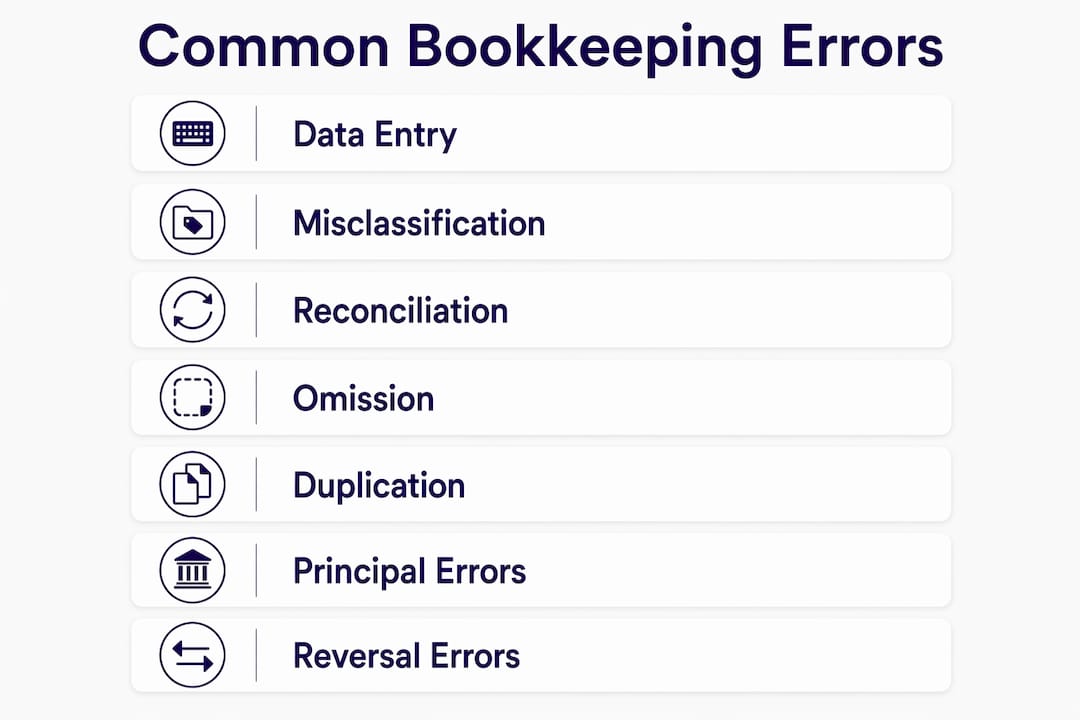
Not all bookkeeping mistakes look the same. Some are obvious the moment you run a report. Others hide for months. Here are the error types small business owners encounter most often, along with what they actually look like in practice.
1. Data entry errors
A misplaced decimal, a transposed digit, or a vendor name typed twice can throw off an entire account balance. These are the most frequent errors, and they’re almost always the result of manual input. Manual data entry errors in bookkeeping occur at a notably high rate, making them a common and serious concern.
2. Misclassification of transactions
This one quietly does the most damage. A Stripe deposit lands in your bank account net of processing fees. If your books record the full deposit as revenue without separating out the fees, your revenue is overstated, your expenses are understated, and your gross margin is wrong on both sides. Misclassified payment processor deposits distort every pricing and budgeting decision you make on top of them. The same pattern applies to PayPal, Square, Shopify Payments, and Amazon settlements.

3. Reconciliation errors
Bank reconciliation errors affect a substantial portion of small firms. When your QuickBooks balance doesn’t match your actual bank statement, something is wrong. It could be a duplicate entry, a missed transaction, or a timing difference that never got cleared. Left alone, reconciliation gaps compound.
4. Omission errors
An expense receipt gets lost. A vendor invoice never makes it into the books. A cash purchase goes unrecorded. A notable share of bookkeeping errors originate from unrecorded transactions, which create a false picture of profitability.
5. Duplication errors
Paying a vendor twice because the invoice got entered twice is more common than most owners realize. Duplicate payments from errors represent a measurable fraction of spend across small businesses. That’s real money leaving your account for no reason.
6. Misclassification of expenses (principle errors)
Loan principal payments hitting the P&L instead of the balance sheet make net income look smaller than it is. Owner draws coded to “Miscellaneous Expense” muddy your financials for any lender or investor who looks at them. Misclassification of expenses in books is a common issue among small businesses.
7. Entry reversal errors
Recording a debit as a credit, or vice versa, flips the effect of a transaction entirely. These errors are easy to miss in a quick review and can take time to trace back to the source.
The error types above describe what goes wrong. The more useful question is why they keep happening, even when owners know better.
The single biggest driver is reactive bookkeeping. Many small business owners treat bookkeeping as something to deal with when a deadline forces them to, not as a weekly discipline. Records pile up. Receipts go missing. By the time someone sits down to reconcile, they’re working from memory and incomplete data. That’s when errors multiply.
Poor data quality blocks nearly half of financial leaders from making informed decisions and erodes trust in financial forecasts. For a small business owner, that translates directly: if your books are a month behind, you’re making pricing, hiring, and spending decisions on stale numbers.
Manual processes make everything worse. 71% of small business owners still use pen, paper, or spreadsheets alongside their accounting software. That hybrid approach is where errors breed. A transaction gets entered in a spreadsheet and then re-entered in the software, and the two versions don’t match.

Organizational weaknesses compound the problem. A significant portion of small and medium-sized businesses lack proper segregation of duties in their books. When one person handles all of accounts payable, reconciliation, and reporting with no second set of eyes, mistakes go undetected. The same person who made the error is the one reviewing the work.
Pro Tip: A bookkeeping routine that takes 30 minutes every Friday beats a four-hour catch-up session every month. Frequency is the fix.
Early detection is the difference between a five-minute correction and a $2,000–$5,000 cleanup engagement. Here’s how to find errors before they compound.
Detection techniques:
Fixing errors once you find them:
The standard correction method is an adjusting journal entry. You reverse the incorrect entry and post the correct one, with a note explaining the change. For misclassified transactions, that means debiting the correct account and crediting the wrong one. For duplicates, you void or delete the extra entry and confirm the remaining one is accurate.
Regular reconciliation catches discrepancies that, if ignored, worsen financial errors and increase fraud risk. Don’t wait for your accountant to find the problem at year-end.
Pro Tip: Set a calendar reminder for the first business day of each month. Reconcile before you do anything else. It takes less time when the month is fresh.
Prevention is cheaper than correction. A year of miscoded transactions costs $2,000–$5,000 to clean up at most firms. Doing it right from the start costs nothing extra.
Prevention checklist:
The table below summarizes the most common errors alongside their prevention approach.
| Error type | Primary cause | Prevention method |
|---|---|---|
| Data entry errors | Manual input, no review | Bank feed automation, monthly reconciliation |
| Misclassification | Wrong chart of accounts | Custom COA setup, transaction review |
| Reconciliation gaps | Infrequent review | Monthly bank reconciliation schedule |
| Omission errors | Lost receipts, no routine | Digital receipt capture, weekly entry habit |
| Duplication errors | Double entry, no audit | Duplicate payment scan, software alerts |
| Principle errors | Misunderstood accounting rules | CPA review, professional training |
98% of small business owners say their accountant boosts their confidence in their business. That’s not a coincidence. Professional oversight catches the errors that owners miss because they’re too close to the day-to-day.
Manual bookkeeping isn’t just slow. It’s structurally error-prone in ways that software alone doesn’t fix.
The core problem is that humans make mistakes on repetitive tasks. Entering 500 transactions a month by hand means 500 opportunities for a typo, a wrong category, or a skipped entry. Manual data entry errors significantly increase costs and client churn in accounting firms because of the time required to find and fix mistakes. For a small business owner doing their own books, that rework eats evenings and weekends.
Spreadsheets carry their own risks. A formula error in one cell can cascade through an entire model without any visible warning. There’s no audit trail, no automatic bank feed, and no alert when a number looks out of range. You can learn more about why manual bookkeeping fails small business owners specifically, but the short version is this: the margin for error is too high and the feedback loop is too slow.
Even with accounting software, the manual portion of the work creates risk. Auto-categorization in tools like QuickBooks Online gets transactions wrong often enough that someone still needs to review every entry. That review step is where errors slip through when owners are rushed or behind.
Accounting software reduces errors when it’s set up correctly. When it isn’t, it can systematize mistakes at scale.
The most common software misuse pattern is accepting the default chart of accounts. Default COAs are built for a generic “small business,” which means they fit almost no specific business well. When transactions get coded to the closest-looking account rather than the right one, office supplies and software subscriptions get blended, owner draws end up in “Miscellaneous Expense,” and loan principal payments hit the P&L instead of the balance sheet.
A second common issue is treating auto-categorization as final. Bank feed rules are static. Your business isn’t. Every new vendor, new payment processor, or changed expense category requires a rule update. Firms that rely entirely on bank rules often end up with hundreds of rules per client and still spend significant time fixing edge cases.
Failing to back up data is another underappreciated risk. If your accounting file is only on one device and that device fails, you lose your records. Cloud-based accounting software with automatic backups removes this risk entirely.
Accuracy and timeliness are non-negotiable for financial integrity. When software is misconfigured or used passively, it produces reports that look clean but contain systematic errors that only surface at audit or tax time. For CPAs and accounting firms managing client files, digital authorization tools that reduce manual document handling can also reduce the downstream errors that come from paper-based workflows.
In a small business with more than one person touching the books, communication gaps are a direct cause of errors.
The most common scenario: one employee records a vendor payment, and another employee records the same payment from a different source, such as a bank notification or an email confirmation. Neither knows the other already entered it. The result is a duplicate entry that may not surface until reconciliation.
Unclear ownership is the root issue. When no one person is explicitly responsible for a specific category of transactions, entries get missed or doubled. A written bookkeeping policy that assigns clear ownership by transaction type removes most of this ambiguity.
Payroll errors follow the same pattern. 23% of businesses experience payroll errors from bookkeeping mistakes monthly. When HR and finance don’t communicate changes in employee status, hours, or compensation in real time, the books reflect outdated information. The fix is a shared, real-time system where changes in one area automatically update the other.
Documentation isn’t just about staying organized. It’s the foundation that makes every other part of bookkeeping accurate.
Without source documents, you can’t verify a transaction. A bank statement shows that $847 left your account on a Tuesday. Without a receipt or invoice, you don’t know what it was for, whether it was a business expense, or which category it belongs in. Small business accounting mistakes often arise from a lack of internal controls and poor documentation practices. That’s not an abstract risk. It’s what happens when receipts get thrown away, invoices get buried in email, and verbal agreements never make it into writing.
The IRS requires contemporaneous records for many deductions. A consultant driving 8,000 business miles a year without a mileage log loses that deduction entirely at audit. A home office deduction without utility bills and square footage calculations doesn’t hold up. Poor documentation doesn’t just create bookkeeping errors. It forfeits real money.
The practical fix is a digital receipt capture habit. Photograph every receipt immediately and link it to the corresponding transaction in your accounting software. For invoices, a consistent naming convention and a single storage location, whether that’s a cloud folder or your accounting platform, removes the search time and the risk of loss. Firms that handle sensitive financial documents electronically also benefit from tools that maintain a clear audit trail, which is part of why e-signature and AML compliance workflows have become standard practice in professional accounting.
Bookkeeping errors happen primarily because of manual processes, reactive habits, and missing controls, and fixing them proactively costs far less than cleaning them up after the fact.
| Point | Details |
|---|---|
| Errors are predictable and preventable | The most common causes are manual entry, misclassification, and missed reconciliation. |
| Reactive bookkeeping multiplies errors | Addressing books only at deadlines leads to disorganized records and compounding mistakes. |
| — | Bookkeeping errors trigger real financial penalties, costing small business owners substantial sums every year. |
| Monthly reconciliation is the top defense | Comparing books to bank statements every month catches most errors before they compound. |
| Professional oversight reduces risk | 98% of small business owners report greater confidence when working with an accountant. |
Most small business owners don’t set out to have messy books. The errors accumulate quietly, one skipped reconciliation and one misclassified transaction at a time, until the problem is big enough to hurt.
What’s underappreciated is how much the timing of discovery matters. An error caught in the same week it happens takes minutes to fix. The same error found at year-end, after twelve months of decisions built on top of it, can require a full cleanup engagement and a revised tax return. The financial cost is real. So is the time cost, and the confidence cost of not knowing whether your numbers are right.
The owners who avoid this pattern share one habit: they treat bookkeeping as a weekly discipline, not a quarterly scramble. They use software that automates what can be automated. And when the complexity of their business outgrows their own capacity to manage it accurately, they bring in professional help before the errors accumulate, not after.
That’s not a complicated formula. It’s just a decision to be proactive rather than reactive, and it pays off every single month.
Taxbowl gives small business owners a dedicated team of accountants, real-time financial visibility, and proactive communication so errors get caught before they compound. Whether you need clean books, accurate payroll, or a clearer picture of your cash flow, Taxbowl is built for exactly this.
Talk to a Taxbowl expert and find out what clean, accurate bookkeeping for your business actually looks like.
The most common bookkeeping errors are data entry mistakes, misclassified transactions, reconciliation gaps, omission of transactions, and duplicate entries. Each one distorts your financial records and can trigger tax penalties or bad business decisions.
The four main types are errors of omission (a transaction never recorded), errors of commission (recorded in the wrong account), errors of principle (a transaction recorded against accounting rules, such as expensing a capital purchase), and duplication errors (the same transaction entered twice).
Fix accounting errors by making an adjusting journal entry that reverses the incorrect posting and records the correct one. For duplicate entries, void the extra transaction. Always document the reason for the correction so your records have a clear audit trail.
Accounting mistakes happen because of manual data entry, reactive bookkeeping habits, poor internal controls, software misconfiguration, and insufficient training. Poor data quality blocks nearly half of financial leaders from making informed decisions, which shows how far the impact reaches beyond the books themselves.