Back to blog
Bookkeeping Mistakes to Avoid for Small Business Owners
Avoid costly bookkeeping mistakes to avoid for small business owners. Learn to identify, prevent, and correct common errors to save money.


Avoid costly bookkeeping mistakes to avoid for small business owners. Learn to identify, prevent, and correct common errors to save money.
TL;DR:
- Most small business bookkeeping errors arise from common mistakes like mixing personal and business finances or skipping monthly bank reconciliation. Implementing dedicated accounts, routine reconciliations, correct categorization, and professional help prevent costly errors and improve cash flow management. Using automated accounting systems and maintaining accurate records protect businesses from penalties and support growth.
Bookkeeping mistakes to avoid are errors in financial recordkeeping that cost small businesses thousands of dollars annually and put their survival at risk. 44% of small businesses experience bookkeeping errors that lead to fines, averaging $12,000 in losses each year. That figure alone should stop any owner from treating bookkeeping as a low-priority task. The good news is that most errors are predictable and preventable. This guide walks you through the most common accounting mistakes, the systems that stop them, and the steps to fix errors before they become crises.
The most damaging bookkeeping mistakes small businesses make are not exotic or complicated. They are routine errors that compound quietly over months until they surface as a cash flow crisis or an IRS notice.

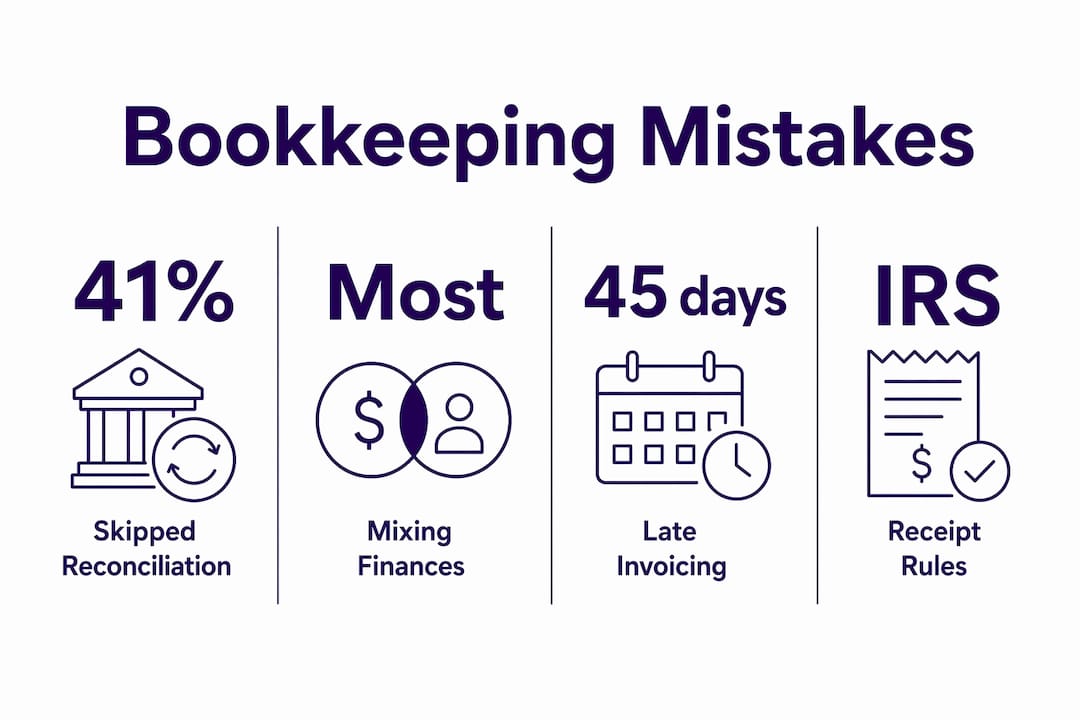
Mixing personal and business accounts is the single most common error small business owners make. When you pay a personal bill from your business checking account, or charge a business expense to your personal credit card, you create a recordkeeping mess that takes hours to untangle at tax time. Dedicated business bank accounts and credit cards are the baseline requirement for clean books. Without them, every transaction becomes a judgment call, and judgment calls introduce errors.
Not reconciling bank accounts monthly causes 41% of small business bookkeeping errors and produces cash flow misinformation. Reconciliation is the process of matching your internal records to your bank statement line by line. When you skip it, duplicate charges, bank fees, and fraudulent transactions hide in your books for months. A business owner who skips reconciliation for a quarter can easily believe they have $8,000 more in the bank than they actually do.
Misclassification means recording a meal with a client as an office supply, or logging a loan repayment as a business expense. Both errors distort your profit and loss statement and can trigger an audit. The IRS uses expense ratios as a benchmark. If your “meals and entertainment” line is three times the industry average, that is a red flag. Correct classification requires a well-structured chart of accounts from day one.
Failing to track who owes you money and who you owe is a fast path to a cash crunch. Late invoicing delays average 45 days, meaning businesses that do not follow up on overdue invoices wait over six weeks longer than necessary to collect. That gap can make payroll impossible. Accounts payable neglect creates a different problem: missed vendor payments damage supplier relationships and can trigger late fees.
The IRS requires businesses to retain receipts for expenses over $75, and in practice, you should keep all of them. Discarding receipts means you cannot substantiate deductions during an audit. Digital receipt storage apps solve this problem at almost zero cost. Photograph every receipt the moment you receive it and attach it to the corresponding transaction in your accounting software.
A transfer between your business checking and savings accounts is not income. An owner draw is not a payroll expense. These are two of the most frequent accounting mistakes that inflate or deflate reported income. Recording a $5,000 transfer as revenue makes your business look more profitable than it is, which leads to bad decisions and a tax bill you did not plan for.
Sales tax rules vary by state, county, and product type. Most owners do not commit tax fraud intentionally. They simply misunderstand deadlines, nexus rules, or assume their accountant handles everything automatically. Missing a sales tax filing deadline triggers penalties that compound monthly. Register for the correct permits in every state where you have economic nexus, and automate the filing wherever possible.
Pro Tip: Set a recurring calendar reminder on the first business day of each month to review your accounts receivable aging report. Catching a 30-day overdue invoice before it becomes 60 days overdue dramatically improves your collection rate.
The right systems eliminate entire categories of error before they happen. Manual bookkeeping produces high error rates, while computerized systems improve accuracy and provide better financial insights. The shift from spreadsheets to accounting software is not a luxury. It is a risk management decision.
Bank feed automation pulls transactions directly from your bank into your accounting software each day. This eliminates manual data entry, which is where most errors originate. Bookkeeping software with bank feed automation and receipt scanning reduces manual entry errors by up to 18%. That reduction translates directly into cleaner financial statements and fewer hours spent correcting mistakes.
Your chart of accounts is the backbone of your bookkeeping system. It defines every category your transactions can fall into. A poorly designed chart of accounts forces you to make classification decisions on the fly, which leads to inconsistency. Work with a CPA or a professional bookkeeper to set up your chart of accounts before you record your first transaction. Changing it mid-year creates reconciliation headaches.
The table below shows the core account categories every small business chart of accounts should include:
| Account Type | Examples | Common Mistakes |
|---|---|---|
| Assets | Cash, accounts receivable, inventory | Recording transfers as income |
| Liabilities | Loans, accounts payable, sales tax payable | Omitting accrued expenses |
| Equity | Owner draws, retained earnings | Misclassifying draws as payroll |
| Revenue | Sales, service income | Counting loans as revenue |
| Expenses | Payroll, rent, utilities, meals | Mixing personal and business costs |
Digital receipt storage removes the risk of losing paper receipts entirely. Apps that integrate with your accounting software let you photograph a receipt and attach it to a transaction in under 30 seconds. Pair this with a weekly or monthly reconciliation routine and you have a system that catches errors in real time rather than at year end. The benefits of consistent bookkeeping go beyond compliance. Regular, consistent bookkeeping transforms financial data from a historical archive into a proactive management tool.
Knowing the mistakes is half the battle. Fixing your process is the other half. These steps give you a clear path from disorganized records to clean, reliable books.
Open separate business accounts. Open a dedicated business checking account and a business credit card before you record another transaction. This single step eliminates the most common source of bookkeeping errors. Every business expense runs through the business account, and every personal expense stays personal.
Set a fixed bookkeeping schedule. Block one hour every Friday to update your books. Consistency matters more than duration. Owners who update their books weekly spend far less time on corrections than those who batch everything at month end. Treat this appointment as non-negotiable.
Categorize transactions correctly from the start. When a transaction comes in through your bank feed, categorize it immediately using your chart of accounts. Do not leave uncategorized transactions sitting in a holding account. Uncategorized transactions are errors waiting to happen.
Reconcile accounts monthly. Match every transaction in your accounting software to your bank statement at the end of each month. Investigate every discrepancy, no matter how small. A $12 difference today can signal a $1,200 problem next quarter.
Track accounts receivable with aging reports. Run an accounts receivable aging report every week. This report shows you which invoices are current, 30 days overdue, 60 days overdue, and beyond. Follow up on every invoice that crosses the 30-day mark with a direct email or phone call. Following up on overdue invoices reduces late payments by an average of 45 days.
Record owner draws and transfers correctly. An owner draw reduces your equity. A loan repayment reduces your liability. A transfer between accounts is neither income nor expense. Label each of these correctly every time. If you are unsure, check with your CPA before recording.
Register for sales tax permits and automate filings. Identify every state where your business has sales tax nexus. Register for the required permits. Then use your accounting software’s sales tax automation feature or a dedicated sales tax tool to calculate, collect, and file on time. Missing a filing deadline costs you money and time.
Pro Tip: If you use a home office or personal vehicle for business, track the business-use percentage monthly. Reconstructing a full year of mileage logs in december is painful and often inaccurate.
Catching errors early is far cheaper than fixing them after an audit or a cash crisis. 82% of failed small businesses cite cash flow problems linked to inaccurate bookkeeping. Most of those problems started as small, fixable errors that went undetected for too long.
Monthly review of financial statements reveals cash flow trends and margin dips early, giving you time to act before a problem becomes a crisis. This means reading your profit and loss statement, your balance sheet, and your cash flow statement every month, not just at tax time. Look for line items that seem out of proportion, revenue that does not match your invoices, or expenses that appear twice.
The warning signs of serious bookkeeping errors include:
When you find a misclassified expense, correct it in your accounting software and add a note explaining the change. Do not delete the original transaction. Your audit trail matters. For omitted transactions, add them with the correct date and category, then re-reconcile the affected period.
“Most bookkeeping mistakes stem not from fraud but from misunderstanding complex tax and financial rules or mismanaging deadlines. The fix is not more discipline. It is better systems and, when needed, professional guidance.”
Knowing when to consult a CPA is itself a bookkeeping best practice. If your books have not been reconciled in more than three months, if you are facing an audit, or if your financial statements do not make sense to you, bring in a professional. The cost of a CPA review is almost always less than the cost of the errors they find. Errors in payroll and tax filing due to bookkeeping mistakes lead to audits and penalties averaging $10,500 per incident. That number makes professional oversight look very affordable.
Preventing bookkeeping mistakes requires consistent systems, correct categorization, and monthly reviews. Owners who build these habits protect their cash flow, reduce audit risk, and make better decisions with accurate data.
| Point | Details |
|---|---|
| Separate accounts are non-negotiable | Open dedicated business checking and credit card accounts before recording any transactions. |
| Reconcile every month | Skipping monthly reconciliation causes 41% of small business bookkeeping errors and hides cash flow problems. |
| Categorize correctly from day one | A well-structured chart of accounts prevents misclassification and keeps financial statements reliable. |
| Review financials monthly | Monthly profit and loss reviews catch margin dips and cash flow trends before they become crises. |
| Get professional help early | A CPA review costs far less than the average $10,500 penalty triggered by bookkeeping errors. |
Working with small business owners every day, the pattern is clear: the businesses that struggle most with bookkeeping are not the ones that lack effort. They are the ones that delay. They plan to clean up the books next month, next quarter, after the busy season. By the time they act, six months of transactions need reclassifying, reconciliations are a mess, and tax deadlines are looming.
The misconception that drives this delay is the belief that bookkeeping is a backward-looking task. Owners think of it as something you do to satisfy the IRS, not something that helps you run your business. That framing is wrong, and it is costly. Clean, current books tell you whether you can afford to hire someone, whether a product line is actually profitable, and whether a slow month is a trend or a blip.
The other thing worth saying plainly: most bookkeeping errors are not the result of incompetence. They are the result of owners doing too many things at once, without the right systems in place. The risks of manual bookkeeping are well documented, and the fix is not to work harder. It is to work with better tools and, when the complexity warrants it, with a dedicated team that handles the books so you can focus on the business.
Proactive financial clarity is not a luxury for large companies. It is the foundation that lets small businesses grow without being blindsided by a tax bill, a cash shortfall, or an audit they were not prepared for.
— Taxbowl
Running a small business is demanding enough without spending your evenings untangling transactions.
Taxbowl’s bookkeeping services for small businesses pair you with a dedicated team of accountants who handle your books in real time, flag issues before they become penalties, and communicate with you directly through platforms like Slack. You get clean, accurate records every month, sales tax compliance built in, and financial statements you can actually use to make decisions. If you are ready to stop guessing about your numbers and start running your business with confidence, talk to a Taxbowl expert today. No complicated onboarding, no waiting until tax season.
The most common errors are mixing personal and business finances, skipping monthly bank reconciliation, misclassifying expenses, and neglecting accounts receivable. These mistakes distort financial statements and can trigger IRS penalties averaging $10,500 per incident.
Reconcile bank and credit card accounts monthly, without exception. Skipping monthly reconciliation causes 41% of small business bookkeeping errors and creates cash flow misinformation that leads to poor decisions.
Hire a professional when your books have not been reconciled in more than three months, when you face an audit, or when your financial statements do not match your actual business activity. Professional oversight costs far less than the penalties it prevents.
Correct the transaction in your accounting software with the right category and date, add a note explaining the change, and re-reconcile the affected period. Never delete the original transaction, as your audit trail must remain intact.
Accounting software with bank feed automation reduces manual entry errors by up to 18%. Automated bank feeds eliminate the most error-prone step in bookkeeping: typing transactions in by hand.