Back to blog
Bookkeeper vs Accountant: Roles Every Small Business Owner Must Know
Discover the role of bookkeeper vs accountant for your business. Learn how understanding these roles can save you time and money!

Discover the role of bookkeeper vs accountant for your business. Learn how understanding these roles can save you time and money!
TL;DR:
- Bookkeepers record daily financial transactions to keep records accurate, while accountants analyze those records to guide business decisions. Both roles are essential for maintaining financial clarity, especially as a business grows. Working together improves financial management and strategic planning.
The role of bookkeeper vs accountant is defined by function: bookkeepers record and organize daily financial transactions, while accountants analyze those records to guide business decisions and ensure tax compliance. These are two distinct professions with different training, tools, and outputs. Confusing them costs small business owners money, time, and clarity. Understanding what each role actually does, and when you need each one, is one of the most practical financial decisions you can make as a business owner.
Bookkeeping is transactional and administrative; accounting is analytical and strategic. That single sentence captures the core distinction. A bookkeeper keeps your financial house in order day to day. An accountant tells you what that house is worth and how to build it bigger.

Bookkeepers focus on the present and recent past. They record what happened: money in, money out, who owes you, and who you owe. Accountants focus on the bigger picture. They take the data bookkeepers produce and turn it into reports, forecasts, and tax filings that shape your business decisions.
Both roles sit inside the broader category of financial management, but they operate at different altitudes. Bookkeeping is ground level. Accounting is the view from above. You need both perspectives to run a financially healthy business.
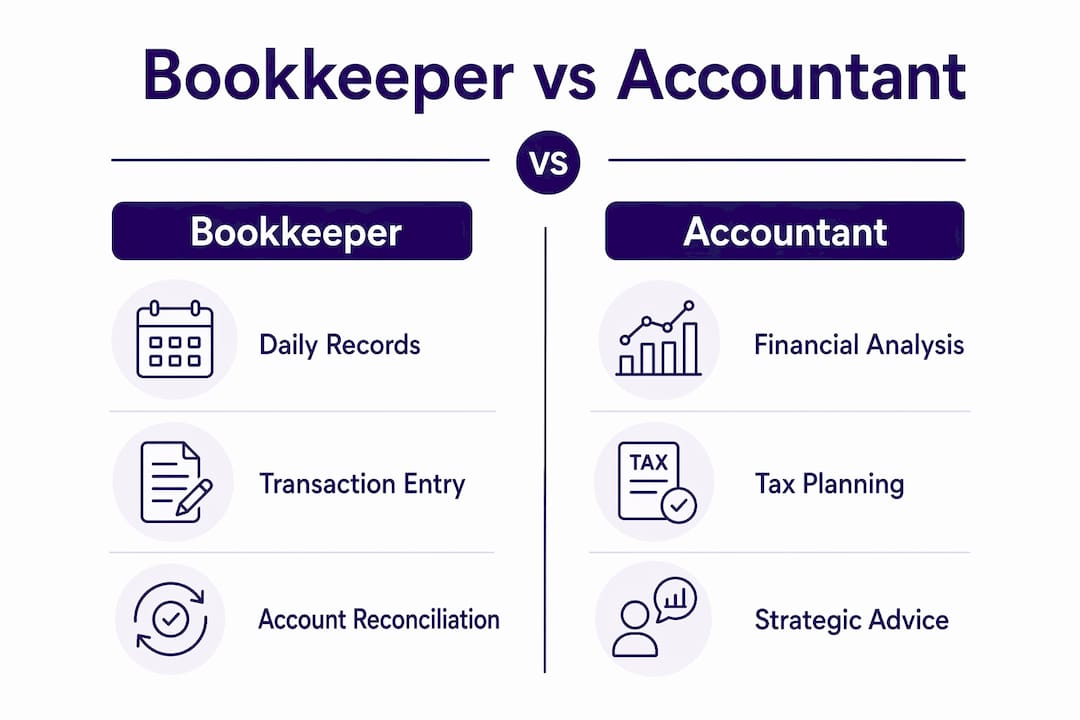
Bookkeepers manage daily financial operations including tracking income, expenses, payroll, and reconciling accounts. Their work is the foundation that every other financial function depends on. Without clean, accurate records, your accountant cannot do their job effectively, and you cannot trust any number in your business.
The core bookkeeper duties include:
Bookkeeping precision matters more than most business owners realize. Errors in transaction recording cascade into larger financial reporting inaccuracies and tax filing risks. A single miscategorized expense can distort your profit and loss statement for an entire quarter.
The bookkeeping services you invest in directly affect the quality of every financial decision you make downstream. Clean books are not a luxury. They are the price of admission for running a business you can actually understand.
Pro Tip: Set a weekly 15-minute review of your accounts receivable aging report. Catching overdue invoices early prevents cash flow gaps before they become emergencies.
Accountants occupy a strategic role, using bookkeepers’ records to prepare financial summaries and ensure tax compliance. Where a bookkeeper records the facts, an accountant interprets them. That interpretation is where real business value gets created.
The core accountant responsibilities include:
Accountants also help with loan applications by preparing financial statements that lenders require. This is a non-obvious benefit that many business owners overlook until they need financing and realize their books are not lender-ready.
When your business faces complex decisions, such as expanding to a new location, taking on investors, or restructuring debt, you need a Certified Public Accountant (CPA). A CPA holds a state license and meets continuing education requirements that a general accountant does not. The CPA designation signals a higher level of accountability and expertise, particularly for tax planning and audit representation.
Pro Tip: Ask your accountant to review your financials quarterly, not just at tax time. Quarterly reviews catch problems early and give you time to adjust before year-end.
The tax advisory role accountants play goes well beyond filing returns. Proactive tax planning, done throughout the year, consistently produces better outcomes than reactive filing done in april.
The clearest financial insights come when bookkeepers and accountants collaborate effectively, providing a complete financial picture. This is not a redundant relationship. It is a relay race. The bookkeeper runs the first leg, and the accountant runs the second.
Here is how the workflow typically operates in a well-run small business:
“Failing to separate these roles leads to poor visibility into profitability drivers. When one person tries to do both jobs, neither gets done at the level your business needs. The bookkeeper focuses on accuracy; the accountant focuses on insight. Both matter, and both require dedicated attention.”
This division of labor is also cost-efficient. Bookkeepers typically charge less per hour than CPAs. Assigning transaction recording to a bookkeeper and reserving the accountant’s time for analysis and planning keeps your financial management costs in check without sacrificing quality.
Why clean books improve tax outcomes is a question with a direct answer: accountants can only work with what bookkeepers give them. Disorganized records force accountants to spend billable hours cleaning up data instead of advising on strategy.
Engaging a bookkeeper early ensures daily record accuracy; engaging an accountant early ensures correct tax compliance and financial soundness. The timing question is one of the most common ones small business owners ask, and the answer depends on where your business is right now.
Hire a bookkeeper when:
Hire an accountant when:
Hire both when:
For startups, a part-time bookkeeper combined with a CPA for quarterly reviews and annual filing covers most needs at a manageable cost. As revenue grows and transactions multiply, moving to full-time or outsourced bookkeeping with dedicated accounting support becomes the right call. The small business accounting support you need at $500,000 in revenue looks very different from what you needed at $50,000.
Bookkeepers and accountants serve distinct but equally necessary functions: bookkeepers build the accurate financial record that accountants use to produce reports, ensure compliance, and guide business strategy.
| Point | Details |
|---|---|
| Bookkeepers handle daily records | They record transactions, reconcile accounts, and manage payroll to keep finances current. |
| Accountants provide strategic analysis | They prepare financial statements, file taxes, and advise on budgeting and business structure. |
| Both roles complement each other | Clean bookkeeping data enables accountants to deliver accurate reports and proactive guidance. |
| Hire a bookkeeper first | Bring in a bookkeeper as soon as transactions become too frequent to track manually. |
| Add an accountant for complexity | Engage a CPA when tax obligations, business structure, or growth decisions require expert analysis. |
Most business owners treat bookkeeping and accounting as a tax expense. That framing is the problem. Viewing accounting and bookkeeping solely as tax expenses risks missing their value as business intelligence tools. The moment you start seeing your bookkeeper as someone who prevents cash flow surprises, and your accountant as someone who helps you make better decisions, everything changes.
At Taxbowl, we work with small business owners every week who come to us after years of reactive financial management. They filed taxes when they had to, reconciled accounts when things felt off, and called an accountant only when something went wrong. The pattern is consistent: they were always behind, always surprised, and always paying more than they needed to.
The businesses that get ahead financially are the ones that treat bookkeeping as a real-time function, not a catch-up exercise. When your books are current, you know your cash position today. You know which clients owe you money. You know whether you can afford to hire. That kind of clarity is not a nice-to-have. It is how you run a business with confidence.
One more thing most articles will not tell you: the relationship between your bookkeeper and accountant matters as much as their individual skills. When they communicate regularly and work from the same data, the output is dramatically better. When they operate in silos, you get gaps. Taxbowl builds that collaboration into the service model by design, so your financial team functions as a unit rather than a collection of disconnected contractors.
— Taxbowl
Running a small business means your time is your most valuable resource. Taxbowl gives you a dedicated team that covers both bookkeeping and accounting, so you get accurate records and strategic guidance without managing two separate vendors.
Taxbowl’s bookkeeping and accounting services are built specifically for small businesses and startups. Your books stay current every month. Your accountant reviews the numbers and flags anything that needs attention. Tax season stops being a scramble because your records are already clean. If you want to see what that looks like for your business, talk to a Taxbowl expert and get a clear picture of where you stand.
A bookkeeper records and organizes daily financial transactions, while an accountant analyzes those records to prepare financial statements, file taxes, and advise on business decisions. Bookkeeping is administrative; accounting is analytical.
A bookkeeper handles transaction recording and reconciliation but is not trained or licensed to prepare financial statements, file complex tax returns, or provide strategic financial advice. For those tasks, you need a qualified accountant or CPA.
Hire a bookkeeper as soon as you spend more than two hours per week on financial data entry, or when your bank statements no longer match your internal records. Early bookkeeping prevents errors that become expensive to fix later.
Most growing small businesses benefit from both. A bookkeeper keeps daily records accurate, and an accountant uses those records to manage taxes, reporting, and financial planning. Using both roles together produces better financial outcomes than relying on one alone.
A Certified Public Accountant (CPA) is a licensed accountant who meets state education and exam requirements. You need a CPA when facing an IRS audit, filing complex business tax returns, applying for business loans, or making major decisions about business structure.