Back to blog
Role of Accountant in Tax Advisory: 2026 Guide
Discover the crucial role of accountant in tax advisory for 2026. Learn how strategic guidance can help reduce your tax burden and ensure compliance.

Discover the crucial role of accountant in tax advisory for 2026. Learn how strategic guidance can help reduce your tax burden and ensure compliance.
The role of accountant in tax advisory is defined as the ongoing process of interpreting tax laws, identifying liabilities before they occur, and guiding small business owners toward decisions that legally reduce their tax burden. This goes far beyond filing a return once a year. A qualified accountant working in a tax advisory capacity acts as a strategic partner, helping you plan around entity structure, income timing, deductions, and IRS compliance. For small business owners heading into 2026, that distinction between basic tax preparation and true tax advisory services has never mattered more.
The role of accountant in tax advisory covers a wide range of services that most business owners never see from a standard tax preparer. Tax prep answers “what to file?” while tax advisory answers “what decisions should you make?” to reduce risk and tax burden legally. That shift in framing changes everything about how you engage with your accountant.
Here is what a qualified accountant provides inside a tax advisory engagement:
This last point matters more than most business owners realize. A planning memo is not a tax return. It is a written record of your options, the financial impact of each, and the recommended path forward. That documentation protects you and creates a clear record for future planning.
Pro Tip: Ask your accountant for a written planning memo at least once per quarter. If they only communicate at tax time, you are getting compliance, not advisory.

Tax preparation and tax advisory are not the same service, and confusing them costs small business owners money. Tax preparation is backward-looking. It records what already happened and files the required forms. Tax advisory is forward-looking. It shapes what happens next.
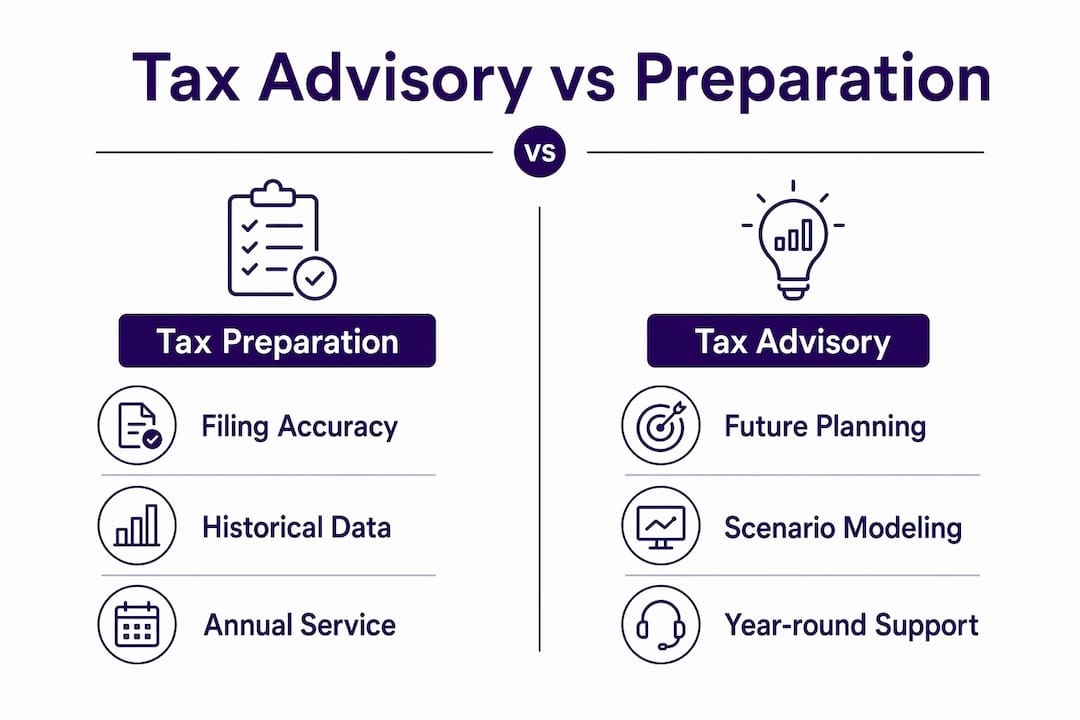
Modern tax consulting is a specialist discipline distinct from basic accounting. Accountants provide the financial data, but tax advisors ensure the legal defensibility of tax positions. Treating tax consulting as an accounting side task is outdated and carries real risk.
The table below shows how service types and professional roles compare:
| Service Type | Primary Focus | Who Delivers It | Frequency |
|---|---|---|---|
| Tax Preparation | Filing accurate returns | Tax preparer, CPA | Annual |
| Tax Planning | Reducing future tax liability | CPA, accountant | Quarterly or ongoing |
| Tax Advisory | Strategic decisions and risk management | CPA, EA, tax attorney | Year-round |
| IRS Representation | Audit defense and IRS communications | EA, CPA, tax attorney | As needed |
The credentials matter here. An Enrolled Agent (EA) is federally licensed by the IRS and specializes in tax matters. A CPA holds a state license covering a broader range of accounting services. A tax attorney handles legal disputes and complex planning. Each plays a different role, and knowing which professional you need for which situation saves you time and money.
Pro Tip: If your current accountant only contacts you in March or April, ask directly whether they offer year-round advisory. Many firms offer it as an add-on service you may not know exists.
The overlap between these roles is real. A CPA who specializes in small business taxes can serve as your accountant, tax planner, and advisory contact all at once. The key is that the engagement must be structured for ongoing involvement, not just annual compliance.
Tax advisory works best as a continuous process rather than an annual event, because tax law and your business circumstances both change throughout the year. Waiting until December to review your tax position means missing months of planning opportunities. A year-round review catches problems early and opens up strategies that simply are not available after the fact.
For 2026 specifically, the stakes are higher than usual. Proactive scenario modeling around entity structure and income timing is critical, given changes beginning in 2025 that affect pass-through entities and withholding rules. If you operate as an S-Corp, LLC, or sole proprietor, your accountant should already be reviewing how these changes affect your after-tax cash flow.
Here are the tax-saving moves your accountant should be walking you through right now:
The importance of accountants in tax planning shows up most clearly in moments like these. Each of these moves requires current knowledge of tax law, an understanding of your specific financials, and the judgment to know which strategies apply to your situation. That is not something a once-a-year filing appointment delivers.
IRS representation is the process by which a credentialed professional acts on your behalf in communications with the IRS, including audits, collections, and appeals. Only specific professionals are authorized to provide this service. Enrolled Agents and CPAs can represent taxpayers before the IRS, managing communications, deadlines, and paperwork to reduce stress and avoid mistakes.
This matters because IRS interactions are high-stakes and procedurally complex. A missed deadline or an overshared document can make a manageable audit significantly worse. Having a credentialed representative handle all IRS contact removes that risk from your plate entirely.
Here is what effective IRS representation includes:
Practitioners must maintain professional conduct per Treasury Circular 230, the set of ethical standards governing tax professionals who practice before the IRS. This framework ensures that the advice and representation you receive is both legally defensible and ethically sound.
Proper authorization mechanisms also prevent oversharing. One of the most common audit mistakes is responding to IRS requests without understanding the exact scope of what was asked. A credentialed representative knows the boundaries and keeps the process focused.
The practical benefit for you as a business owner is straightforward. You do not have to talk to the IRS directly. Your accountant handles the correspondence, attends any meetings, and reports back to you with clear updates. That separation reduces stress and significantly lowers the risk of an avoidable error.
Accountants in tax advisory roles deliver the most value when engaged year-round, combining proactive planning, scenario modeling, and IRS representation to legally reduce your tax burden and protect your business.
| Point | Details |
|---|---|
| Advisory vs. preparation | Tax advisory shapes future decisions; tax preparation records what already happened. |
| Year-round engagement | Continuous review uncovers tax-saving opportunities that annual filing appointments miss. |
| Credentials matter | EAs, CPAs, and tax attorneys each serve distinct roles; match the professional to the task. |
| 2026 planning priorities | Entity structure, income timing, and retirement contributions are the highest-impact moves right now. |
| IRS representation | Credentialed professionals handle all IRS contact, protecting you from procedural mistakes and oversharing. |
Most small business owners come to us after a painful experience. They filed on time, paid what they owed, and still ended up surprised by a large tax bill or an IRS notice they did not know how to handle. The common thread is not negligence. It is the mistaken belief that tax compliance and tax advisory are the same thing.
They are not. Tax compliance is the floor. Tax advisory is everything above it.
What I have seen work consistently is this: business owners who treat their accountant as a year-round advisor, not just a once-a-year filer, make better financial decisions. They know their estimated tax position in real time. They make compensation and distribution decisions with full awareness of the tax impact. They are not surprised in April.
The other thing I want to push back on is the idea that tax advisory is only for large businesses. A sole proprietor with $200,000 in revenue has just as much to gain from proactive planning as a company with $2 million. The strategies scale. The entity structure review, the retirement contribution timing, the depreciation elections — these apply at every level.
One more observation: the shift toward specialized tax advisory, separate from general accounting, is real and accelerating. The professionals who do this well are not generalists. They stay current on tax law changes, they document their recommendations, and they measure their value by the tax savings they generate for clients, not just the returns they file.
If your current accountant cannot tell you what your estimated tax liability is right now, in this quarter, that is a signal worth paying attention to.
— Taxbowl
Running a small business means your time is already stretched. Tax strategy should not be another item you are figuring out alone.
Taxbowl combines a dedicated team of accountants with real-time financial visibility and direct communication so you always know where you stand. From bookkeeping services that keep your records audit-ready to fractional CFO support that brings strategic financial guidance to your business, Taxbowl is built for small business owners who want proactive tax advisory, not just annual compliance. Our team works with you throughout the year, not just at tax time. If you are ready to move from reactive filing to forward-looking tax strategy, talk to a Taxbowl expert and get a plan built around your business.
An accountant in a tax advisory role interprets tax laws, identifies liabilities before they occur, models financial scenarios, and advises on business decisions that affect your tax burden. This is distinct from tax preparation, which focuses only on filing accurate returns.
Tax preparation records past financial activity and files required forms. Tax advisory is forward-looking, shaping decisions on entity structure, income timing, and deductions to legally reduce future tax liability.
Enrolled Agents, CPAs, and tax attorneys are the three categories of professionals authorized to represent taxpayers before the IRS. They can manage audits, respond to notices, and negotiate on your behalf under Treasury Circular 230 standards.
Quarterly reviews are the standard for effective tax advisory, with additional check-ins whenever a major business decision occurs. Year-round engagement consistently produces better tax outcomes than annual-only contact.
Tax advisory delivers value at every revenue level. Entity structure reviews, retirement contribution timing, and deduction optimization apply to sole proprietors and small LLCs just as much as to larger companies.