Back to blog
Why Law Firms Miss Quarterly Tax Deadlines
Learn why law firms miss quarterly tax deadlines and discover strategies to avoid costly compliance failures. Don't let income volatility catch you!

Learn why law firms miss quarterly tax deadlines and discover strategies to avoid costly compliance failures. Don't let income volatility catch you!
Law firms miss quarterly tax deadlines primarily because of income volatility, misunderstood IRS penalty rules, and operational process gaps that compound into costly compliance failures. The formal term for these obligations is “estimated tax payments,” and the IRS treats each quarterly installment as a separate, standalone deadline. Missing one quarter is not corrected by paying more in the next. For law firm professionals and financial administrators, understanding why these failures happen is the first step toward preventing them.
The root cause of quarterly tax filing challenges in law firms is structural. Law firms do not earn income the way a salaried employee does. Revenue arrives in irregular bursts driven by case settlements, contingency fee collections, and partner draws that rarely align with the IRS’s four fixed payment windows.
Income volatility leads directly to underpayment risk and cash flow strain when estimates are not updated throughout the year. A firm that closes a large personal injury settlement in october may have dramatically different tax exposure than it projected in april. Without real-time financial data, the firm’s quarterly estimates are based on stale numbers.

Three additional factors make this worse. First, many law firm partners do not fully understand that the IRS calculates penalties per quarter, not per year. Second, financial administrators often assume the firm’s CPA handles estimated payments automatically. Third, manual bookkeeping creates delays that make accurate projections nearly impossible. All three failures feed each other.
Contingency fees are the single largest driver of income unpredictability in law firms. A firm may go months without a major settlement, then receive a $2 million fee in a single week. That fee lands in one quarter, but the tax liability it creates may not be recognized until the firm’s books are reconciled weeks later. By then, the quarterly deadline may have already passed.
The safe harbor rule offers some protection. Paying 100% of the prior year’s tax liability (or 110% for higher earners) shields firms from underpayment penalties. But relying on prior year numbers creates a different risk: if this year’s income is significantly higher, the safe harbor payment covers the penalty but not the full tax owed. The firm still faces a large balance due in april.
Partner compensation structures create a problem that most financial administrators underestimate. In a partnership or S corporation, partners are taxed on their allocated share of firm profits, not on the cash they actually receive. This is called phantom income, and it is a hidden cause of payment shortfalls for law firm partners.
A partner allocated $300,000 in firm profits may only receive $200,000 in actual distributions because the firm retained capital for operating expenses. That partner still owes taxes on the full $300,000. If the quarterly estimates were based on expected cash distributions rather than allocated income, the estimates will be short every single quarter.
Pro Tip: Track profit monthly using accounting software like QuickBooks or Xero, and recalculate your estimated tax payment at the start of each quarter based on actual year-to-date income, not last year’s figures.
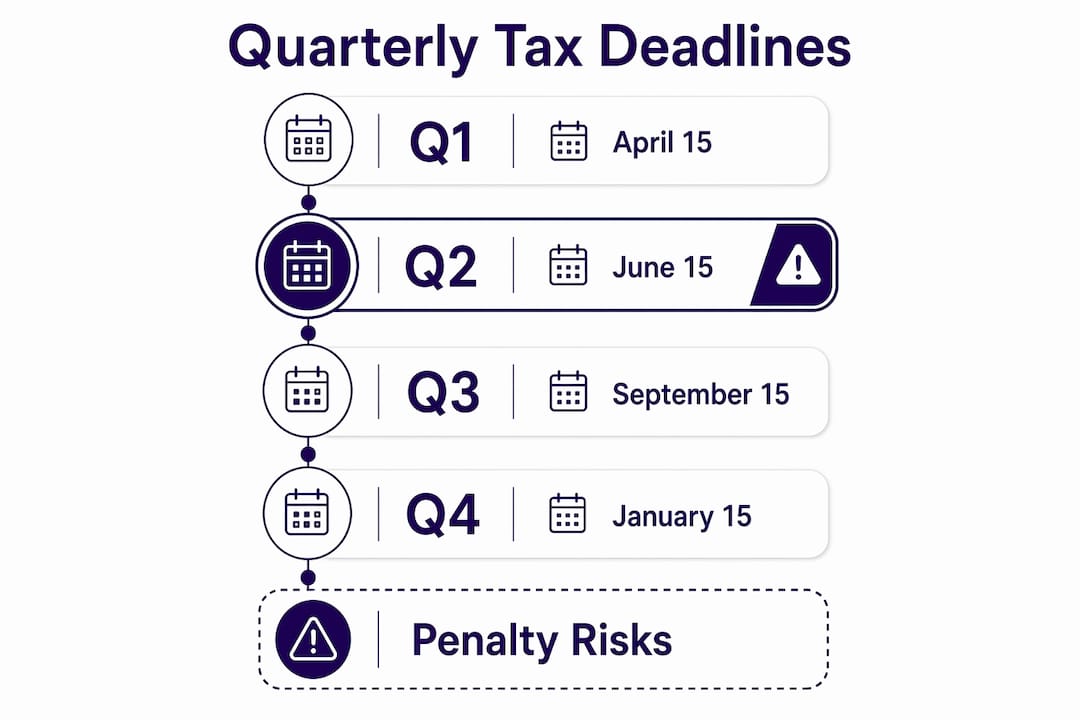
Federal estimated tax deadlines for 2026 fall on april 15, june 15, september 15, and january 15 of the following year. Each deadline covers a specific income period, and the IRS expects a payment proportional to the income earned during that window.
The june 15 deadline is the most dangerous for law firms. The Q2 income period covers only april 1 through may 31, a compressed two-month window. To make an accurate payment by june 15, a firm needs its april and may financials fully reconciled by early may. Most firms are not that fast.
The IRS does not calculate underpayment penalties on an annual basis. Each quarterly payment is its own deadline with its own penalty calculation. Paying the full year’s tax in april does not erase the penalties that accrued for missing the june, september, or january payments. This surprises many law firm partners who believe a large year-end payment resolves everything.
Law firms often try to catch up on missed payments in later quarters. The IRS still assesses penalties for the earlier underpayments. The catch-up payment reduces future exposure but does not eliminate past penalties.
| Quarter | Due Date | Income Period Covered | Penalty Risk |
|---|---|---|---|
| Q1 | April 15, 2026 | January 1 – March 31 | Penalty if Q1 payment is short |
| Q2 | June 15, 2026 | April 1 – May 31 | High risk due to compressed timeline |
| Q3 | September 15, 2026 | June 1 – August 31 | Risk if summer settlements are large |
| Q4 | January 15, 2027 | September 1 – December 31 | Risk if year-end income spikes |
The table shows why Q2 is the highest-risk quarter for most law firms. The income window is the shortest, but the deadline arrives before most firms have finalized their may financials. A firm that misses Q2 cannot undo that penalty by overpaying in september.
The most common process failure is treating estimated taxes as a tax-season task rather than a year-round obligation. Financial administrators who focus on annual returns often do not build quarterly payment workflows into their calendar. By the time they recognize a payment is due, the deadline is days away and the financial data needed to calculate the correct amount is incomplete.
Delayed planning and poor bookkeeping are the two most cited process failures that cause missed payments and accrued interest. Both are preventable with the right systems in place.
Many law firm partners assume their CPA manages quarterly payments automatically. CPAs prepare returns and advise on strategy, but they do not initiate payments on a client’s behalf unless explicitly contracted to do so. This assumption creates a gap where no one owns the payment task. The deadline passes, and both the partner and the CPA believed the other was responsible.
Bookkeeping timeliness is critical. Outdated financial records misrepresent tax liability and lead to missed or inaccurate payments. A CPA working from books that are 60 days behind cannot produce a reliable estimate.
Pro Tip: Set up automated payment scheduling through EFTPS at least two weeks before each quarterly deadline. Build an internal approval workflow so the payment amount is reviewed and confirmed before the scheduled date.
Preventing law firm tax deadline issues requires a shift from reactive to proactive financial management. The following steps give financial administrators a concrete framework for staying compliant year-round.
Run monthly profit and loss reviews. Real-time bookkeeping and monthly financial reports help law firms update quarterly tax estimates and avoid both overpayments and underpayments. Schedule a monthly close date and treat it as non-negotiable.
Use current-year projections, not prior-year data. Safe harbor protects against penalties but does not reflect actual tax liability. Build a quarterly projection model that incorporates year-to-date income, expected settlements, and partner allocations. Update it at the start of each quarter.
Schedule payments through EFTPS or IRS Direct Pay. Automated payment workflows reduce the risk of missed deadlines in busy law firm environments. Schedule each payment two weeks before the due date to allow for review and correction.
Address phantom income in partner compensation planning. Work with a CPA who specializes in law firm partnerships to align partner distributions with tax obligations. Partners should receive enough in distributions to fund their estimated payments before each quarterly deadline.
Clarify CPA responsibilities in writing. Define exactly which tasks the firm’s CPA owns versus which tasks the financial administrator owns. Estimated tax payment initiation should be explicitly assigned to one party with a documented deadline.
Consult a CPA who specializes in law firm tax planning. General CPAs may not be familiar with contingency fee timing, phantom income, or partner-level tax planning specific to law firm structures. A specialist reduces the risk of miscalculation.
Adopt year-round tax planning. Ongoing tax planning prevents the year-end scramble that causes firms to miss earlier quarter obligations. Treat tax compliance as a continuous process, not an annual event.
The firms that consistently meet quarterly deadlines share one trait: they treat estimated tax payments as a scheduled financial operation, not a reactive task. Process design matters more than spreadsheet accuracy.
Law firms miss quarterly estimated tax payments because income volatility, phantom income, and per-quarter IRS penalty rules combine with weak internal processes to create compliance failures that a single year-end payment cannot fix.
| Point | Details |
|---|---|
| Per-quarter IRS penalties | Missing one quarterly payment creates a penalty that later catch-up payments cannot erase. |
| Phantom income risk | Partners owe taxes on allocated profits even when cash distributions fall short of that amount. |
| Q2 is the highest-risk deadline | The june 15 deadline covers only two months of income, requiring financials to be ready by early may. |
| Process gaps cause most failures | Assuming the CPA handles payments and using manual bookkeeping are the two most common operational failures. |
| Automation prevents missed deadlines | Scheduling payments through EFTPS two weeks early and running monthly financial reviews eliminates most deadline risk. |
At Taxbowl, we work with law firm financial administrators who are genuinely skilled at their jobs. They track billing, manage trust accounts, and handle payroll without missing a beat. But quarterly estimated taxes trip them up repeatedly, and the reason is almost never incompetence. It is a design problem.
Most law firms were not built with a quarterly tax payment workflow in mind. The CPA relationship is structured around annual returns. The bookkeeping calendar is structured around billing cycles. Neither of those rhythms aligns with the IRS’s four payment windows. So the deadlines arrive, and the firm scrambles.
The conventional advice is to “work more closely with your CPA.” That is true but incomplete. What actually changes compliance outcomes is building a payment calendar into the firm’s financial operations, assigning ownership of each deadline to a specific person, and connecting that person to real-time financial data. Without those three elements, even the best CPA cannot prevent a missed payment.
The firms that struggle most are the ones that treat estimated taxes as a tax problem. The firms that stay compliant treat it as an operations problem. That shift in framing changes everything. When you own the process rather than outsource the worry, quarterly deadlines become routine rather than stressful.
Technology adoption accelerates this shift. Firms using real-time bookkeeping close their books faster, produce accurate projections earlier, and schedule payments with confidence. The firms still relying on manual reconciliation are always one delayed settlement away from a missed deadline.
— Taxbowl
Law firms that miss quarterly payments are not short on talent. They are short on systems. Taxbowl provides law firm bookkeeping and tax support that keeps your financial data current, your quarterly estimates accurate, and your payment schedule on track.
Taxbowl’s dedicated accounting team works alongside your firm to close books monthly, flag phantom income issues before they create payment gaps, and coordinate directly with your CPA on estimated tax projections. You get real-time financial visibility through proactive communication, so no deadline catches you off guard. If you want to stop reacting to tax deadlines and start owning them, talk to a Taxbowl expert and get a plan built around your firm’s actual income structure.
The four federal estimated tax deadlines for 2026 are april 15, june 15, september 15, and january 15, 2027. Each deadline falls on the 15th or the next business day if the 15th is a weekend or holiday.
The IRS calculates underpayment penalties per quarter, not per year. Paying the full tax balance in april does not eliminate penalties that accrued for missing the june, september, or january payments.
Phantom income is taxable profit allocated to a partner that exceeds the cash they actually received. Law firm partners owe estimated taxes on their full profit allocation, even when the firm retains cash and distributions fall short.
The Q2 payment due june 15 covers only april and may income, a compressed two-month window. Firms need their may financials fully reconciled by early may to calculate an accurate payment, which most firms cannot do without real-time bookkeeping.
Schedule payments through EFTPS or IRS Direct Pay at least two weeks before each deadline, run monthly profit and loss reviews, and assign clear ownership of the payment task to one person inside the firm.