Back to blog
Tax Planning Strategies for Law Partners: 2026 Guide
Discover essential tax planning strategies for law partners to minimize tax burdens and align with your financial goals. Get expert insights now!

Discover essential tax planning strategies for law partners to minimize tax burdens and align with your financial goals. Get expert insights now!
Tax planning strategies for law partners are defined as year-round, proactive methods that reduce taxable income, manage self-employment tax, and align compensation structures with long-term financial goals. As a law firm partner, you face tax challenges that salaried attorneys never encounter: quarterly estimated payments, Schedule K-1 reporting, self-employment tax on guaranteed payments, and multi-state nexus obligations. The IRS does not withhold taxes from partnership distributions, which means the burden of planning falls entirely on you. This guide covers the structures, deductions, compensation strategies, and state tax considerations that effective tax planning for partners depends on.
The most consequential decision a law firm partner makes is choosing the right legal entity. That choice determines how income is taxed, how self-employment tax applies, and what retirement contributions are possible. Getting it right from the start saves tens of thousands of dollars annually.
Law firms typically operate as general partnerships, limited liability partnerships (LLPs), professional corporations (PCs), or limited liability companies (LLCs). Each carries distinct tax treatment.

| Structure | Self-Employment Tax on Income | Retirement Plan Access | Key Tax Consideration |
|---|---|---|---|
| General Partnership / LLP | Full SE tax on distributive share | SEP-IRA, Solo 401(k) | Pass-through income; no corporate layer |
| Professional Corporation (PC) | Only on W-2 salary | 401(k), defined benefit | Double taxation risk on dividends |
| LLC (taxed as partnership) | Full SE tax on active income | SEP-IRA, Solo 401(k) | Flexible; default pass-through treatment |
| LLC (S-Corp election) | Only on reasonable W-2 salary | 401(k), profit-sharing | SE tax savings on distributions above salary |
A professional corporation with an S-Corp election is the structure most commonly used to reduce self-employment tax. Partners pay themselves a reasonable salary subject to payroll taxes, then take remaining profits as distributions not subject to self-employment tax. The IRS scrutinizes unreasonably low salaries, so the salary must reflect fair market compensation for the legal work performed.
An LLC taxed as a partnership offers flexibility but subjects all active income to self-employment tax. For partners with high distributive shares, this can be a significant cost. Reviewing your entity election annually with a CPA is not optional. It is a core part of law firm tax optimization.
Pro Tip: Coordinate any entity election change with your retirement plan setup. Switching to an S-Corp election mid-year can disrupt contribution limits and plan eligibility. Plan the transition at the start of a fiscal year.
Partnership income is not subject to withholding, which creates a cash flow trap for partners who do not plan ahead. The IRS requires quarterly estimated tax payments, and missing them triggers penalties regardless of whether you pay in full at year-end.
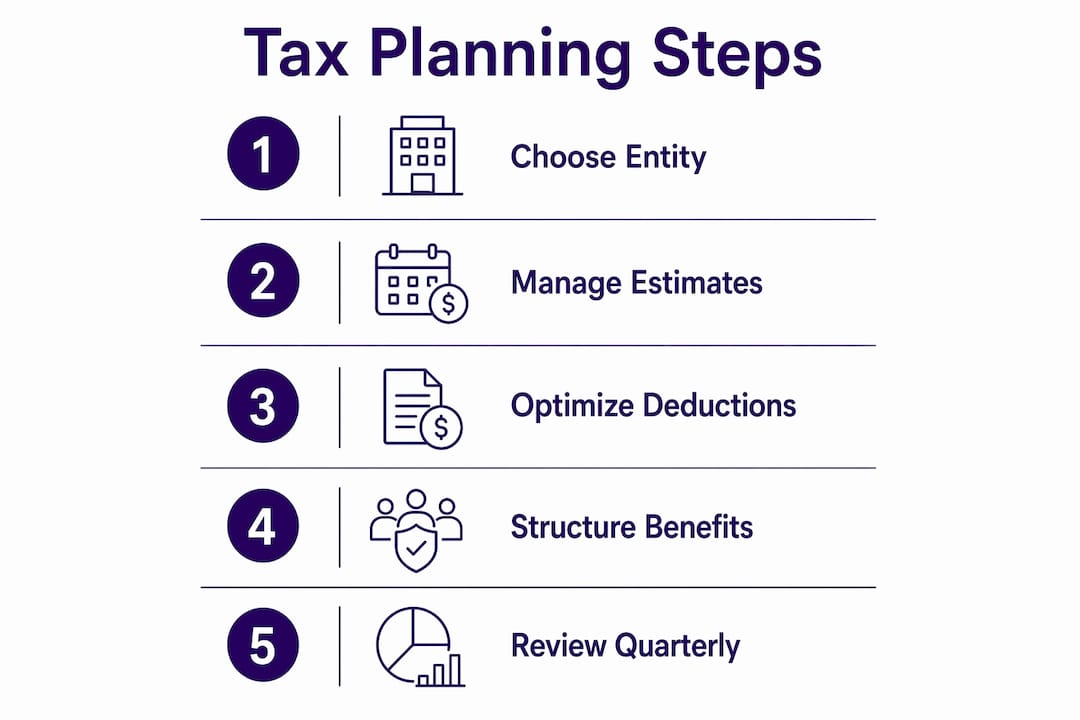
The IRS safe harbor rules set the minimum you must pay to avoid underpayment penalties. You must pay either 100% of your prior year’s total tax liability or 110% of that amount if your adjusted gross income exceeded $150,000 in the prior year. This safe harbor threshold applies to most law firm partners given typical income levels.
Here is a practical framework for managing estimated payments through the year:
Consider a partner receiving $100,000 in guaranteed payments and $50,000 in distributive share income. The combined $150,000 triggers a self-employment tax of approximately $21,200 before deductions. That figure represents a significant tax burden that must be planned for, not discovered at filing time. The deductible portion of self-employment tax (50% of the total) reduces your adjusted gross income, which partially offsets the hit.
Pro Tip: Open a dedicated tax reserve account separate from your operating account. Transfer 35%–40% of every K-1 distribution into it immediately. This single habit eliminates the most common cash flow problem partners face at tax time.
Deductible business expenses are the most direct way to reduce taxable income. Law partners have access to a broader range of deductions than most professionals, but only if records are maintained properly.
Equipment purchases can be timed near year-end to take advantage of bonus depreciation rules and reduce taxable income in the current year. Under current tax law, qualifying assets placed in service before December 31 may be eligible for immediate expensing under Section 179 or bonus depreciation. This applies to computers, office furniture, and certain software. Buying a $20,000 workstation setup in december rather than january can shift a significant deduction into the current tax year.
Recordkeeping is the foundation of every deduction. The IRS requires documentation of the business purpose, amount, date, and parties involved for every expense. Use accounting software that categorizes expenses automatically and stores digital receipts. Without documentation, deductions are disallowed on audit.
Pro Tip: Conduct a deduction audit in october each year. Review your year-to-date expenses, identify any missing categories, and make qualifying purchases before december 31. This gives you time to act rather than scrambling at year-end.
Partner compensation is not a single concept. Law firms use three distinct payment types, and each carries different tax treatment. Understanding the difference is central to any income tax planning for lawyers.
| Compensation Type | Self-Employment Tax | Reported On | Key Planning Note |
|---|---|---|---|
| Guaranteed payments | Subject to full SE tax | Schedule K-1, Box 4 | Deductible by the firm; taxable to partner |
| Distributive share | Subject to SE tax if active | Schedule K-1, Box 1 | Reflects partner’s share of firm profit/loss |
| Draws | Not a separate tax event | Reduces capital account | Treated as advance against distributive share |
Different partner payments carry varying self-employment tax treatments and reporting requirements. Guaranteed payments are the most straightforward: they are fixed amounts paid regardless of firm profitability, fully subject to self-employment tax, and deductible by the partnership. Distributive shares reflect your allocated portion of firm profits and are also subject to self-employment tax for active partners. Draws are simply advances against your expected share and do not create a separate tax event at the time of withdrawal.
Retirement plans are the most powerful tool available for reducing taxable income for law firm partners. The right plan depends on your income level, age, and how many employees the firm has.
A SEP-IRA allows contributions up to 25% of net self-employment income, with a 2026 maximum of $70,000. Setup is simple and contributions can be made up to the tax filing deadline including extensions. A Solo 401(k) allows both employee and employer contributions, making it possible to shelter more income at lower net profit levels. A defined benefit plan is the most aggressive option for high-earning partners over 50. Contributions are actuarially determined and can exceed $200,000 annually, creating a substantial deduction.
Quarterly tax planning that includes a review of retirement contribution limits prevents the common mistake of missing the contribution window or undercontributing. Review your projected income each quarter and adjust contributions accordingly.
Pro Tip: If you are over 50 and in a high-income year, model a defined benefit plan alongside your existing 401(k). The combined deduction can reduce taxable income by $250,000 or more in a single year, which is a result no other strategy matches at that income level.
State and local taxes represent the most overlooked area of tax strategy for attorneys. The complexity grows with every state where your firm operates or serves clients.
State and local tax obligations depend on both firm location and client nexus, requiring careful review of PTET elections and multi-state rules. Work with a CPA who specializes in multi-jurisdictional tax planning. A generalist accountant will miss state-specific elections and filing requirements that cost you real money.
Pro Tip: File a PTET election review every january. States change their PTET rules frequently, and the election deadline varies by state. Missing the election window by even one day forfeits the deduction for the entire year.
Effective tax planning for law partners requires year-round attention to structure, compensation, deductions, and state obligations, not a single annual filing.
| Point | Details |
|---|---|
| Choose the right entity | S-Corp elections and professional corporations reduce self-employment tax on distributions above a reasonable salary. |
| Reserve for estimated taxes | Set aside 30%–45% of every distribution in a dedicated account to cover quarterly IRS payments. |
| Time equipment purchases | Buy qualifying assets before December 31 to capture bonus depreciation in the current tax year. |
| Maximize retirement contributions | SEP-IRAs, Solo 401(k)s, and defined benefit plans reduce taxable income and build long-term wealth simultaneously. |
| Address state taxes proactively | PTET elections and accurate basis tracking prevent costly compliance failures in multi-state practices. |
Most partners I work with arrive with the same problem: they treated their first few years as a partner the same way they treated their years as an associate. They filed once a year, paid what they owed, and moved on. That approach works when an employer handles withholding. It fails completely when you are responsible for your own tax management.
The partners who build real wealth are the ones who treat tax planning as a quarterly discipline. They review their K-1 projections in march, june, september, and december. They make retirement contributions throughout the year rather than scrambling in april. They call their CPA before making a major equipment purchase, not after.
The PTET election is the single most underused strategy I see among law firm partners in high-tax states. Partners in New York or California who skip this election are effectively paying a premium on their federal taxes that they do not have to pay. The election is not complicated. It just requires knowing it exists and filing on time.
One more thing: do not underestimate state tax complexity. I have seen partners receive unexpected tax bills from states they did not realize they had nexus in, simply because one attorney worked remotely from that state for six months. Multi-state compliance is not a niche concern. For any firm with more than a handful of partners, it is a core planning issue.
The firms that get this right share one trait: they maintain a close, ongoing relationship with a tax advisor who understands legal practice structures. Not a generalist. A specialist. The cost of that relationship is a fraction of what it saves.
— Taxbowl
Managing quarterly estimates, K-1 allocations, retirement contributions, and multi-state filings is a full-time job on top of your actual practice. Taxbowl provides bookkeeping and accounting services built for small businesses and professional practices, including law firms. You get a dedicated team of accountants, real-time financial visibility, and direct communication through platforms like Slack so you always know where your numbers stand.
Taxbowl tracks your outstanding receivables, flags estimated payment deadlines, and keeps your books clean so your CPA can focus on strategy rather than cleanup. If you want tax planning that works year-round rather than once in april, Taxbowl is built for exactly that.
Self-employment tax applies to a partner’s net earnings from the firm, including guaranteed payments and distributive shares from active participation. The rate is 15.3% on income up to $176,100 and 2.9% on income above that threshold in 2026.
Safe harbor rules require partners to pay either 100% of their prior year tax liability or 110% if their AGI exceeded $150,000. Meeting either threshold protects you from underpayment penalties even if you owe more at filing.
A Pass-Through Entity Tax election allows a partnership to pay state income tax at the entity level, converting a personal state tax payment into a deductible business expense. This bypasses the $10,000 federal SALT cap and produces a real federal tax benefit for partners in high-tax states.
A defined benefit plan offers the largest potential deduction, with contributions that can exceed $200,000 annually for partners over 50. It works best when combined with a 401(k) and is most effective in high-income years.
Successful firms adopt disciplined quarterly tax planning aligned with operational goals. Reviewing estimated payments, retirement contributions, and entity elections four times per year prevents the surprises that annual-only planning consistently produces.