Back to blog
Retirement Accounts Tax Reduction Guide for 2026
Unlock savings with our retirement accounts tax reduction guide for 2026. Learn how Solo 401(k)s and SEP IRAs can reduce your taxable income!


Unlock savings with our retirement accounts tax reduction guide for 2026. Learn how Solo 401(k)s and SEP IRAs can reduce your taxable income!
TL;DR:
- For owner-only businesses, a Solo 401(k) offers the highest potential tax savings, especially with Roth options. Small businesses with employees should consider a SIMPLE IRA for manageable costs and minimal administration. Accurate timing of plan setup and contributions is essential to maximize tax benefits and ensure compliance under IRS deadlines.
For most owner-only businesses, a Solo 401(k) or SEP IRA delivers the largest legal reduction to taxable income available under current IRS rules. If you have employees, a SIMPLE IRA keeps employer costs manageable while still giving your team a savings vehicle. Your three immediate steps:
SECURE 2.0 provisions and Department of Labor guidance have expanded options for small employers, including Roth availability in SEP and SIMPLE plans starting after 2022. The plan you choose this year can cut your federal tax bill by thousands — but only if you hit the right deadlines.
The four plans most relevant to small-business owners differ most on who can contribute, how much, and how much paperwork you take on.
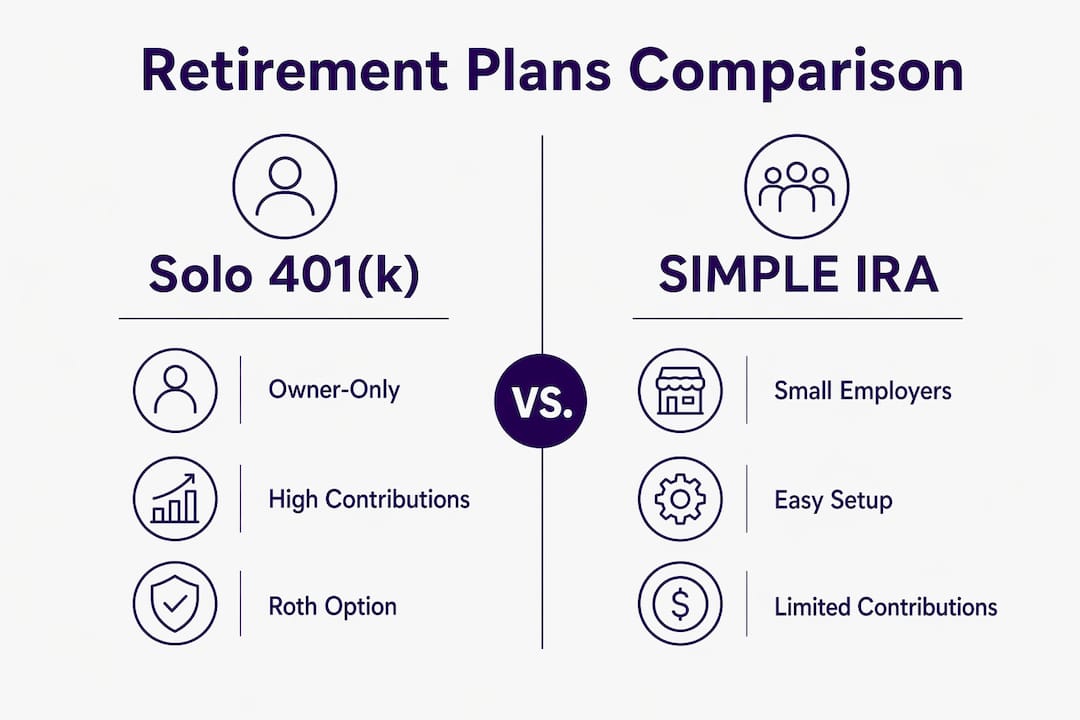
| Plan | Who Contributes | 2025 Contribution Limit | Roth Available | Establishment Deadline | Reporting Burden | Best Fit |
|---|---|---|---|---|---|---|
| SEP IRA | Employer only | Up to 25% of net SE earnings, max. The maximum contribution to a SEP IRA is limited by IRS rules to a percentage of net self-employment income capped at annual limits | Yes (post-SECURE 2.0) | Tax filing deadline + extensions | Minimal; no Form 5500 | Owner-only or employer wanting flexibility |
| SIMPLE IRA | Both employer and employee | Employee deferrals subject to IRS-set limits; higher catch-up contributions allowed for employees age 50 or older; employer contributions may match a portion of employee compensation or be fixed percentage non-elective contributions | Yes (post-SECURE 2.0) | October 1 of the tax year | Low; annual notices required | Businesses with up to 100 employees, low admin budget |
| Solo 401(k) | Both (owner wears both hats) | $23,500 employee deferral + 25% employer; total max allowed by IRS rules | Yes | December 31 of the tax year | Moderate; Form 5500-EZ once assets exceed $250,000 | Owner-only, high earners, Roth seekers |
| Defined Benefit / Cash Balance | Employer only | Actuarially determined; can far exceed IRS limits for DC plans | No | Varies; actuarial required | High; annual actuarial certification | Older high-earners wanting maximum deductions |
Quick scenario picks:
The tax reduction works through three distinct channels, and knowing which one applies to your plan changes how you time contributions.
Employer contributions are deductible directly from business income. If you contribute $50,000 to a SEP IRA and you’re in the 32% federal bracket, that’s Contributions reduce federal taxable income proportionally to your tax bracket; total tax savings including state taxes will vary depending on each state’s top income tax rates
Employee elective deferrals in a Solo 401(k) or SIMPLE IRA reduce your W-2 or net self-employment income before payroll taxes are calculated. For S-corp owners, this matters: salary deferrals reduce the payroll-taxable wage base, which can lower both the employer and employee share of FICA. Roth deferrals don’t reduce current taxable income, but they shift future withdrawals to tax-free status — a real advantage if you expect your tax rate to rise.
One calculation trap catches many self-employed owners: the contribution deduction is circular. Your deductible contribution reduces net earnings, which in turn changes the allowable contribution amount. The IRS self-employed contribution worksheet is the correct tool here. Skipping it is one of the fastest ways to trigger an excess-contribution penalty.
Beyond the immediate deduction, money inside the plan grows tax-deferred. The DOL’s small-business retirement guidance notes that starting early — even with modest contributions — compounds that deferred growth significantly over time, often outweighing the benefit of waiting for a larger deduction in a single high-income year.
The single most important timing rule: which deadline applies determines whether a contribution shelters the current tax year at all.
Required administrative tasks:
Pro Tip: The three administrative traps CPAs see most often are: (1) confusing the plan establishment deadline with the contribution funding deadline, (2) depositing employee deferrals late, and (3) skipping the SIMPLE IRA annual notice. Put all three on a calendar alert the moment you open the plan.
Follow this decision sequence before talking to your CPA.
Step 1 — Do you have employees other than a spouse? If no, the Solo 401(k) is almost always the right answer for owners who want maximum contribution room and Roth access. If yes, move to Step 2.

Step 2 — How many employees, and what’s your admin capacity? Under 100 employees with limited HR bandwidth points to a SIMPLE IRA. If you want higher contribution limits and can handle the requirement to contribute the same percentage for all eligible employees, a SEP IRA works. SECURE 2.0 also introduced changes to part-time employee deferral eligibility starting in 2025 — if you have long-term part-time workers, confirm their eligibility status before choosing a plan with elective deferrals.
Step 3 — Do you need Roth contributions? Solo 401(k) is the clearest path. SEP and SIMPLE Roth options exist post-SECURE 2.0 but custodian support varies.
Step 4 — Is cash flow variable? SEP IRA contributions are fully discretionary — you can contribute up to 25% of net self-employment income (subject to IRS annual limits) in a great year and nothing in a lean one. SIMPLE IRA requires a mandatory employer contribution every year, which can strain cash flow if revenue dips.
Red flags to watch: Part-time staff who meet eligibility thresholds can trigger deferral obligations in a SIMPLE or 401(k) plan. If you can’t reliably send annual notices or fund mandatory employer contributions, a SEP IRA’s simplicity protects you from compliance failures.
Pooled employer plans and PEO-sponsored arrangements are worth exploring if you want to offload fiduciary responsibility entirely — the DOL specifically recommends these for small employers who lack internal HR resources.
Pro Tip: If you plan to fund a SEP IRA after December 31 (using the filing-deadline window), do not file your return before making the contribution — once the return is filed, the window closes for that tax year. Coordinate this timing explicitly with your CPA or tax planning service before you submit.
The most common mistake is treating the establishment deadline and the contribution deadline as the same thing. They are not, and the confusion causes owners to either miss the year’s benefit entirely or set up the wrong plan too late.
Mistake 1: Setting up a Solo 401(k) in January for the prior year. The plan must exist by December 31. If you missed that date, a SEP IRA is your only retroactive option.
Mistake 2: Late employee deferral deposits. The DOL requires deferrals to be deposited as soon as they can be segregated from business assets. Holding them even a few extra days creates a prohibited transaction and potential IRS levy exposure for the business.
Mistake 3: Skipping the SIMPLE IRA annual notice. This notice must go to employees at least 60 days before the plan year begins. Missing it doesn’t void the plan, but it creates a compliance failure that requires a correction program.
Mistake 4: Excess contributions from circular SE calculations. Without using the IRS worksheet, self-employed owners routinely over-contribute and face a 6% excise tax on the excess.
Pro Tip: Run a monthly retirement-deferral reconciliation — compare payroll records to custodial account deposits. A 15-minute check each month catches deposit timing errors before they become DOL violations.
Example 1 — Sole proprietor, SEP IRA (funded by filing deadline)
| Input | Value |
|---|---|
| SEP contribution (25% of net earnings) | $34,851 |
| Plan established | By October 15 (extended filing deadline) |
This owner can open and fund the SEP after December 31, as long as the return hasn’t been filed. The $34,851 deduction reduces both federal income tax and, indirectly, state income tax.
Example 2 — S-corp owner, Solo 401(k) (must be adopted by December 31)
| Input | Value |
|---|---|
| Employee deferral (Solo 401(k)) | $23,500 |
| Employer profit-sharing (25% of W-2) | $25,000 |
| Federal tax bracket | 32% |
| Plan adoption deadline | December 31 of the tax year |
The S-corp deducts the $25,000 employer contribution as a business expense. The $23,500 employee deferral reduces the owner’s W-2 taxable income. Use Taxbowl’s tax planning calculator to model your own numbers before year-end.
The right retirement plan, set up before the correct deadline, is one of the most direct ways to reduce your business’s taxable income under current IRS rules.
| Point | Details |
|---|---|
| Plan type by situation | Solo 401(k) for owner-only; SIMPLE IRA for businesses with employees and low admin budget; SEP IRA for maximum flexibility. |
| Establishment deadlines | Solo 401(k) by December 31; SIMPLE IRA by October 1; SEP IRA by tax filing deadline including extensions. |
| Contribution math | A $50,000 SEP contribution in the 32% bracket saves tax proportional to your bracket; SE tax savings add more for sole proprietors. |
| Admin compliance | Form 5500-EZ is required for Solo 401(k) plans once assets exceed $250,000; SIMPLE plans require annual employee notices. |
| Taxbowl support | Taxbowl helps small-business owners set up plans, integrate payroll, and stay on top of compliance deadlines year-round. |
The gap between knowing about retirement plans and actually using them correctly is wider than most owners expect. The owners who get the most out of these plans aren’t necessarily the ones with the highest incomes — they’re the ones who treat plan administration as a recurring business process, not a once-a-year scramble.
The most common scenario: an owner realizes in February that they missed the December 31 Solo 401(k) adoption deadline. At that point, the only retroactive option is a SEP IRA, which covers the prior year but lacks the Roth option and the employee deferral component. That’s a real cost — not just in tax savings, but in long-term tax diversification.
The fix is almost always the same: get the plan established during Q4 planning, not during tax prep season. Coordinating with your bookkeeper and payroll provider before year-end means deposit timing is clean, notices go out on schedule, and your CPA isn’t scrambling to reconstruct contribution records in March. Good accountant communication on this one topic alone can save you thousands.
Setting up the right plan is step one. Keeping it compliant — accurate payroll deferrals, on-time deposits, annual notices, and clean records for your CPA — is where most small-business owners need ongoing support.
Taxbowl’s team of dedicated accountants handles bookkeeping, payroll integration, and proactive deadline monitoring so nothing slips through. Whether you need small-business accounting support to keep contribution records clean or fractional CFO services to model how a defined benefit plan fits your compensation strategy, Taxbowl has the right level of support. Ready to get your plan set up correctly before the next deadline? Talk to a Taxbowl expert today.
The IRS and DOL publish the primary rules — always confirm current limits and deadlines directly with these sources before filing.
When your situation involves a defined benefit or cash-balance plan, or when you’re designing a plan document for a business with multiple employee classes, consult a CPA or ERISA attorney. The actuarial and nondiscrimination testing requirements in those plans go beyond what any general guide can cover.
This article is general information, not professional tax or legal advice. Confirm current contribution limits, deadlines, and eligibility rules with IRS.gov or a qualified tax professional for your specific situation.
A Solo 401(k) typically allows the highest total contribution at moderate income levels because it combines an employee deferral (up to $23,500 for 2025) with an employer profit-sharing contribution (up to 25% of net earnings), for a combined maximum allowed by current IRS annual contribution limits. A SEP IRA can reach the same annual limit, but only through employer contributions, so it requires higher net earnings to hit the ceiling.
Yes, but only with a SEP IRA. A SEP can be established and funded up to your tax filing deadline including extensions, per IRS Publication 560. A Solo 401(k) must have been adopted by December 31 of the tax year — contributions can follow by the filing deadline, but only if the plan already existed.
For sole proprietors, employer contributions to a SEP IRA or Solo 401(k) reduce net self-employment income, which lowers the SE tax base. Employee elective deferrals in a Solo 401(k) do not reduce SE tax directly, but they do reduce federal income tax. S-corp owners pay SE tax only on their W-2 salary, so the interaction is different — salary deferrals reduce W-2 taxable income but not the payroll tax base.
Form 5500-EZ must be filed annually once Solo 401(k) plan assets exceed $250,000 as of December 31. Plans below that threshold are exempt from the annual filing requirement.
Taxbowl provides bookkeeping, payroll integration, and proactive deadline monitoring to keep contribution records clean and notices on schedule. Owners can also access fractional CFO support for plan design decisions that interact with compensation strategy and cash-flow planning.