
Back to blog
Separate Business and Personal Finances: 2026 Guide
Protect your assets and simplify taxes with our separate business personal finances guide for 2026. Follow essential steps for compliance.

Protect your assets and simplify taxes with our separate business personal finances guide for 2026. Follow essential steps for compliance.
TL;DR:
- Separating business and personal finances keeps your personal assets protected from business liabilities and simplifies tax reporting. Establishing a legal entity, opening dedicated bank accounts, and maintaining strict recordkeeping are essential for proper financial separation and legal protection. Using an approved Accountable Plan and monitoring your Separation Ratio help ensure ongoing compliance and reduce legal and tax risks.
Separating business and personal finances is defined as the practice of maintaining entirely distinct financial accounts, records, and transactions for your business versus your personal life. This separation protects your personal assets from business liabilities, simplifies tax reporting, and builds independent business credit. Without it, you risk losing your LLC’s limited liability protection under the “Alter Ego” doctrine, a legal principle where judges treat your business and personal finances as one. The IRS also scrutinizes mixed records closely. This guide walks you through every step, from forming a legal entity to handling mixed expenses correctly, so you stay protected and compliant in 2026.
The first step in any separate business personal finances guide is establishing a legal business entity. Operating as a sole proprietor means your personal and business finances are legally the same thing. Forming an LLC or corporation creates a distinct legal person, which is the foundation of all financial separation.
Once your entity is formed, you need a Federal Employer Identification Number (EIN) from the IRS. An EIN works like a Social Security number for your business. Banks require it to open a business account, and the IRS uses it to track your business tax filings separately from your personal returns. The foundational steps for separation always include an EIN, articles of organization, and personal identification.
Beyond the EIN, consider applying for a DUNS number through Dun & Bradstreet. A DUNS number establishes your business in commercial credit databases, which matters when you apply for business loans or vendor credit lines. These identifiers signal to lenders and partners that your business is a real, independent entity.
Here is what you need to complete before opening any business account:
Pro Tip: File your entity formation documents before you earn your first dollar of business revenue. Retroactively separating finances is far harder than starting clean from day one.
California Corporations Code § 17704.04 requires LLC members to maintain records and operate the LLC as a separate entity. Ignoring this requirement gives creditors grounds to pierce the corporate veil and come after your personal savings, home, and investments.
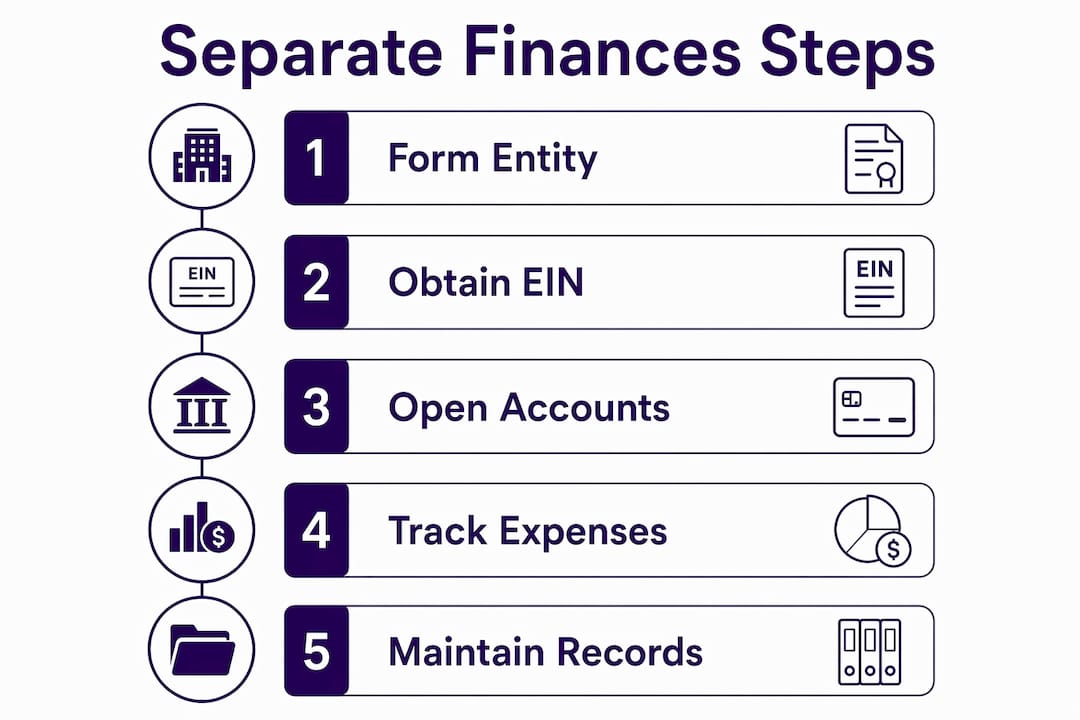
A dedicated business checking account is non-negotiable. All business income goes in. All business expenses come out. This single rule eliminates most commingling problems before they start. Business accounts sync with accounting software and clearly identify deductible expenses, which cuts hours off your tax preparation every year.

A business savings account adds another layer of discipline. Use it to set aside funds for quarterly estimated tax payments, which the IRS requires for self-employed owners and business entities. Keeping tax reserves in a separate savings account prevents you from accidentally spending money that belongs to the IRS.
Business credit cards serve two purposes at once. They track expenses automatically by category, and they report to business credit bureaus rather than personal ones. Business credit cards rarely report to personal credit bureaus, which means your business spending does not affect your personal credit score. That protection matters when you apply for a mortgage or personal loan.
| Account or Credit Type | Primary Purpose | Key Benefit |
|---|---|---|
| Business checking account | Receive income, pay expenses | Clean transaction record for taxes |
| Business savings account | Hold tax reserves and emergency funds | Prevents accidental spending of tax funds |
| Business credit card | Pay recurring and variable expenses | Builds business credit, auto-categorizes spending |
| Business line of credit | Cover short-term cash flow gaps | Keeps personal credit untouched |
| Merchant account | Accept customer payments | Deposits directly into business checking |
Sync all your business accounts with your accounting software from day one. Most platforms connect directly to business bank accounts and pull transactions automatically. This removes manual data entry and reduces the chance of missed or miscategorized expenses.
Pro Tip: Never use your business debit card for personal purchases, even once. A single personal transaction on a business account creates a paper trail that can complicate an IRS audit or a legal dispute.
Clean records are the proof that your separation is real. Without them, the IRS and courts have no evidence that your business operates independently from your personal finances. Good recordkeeping also protects every tax deduction you claim.
The IRS requires documentation for every income, deduction, and credit item on your tax return. The standard retention period is three years, but that extends to six years if you under-report income by 25% or more. Keep every receipt, invoice, bank statement, and contract for at least six years to be safe.
Follow this numbered process to build a recordkeeping system that holds up under scrutiny:
Monthly financial reviews are a recognized best practice for reducing tax-time stress and audit risk. Owners who skip monthly reconciliation often discover problems only when their accountant asks questions in april, which is the worst possible time to find a year’s worth of errors.
Keep these records in organized, separate folders:
The financial records your business needs go beyond just receipts. Contracts, board resolutions, and meeting minutes all support the argument that your business operates as a real, independent entity.
Mixed-use expenses are costs that serve both personal and business purposes. A cell phone used 60% for business and 40% personally is a classic example. The IRS allows you to deduct only the business-use portion, so you must document the split accurately and consistently.
Calculate your business-use percentage based on actual usage, not a rough guess. For a vehicle, track mileage with a mileage log that records the date, destination, and business purpose of every trip. For a home office, calculate the square footage of your dedicated workspace divided by total home square footage. These calculations must be defensible if the IRS asks.
Paying yourself correctly is equally important. The right method depends on your entity type:
Without a formal written Accountable Plan, reimbursements for business expenses you paid personally can be reclassified by the IRS as taxable income. A proper Accountable Plan allows legitimate business reimbursements without negative tax consequences, and every business owner who occasionally pays business costs from a personal account needs one in writing.
The Separation Ratio (SR) measures how much commingling exists in your accounts. An SR above 0.05 (5%) puts your personal assets at high risk of legal challenge. An SR below 0.01 is best practice. Calculate it by dividing the dollar value of mixed or personal transactions in your business accounts by total business transactions. If your SR creeps above 0.02, clean it up immediately before it becomes a legal problem.
The most damaging mistake is paying personal bills from a business account. It seems harmless once, but commingling funds is the primary evidence judges use to apply the Alter Ego doctrine and pierce the corporate veil. One personal Netflix charge on your business account will not destroy your LLC, but a pattern of personal payments absolutely can.
Here are the mistakes that most often jeopardize separation:
Failure to maintain separation threatens your LLC’s limited liability protection and can make you personally liable for business debts. That is the core risk. Everything else, the tax complications, the bookkeeping headaches, is secondary to the legal exposure.
Pro Tip: Schedule a 30-minute financial review every month. Check your business accounts for any personal transactions, verify your entity filings are current, and confirm your accounting software matches your bank statements. Catching problems monthly costs minutes. Fixing them at tax time costs hours and money.
Working with a CPA or professional bookkeeper adds a layer of accountability. A professional reviews your records with fresh eyes and catches patterns you might miss. The cost of professional help is almost always less than the cost of an IRS audit or a lawsuit that pierces your corporate veil. Manual bookkeeping creates gaps that grow into serious problems over time, especially as your transaction volume increases.
Maintaining a clean separation between business and personal finances protects your personal assets, reduces your tax burden, and builds the business credit your company needs to grow.
| Point | Details |
|---|---|
| Form a legal entity first | An LLC or corporation creates the legal foundation that makes financial separation meaningful and enforceable. |
| Open dedicated accounts immediately | A separate business checking account, savings account, and credit card eliminate most commingling problems from the start. |
| Document everything with a business purpose | The IRS requires written business justification for deductions; a brief note on every receipt is enough. |
| Use an Accountable Plan for reimbursements | A written Accountable Plan prevents the IRS from treating personal expense reimbursements as taxable income. |
| Monitor your Separation Ratio monthly | Keep your SR below 0.01 to stay in the low-risk zone and protect your LLC’s limited liability shield. |
Most new business owners underestimate how quickly commingling becomes a legal problem. They open a business account with good intentions, then use it once for a personal purchase because it is convenient. That one transaction becomes a habit. By the end of the year, their business account looks like a personal account with some business activity mixed in. At that point, the corporate veil is already weakened.
The owners who get this right share one habit: they treat their business account like it belongs to someone else. They would never pay a personal bill from a client’s account. They apply the same discipline to their own business. That mental shift is more powerful than any software or system.
The Accountable Plan is the most underused tool I see. Owners regularly pay business expenses from personal cards, then just forget to reimburse themselves formally. That creates a mess at tax time and a potential IRS problem. A one-page written Accountable Plan, reviewed by your CPA, fixes this entirely. It takes an hour to set up and saves significant headaches every year.
The other thing I tell every small business owner: get professional help earlier than you think you need it. Most owners wait until they have a problem, an audit notice, a lawsuit, a tax bill they did not expect. The owners who engage a bookkeeper and CPA from the beginning spend less money overall and sleep better. Financial hygiene is not a luxury for established businesses. It is the foundation that lets you build one.
— Taxbowl
Running a business is demanding enough without spending your evenings reconciling bank statements or second-guessing whether an expense was categorized correctly.
Taxbowl’s bookkeeping services are built specifically for small business owners who want clean, accurate financials without doing it themselves. A dedicated team of accountants handles your monthly reconciliation, expense categorization, and financial reporting, so your records are always audit-ready. When tax season arrives, your books are already done. For owners who want higher-level financial guidance, Taxbowl’s fractional CFO services provide the strategic oversight your business needs to grow with confidence. Talk to a Taxbowl expert and get a clear picture of where your finances stand today.
Maintaining financial separation preserves the corporate veil, which prevents creditors from seizing your personal assets to pay business debts. Courts treat commingling as primary evidence to pierce that veil under the Alter Ego doctrine.
An EIN (Employer Identification Number) is a federal tax ID issued by the IRS that identifies your business as a separate taxpayer. Most banks require an EIN to open a business account, and the IRS uses it to track your business filings independently from your personal tax return.
The IRS recommends keeping records for three years under normal circumstances, but that period extends to six years if you under-report income by 25% or more. Keeping all records for six years is the safest standard for most small business owners.
The Separation Ratio (SR) measures the percentage of personal or mixed transactions in your business accounts relative to total business transactions. An SR above 0.05 signals high legal risk, while keeping it below 0.01 is best practice for protecting your LLC’s limited liability status.
Yes. Without a written Accountable Plan, the IRS can reclassify reimbursements for personally paid business expenses as taxable income. A formal Accountable Plan, reviewed by a CPA, protects those reimbursements and keeps your deductions intact.