
Back to blog
Role of Quarterly Tax Estimates: 2026 Guide
Discover the vital role of quarterly tax estimates for small business owners and the self-employed. Learn how to avoid year-end tax surprises!
Discover the vital role of quarterly tax estimates for small business owners and the self-employed. Learn how to avoid year-end tax surprises!
Quarterly tax estimates are required payments made four times a year to the IRS, designed to help small business owners and self-employed individuals pay taxes on income as they earn it. The role of quarterly tax estimates goes well beyond simple compliance. These payments, formally called estimated taxes and filed using Form 1040-ES, serve as a cash flow management tool that prevents large, painful year-end tax bills. If you run a business, freelance, or earn income without automatic withholding, understanding this system is not optional. It is the foundation of sound financial management.
Estimated taxes are the IRS’s pay-as-you-go system for income that does not have automatic withholding. Employees have taxes withheld from every paycheck. Business owners, freelancers, and self-employed individuals do not. The IRS expects you to fill that gap with four scheduled payments each year.
The core role of quarterly tax estimates is to distribute your tax burden evenly across the year. Without them, you face a single massive payment every april, often with penalties added on top. With them, you build a predictable financial rhythm that keeps your cash flow stable and your IRS relationship clean.

Two named entities define this system: the IRS sets the rules, and Form 1040-ES is the worksheet and payment voucher you use to calculate and submit each payment. Many business owners also use accounting software like QuickBooks or Xero to track income and project quarterly obligations in real time.
The IRS applies clear thresholds to determine who must pay. Individuals owe estimated taxes if they expect to owe $1,000 or more after subtracting withholding and credits. Corporations hit the threshold at $500 or more. These numbers apply to sole proprietors, S-corp shareholders, partners in partnerships, and anyone with significant investment income.
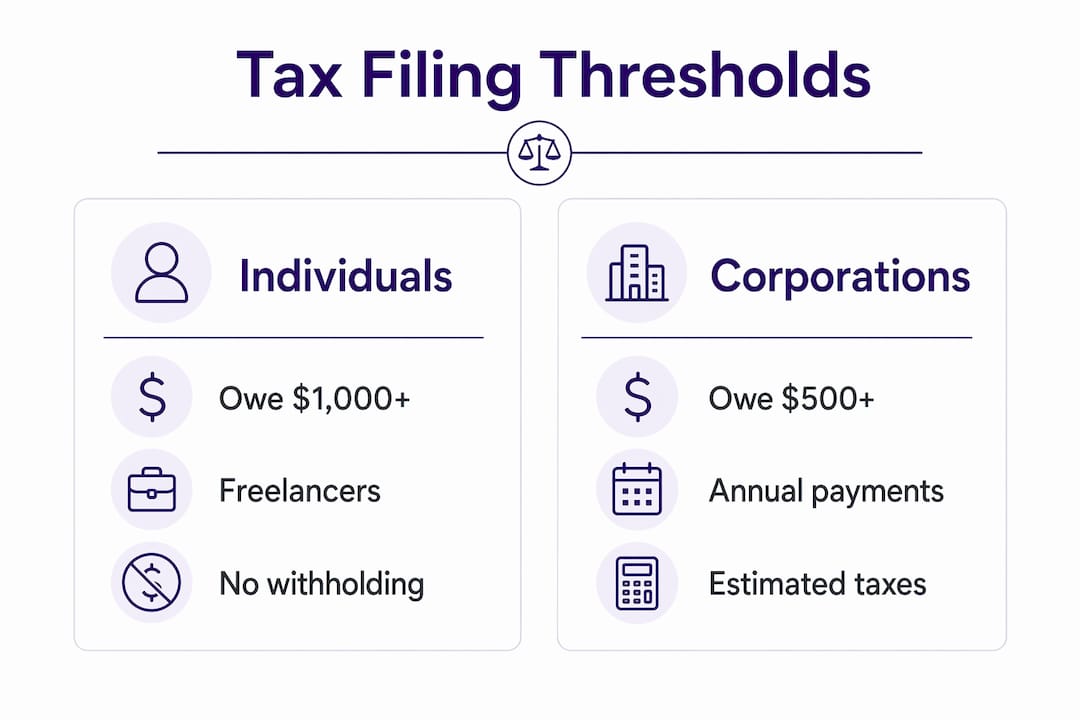
If you are a freelancer billing $80,000 a year with no withholding, you almost certainly cross the $1,000 threshold. The same applies to a restaurant owner, a real estate agent, or a consultant who left a salaried job mid-year.
The 2026 federal deadlines follow the standard IRS schedule. Each quarter covers a specific income period, and missing a deadline triggers a penalty assessed for that quarter specifically.
| Quarter | Income Period | Payment Due Date |
|---|---|---|
| Q1 | January 1 – March 31 | April 15, 2026 |
| Q2 | April 1 – May 31 | June 15, 2026 |
| Q3 | June 1 – August 31 | September 15, 2026 |
| Q4 | September 1 – December 31 | January 15, 2027 |
Notice that Q2 covers only two months, not three. This is one of the most common sources of confusion for first-time filers. The IRS designed the schedule this way, and it does not change.
The IRS offers two safe harbor options that protect you from underpayment penalties even if your final tax bill is higher than expected:
The IRS safe harbor rules give you a clear target. Many business owners choose the prior year method because it requires no guesswork. You simply divide last year’s tax bill by four and pay that amount each quarter.
One often-overlooked fact: the IRS allows you to pay estimated taxes weekly or monthly, not just quarterly. The only requirement is that your cumulative payments meet each quarterly deadline. This flexibility is a real advantage for businesses with irregular cash flow.
Accurate calculation is where most business owners either save money or lose it. Two primary methods exist, and choosing the right one depends on how consistent your income is.
This method is straightforward. Take your total tax liability from last year’s return, divide by four, and pay that amount each quarter. If your prior year tax bill was $12,000, you pay $3,000 per quarter. The Prior Year Safe Harbor method protects you from penalties regardless of what you actually earn this year. That protection is valuable, but it comes with a trade-off. If your income drops significantly, you may overpay and wait for a refund. If income spikes, you will owe a lump sum at filing.
The Annualized Income method adjusts each quarterly payment based on what you actually earned in that period. The Annualized Income method is recommended for business owners with fluctuating income, such as seasonal retailers, project-based consultants, or anyone whose revenue swings significantly quarter to quarter. It prevents overpayment in slow quarters and underpayment in strong ones.
To use this method, you calculate your income for each period, project it forward to an annual rate, apply the appropriate tax rate, and divide by four. It requires more work, but it aligns your payments with your actual financial reality.
The Form 1040-ES worksheet walks you through both methods step by step. Most tax preparation software, including TurboTax, H&R Block, and TaxAct, automates this calculation once you enter your income and deduction estimates. Accounting platforms like QuickBooks Self-Employed include quarterly tax estimators built directly into their dashboards.
Here is a practical step-by-step process for calculating your quarterly estimate:
Pro Tip: Set a calendar reminder two weeks before each quarterly deadline to update your income projection. A 30-minute review every quarter prevents the kind of surprises that cost real money at filing time.
Most business owners think of estimated taxes purely as a penalty avoidance tool. That framing misses the bigger picture. Quarterly taxes enforce a disciplined, predictable financial routine that prevents massive unexpected liabilities at year-end. That discipline is worth more than the penalty you avoid.
The pay-as-you-go system forces you to account for your tax liability in real time. When you set aside tax funds monthly and pay quarterly, you always know where you stand. You are not guessing in april whether you can cover a $30,000 tax bill. You have already paid most of it.
Business owners often misunderstand quarterly taxes as solely a compliance requirement rather than a cash flow management tool. This misunderstanding leads to reactive financial behavior, scrambling for cash in april instead of planning ahead all year.
Here are the most effective ways to use quarterly payments as a cash flow tool:
“Treating quarterly tax payments as a tax liability reserve, with cash set aside monthly in a dedicated account, improves cash management versus scrambling for a lump sum at quarter end.” — Fidelity
Pro Tip: A high-yield savings account earning 4–5% annually on your tax reserve turns a compliance obligation into a minor financial asset. You earn interest on money you owe, and you never face a cash crunch at payment time.
Compliance failures with estimated taxes follow predictable patterns. Knowing the most common mistakes lets you sidestep them before they cost you money.
Underpaying early quarters triggers penalties assessed per quarter, even if you overpay in later quarters. This is the most misunderstood rule in the estimated tax system. You cannot “catch up” in Q4 and erase a Q1 penalty. Each quarter stands on its own. The only exception is the Annualized Income Installment method, which accounts for actual income fluctuations and can reduce or eliminate penalties when income is uneven.
Missing a quarterly deadline is not the same as missing an annual filing deadline, but it still costs you. The IRS calculates the underpayment penalty based on the federal short-term interest rate plus 3 percentage points, applied to the amount you should have paid. Even a modest underpayment compounds over time.
Key compliance practices to build into your routine:
First-year entrepreneurs generally avoid underpayment penalties because they have no prior year tax return to base payments on. The IRS does not penalize you for not knowing what you did not yet earn. However, this grace period does not eliminate your tax liability. It only delays the reckoning. Many first-year business owners are blindsided by a large tax bill in april of their second year because they did not set aside funds during year one.
If you are in your first year of business, the Annualized Income method is your best tool. It bases payments on what you actually earn each quarter rather than a prior year baseline you do not have.
Pro Tip: Work with a CPA or enrolled agent at least once during your first year in business. A single consultation to set up your quarterly estimate process pays for itself many times over in avoided penalties and better cash planning.
Quarterly tax estimates are the most direct tool small business owners have for controlling cash flow, avoiding penalties, and building financial predictability throughout the year.
| Point | Details |
|---|---|
| Know your threshold | Individuals owing $1,000+ must pay quarterly; corporations owe at $500+. |
| Mark the 2026 deadlines | Payments are due april 15, june 15, september 15, and january 15, 2027. |
| Choose the right method | Use Prior Year Safe Harbor for stable income; use Annualized Income for fluctuating revenue. |
| Treat payments as reserves | Set aside tax funds monthly in a dedicated account to avoid cash crunches at payment time. |
| Never skip early quarters | Q1 and Q2 penalties cannot be erased by overpaying later unless you use the Annualized method. |
Most of the small business owners I work with come in thinking about quarterly taxes the wrong way. They see them as a punishment for not having an employer. They resent the paperwork, resent the deadlines, and treat each payment as money leaving their hands too soon. That mindset is expensive.
The business owners who manage their finances well think about quarterly estimates completely differently. They treat each payment as a confirmation that their business is profitable. If you owe estimated taxes, you are earning money. The payment is proof of that.
What I have seen consistently is that the owners who struggle most with quarterly taxes are the ones whose bookkeeping is behind. When your books are three months out of date, you are guessing at your income. You either overpay and hurt your cash flow, or you underpay and face a penalty. Current books solve both problems. Real-time financial visibility is not a luxury for small businesses. It is the prerequisite for accurate quarterly tax planning.
The other pattern I notice is that first-year business owners almost always underestimate their year-one tax liability. The IRS grace period on penalties creates a false sense of security. By the time april arrives in year two, the bill is real and the cash is often gone. The fix is simple: start setting aside 25–30% of net profit from day one, regardless of whether you owe a quarterly payment yet.
Quarterly tax planning and bookkeeping are not separate tasks. They are the same task. When you know your numbers, you know your tax obligation. When you know your obligation, you plan for it. That cycle, done consistently, is what separates businesses that grow from businesses that scramble.
— Taxbowl
Managing quarterly tax estimates requires accurate books, current income data, and a clear view of your cash position at all times. Taxbowl delivers exactly that for small business owners and entrepreneurs.
Taxbowl’s bookkeeping services keep your financial records current so your quarterly tax calculations are based on real numbers, not estimates built on outdated data. With a dedicated team of accountants, real-time financial visibility, and direct communication through platforms like Slack, Taxbowl gives you the support you need before each quarterly deadline. Taxbowl clients gain an average of $53,399 in visible outstanding receivables, which directly improves the accuracy of cash flow planning around tax payments. If you want quarterly taxes to work for your business instead of against it, talk to a Taxbowl expert today.
Any individual who expects to owe $1,000 or more in federal taxes after withholding and credits must make quarterly estimated payments. Corporations hit the requirement at $500 or more in expected tax liability.
The four federal deadlines for 2026 are april 15, june 15, september 15, and january 15, 2027. Each covers a specific income period, and missing any one of them triggers a per-quarter penalty.
The Prior Year Safe Harbor method is the most reliable for business owners with stable income. Pay 100% of last year’s tax liability in four equal installments, or 110% if your prior year adjusted gross income exceeded $150,000.
Yes. The IRS allows weekly or monthly payments as long as your cumulative total meets each quarterly deadline. This flexibility helps business owners with irregular cash flow avoid large one-time payments.
First-year business owners typically avoid underpayment penalties because they have no prior year return on file. However, they still owe the full tax liability at filing, so setting aside 25–30% of net profit from the start prevents a large surprise bill in year two.