
Back to blog
What Is Outsourced Bookkeeping for Small Businesses?
Discover what is outsourced bookkeeping and how it can save your small business time and money while ensuring accurate financial management.
Discover what is outsourced bookkeeping and how it can save your small business time and money while ensuring accurate financial management.
TL;DR:
- Outsourced bookkeeping involves hiring external providers to manage financial records remotely, offering accurate reports and real-time visibility. It helps small businesses scale efficiently by delivering professional expertise, reducing errors, and ensuring timely financial data. This approach is cost-effective, supports growth, and enhances control over business finances.
Outsourced bookkeeping is defined as the practice of hiring an external provider to manage your business’s financial record-keeping instead of handling it internally. The industry term for this practice is “outsourced accounting services,” though “outsourced bookkeeping” is the phrase most small business owners search for and use in practice. For small business owners, this model delivers access to skilled professionals, accurate monthly financials, and real-time visibility without the cost of a full-time hire. Outsourcing bookkeeping services means your transactions get recorded, your accounts get reconciled, and your reports get delivered on a predictable schedule. The result is cleaner books, fewer surprises, and more time to focus on running your business.
Outsourced bookkeeping is the delegation of financial record-keeping tasks to a third-party team or firm. Those tasks include recording transactions, reconciling bank accounts, managing accounts payable and receivable, and producing monthly financial reports. The provider works remotely, using cloud-based tools to access your financial data securely.
The importance of outsourced bookkeeping comes down to one thing: accurate, timely financial information. Without it, you are making decisions based on guesswork. A business owner who does not know their cash position until six weeks after month-end cannot react to problems fast enough to prevent them.
Outsourcing bookkeeping is not just a cost-saving move. It is a way to scale your finance operations by gaining access to enterprise-level tools and industry best practices that most small businesses cannot afford to build internally. That distinction matters because it reframes outsourcing as a growth decision, not a budget cut.
The benefits of outsourced bookkeeping go well beyond saving money on a salary. Here is what small business owners consistently gain from making the switch.
Cost savings without sacrificing quality. Hiring a full-time bookkeeper means paying wages, payroll taxes, benefits, and training costs. Outsourcing saves startups all of those expenses while delivering access to skilled experts familiar with financial regulations and modern software. You pay for the service, not the overhead.
Access to professional expertise. An outsourced team brings experience across multiple industries and business types. They know how to categorize transactions correctly, flag unusual activity, and prepare books that are audit-ready. A solo in-house bookkeeper rarely has that breadth of exposure.
Improved financial accuracy. Errors in bookkeeping compound over time. A missed reconciliation in january can distort your profit and loss statement for the entire quarter. Outsourced providers use structured workflows and review processes that catch mistakes before they become problems.
Real-time financial visibility. Cloud-based bookkeeping platforms allow you to access financial reports anytime, securely. That transparency means you can check your cash position on a Tuesday afternoon without waiting for a weekly update.
Scalability. As your business grows, your bookkeeping needs grow with it. Adding a new revenue stream or hiring your first employees creates more transactions to track. An outsourced provider scales with you without requiring you to hire, train, or manage additional staff.
Lower audit risk. Clean, consistently maintained books reduce the chance of errors that trigger IRS scrutiny. Outsourced bookkeepers follow standardized practices that keep your records organized and defensible.
Pro Tip: If you are competing against larger businesses with dedicated finance teams, outsourcing your bookkeeping levels the playing field. You get the same quality of financial reporting they do, at a fraction of the cost.
Outsourced bookkeeping operates through a remote, cloud-based workflow. Your provider connects to your financial accounts, processes transactions, and delivers reports on a regular schedule. You do not need to be in the same city, or even the same time zone.

The process follows a consistent monthly cycle:
A high-quality bookkeeping service should close your books within 5–7 business days after month-end. That timeline gives you timely financial reports while the month is still fresh, so you can make decisions mid-month rather than reacting to outdated numbers weeks later.
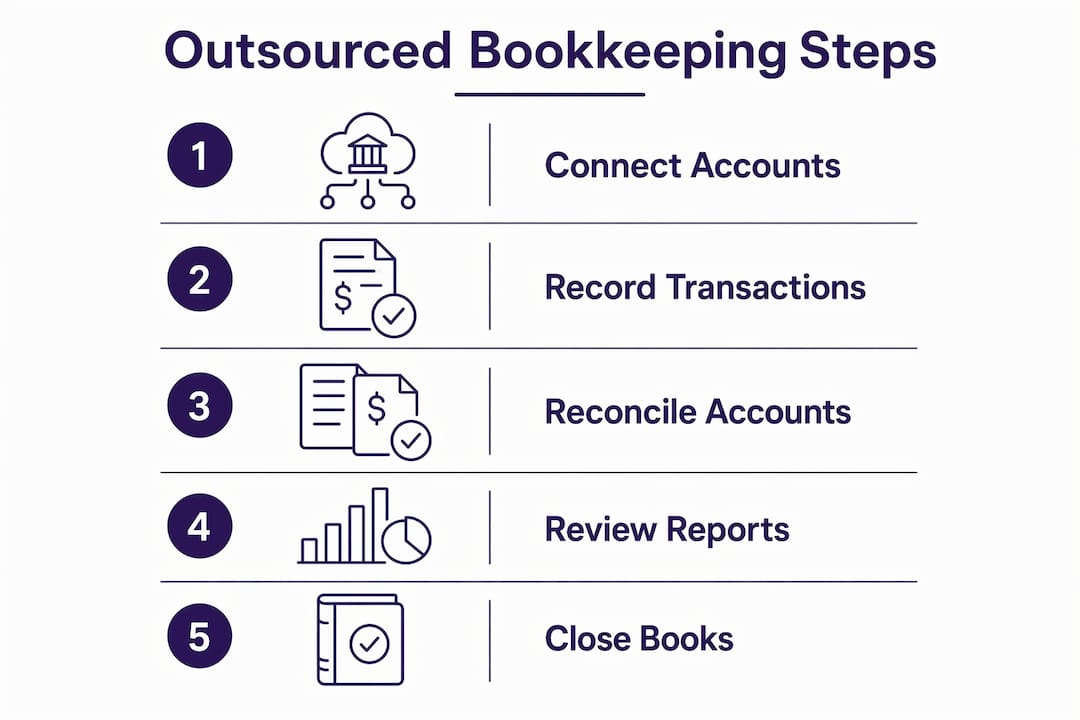
Providers that integrate with software like QuickBooks and your payment processors help avoid bookkeeping errors and delays. That clean data flow is what makes faster closes and accurate reports possible. Most outsourced bookkeeping firms also use secure portals or communication platforms to share documents and answer questions quickly.
Data security is a legitimate concern, and reputable providers address it directly. They use encrypted connections, role-based access controls, and regular backups to protect your financial data.
Typical outsourced bookkeeping services cover the full range of tasks needed to maintain accurate financial records. Here is what most providers include:
| Service | What it does for your business |
|---|---|
| Transaction recording | Keeps your books current and categorized correctly |
| Bank reconciliations | Confirms your records match actual account balances |
| Accounts payable/receivable | Tracks money owed and money due |
| Financial reporting | Delivers monthly profit and loss, balance sheet, cash flow |
| Payroll support | Aligns payroll data with your financial records |
| Tax preparation support | Organizes records for accurate, efficient tax filing |
The right provider covers all of these areas without requiring you to manage multiple vendors. That single-point-of-contact model reduces confusion and keeps your financial data consistent across every report.
Choosing the right provider is where most small business owners make avoidable mistakes. Price is the most visible factor, but it is rarely the most important one.
The right outsourced bookkeeping service depends heavily on your business’s stage of growth and complexity, not just price. A startup with 50 monthly transactions has different needs than a $2 million revenue business with multiple revenue streams, employees, and inventory. Match the provider to where your business actually is, not where you hope it will be in two years.
Here are the criteria that matter most:
Pro Tip: Before signing any contract, ask the provider to walk you through a sample monthly close process. How they explain it tells you a lot about how organized and communicative they actually are.
The cost of outsourced bookkeeping varies by business size and service scope. Entry-level packages for simple businesses typically start at a few hundred dollars per month. More complex businesses with payroll, multiple accounts, and detailed reporting pay more. In most cases, that cost is still lower than the fully loaded expense of a part-time in-house bookkeeper when you factor in wages, taxes, and benefits.
Outsourced bookkeeping gives small business owners accurate, timely financial records without the cost and complexity of managing an in-house bookkeeping function.
| Point | Details |
|---|---|
| Core definition | Outsourced bookkeeping means hiring an external provider to manage your financial records remotely. |
| Primary benefit | You get accurate monthly financials and real-time visibility without a full-time hire. |
| Standard timeline | A quality provider closes your books within 5–7 business days after month-end. |
| Selection criteria | Match the provider to your business’s growth stage and complexity, not just the lowest price. |
| Included services | Expect transaction recording, reconciliations, financial reporting, payroll support, and tax prep support. |
Most small business owners come to outsourcing after a painful moment. A missed tax deadline. A cash flow crisis they did not see coming. A bank reconciliation that has not been touched in four months. By the time they reach out for help, the books are a mess and the cleanup costs more than prevention would have.
Here is what years of working with small business owners has taught us at Taxbowl: the owners who struggle most with their finances are not careless. They are busy. They are doing the work of three people, and bookkeeping keeps sliding to the bottom of the list because it does not feel urgent until it suddenly is.
The misconception we hear most often is that outsourcing is only for businesses that cannot afford a real employee. That is backwards. The businesses that benefit most from outsourced bookkeeping are the ones growing fast enough that their financial complexity is outpacing what one person can manage. They need a team, not a single hire.
The other misconception is that outsourcing means losing control of your finances. The opposite is true. When your books are current, your reports arrive on time, and you can ping your bookkeeping team with a question and get an answer the same day, you have more control than you ever did when the books sat on someone’s desk waiting to be updated.
Outsourcing bookkeeping is not about handing off a problem. It is about building a financial foundation that supports every other decision you make in your business. The owners who treat it that way consistently make better decisions, catch problems earlier, and grow with less financial stress.
— Taxbowl
Small business owners who want clean books, fast closes, and a team they can actually reach should look at what Taxbowl offers.
Taxbowl provides dedicated bookkeeping services built specifically for small businesses and startups. Your account is handled by a team of experienced accountants who close your books within the industry-standard window, deliver monthly financial reports, and stay available through real-time communication on platforms like Slack. There are no handoffs to junior staff and no waiting days for a reply to a simple question. If you want to see how Taxbowl fits your business, talk to an expert and get a clear picture of what your books could look like.
Outsourced bookkeeping means hiring an external provider to record your financial transactions, reconcile your accounts, and produce monthly financial reports instead of doing it yourself or hiring an in-house employee.
The cost varies by business size and service scope. Simple businesses typically pay a few hundred dollars per month, while more complex businesses with payroll and multiple accounts pay more. The total is usually lower than the fully loaded cost of a part-time in-house bookkeeper.
In-house bookkeeping means employing someone directly, which adds wages, payroll taxes, and benefits to your overhead. Outsourced bookkeeping delivers the same or better quality through an external team, typically at a lower total cost and with broader expertise.
Your provider records transactions, reconciles your bank and credit card accounts, manages accounts payable and receivable, and delivers a full set of financial reports. A quality provider completes this cycle within 5–7 business days after each month-end.
Reputable outsourced bookkeeping providers use encrypted connections, secure document portals, and role-based access controls to protect your financial data. Always confirm a provider’s security practices before sharing account access.