
Back to blog
Law Firm Tax Classification: What Partners Must Know
Learn what is law firm tax classification and how it impacts partners. Get the right tax status to reduce tax burdens and avoid compliance risks.

Learn what is law firm tax classification and how it impacts partners. Get the right tax status to reduce tax burdens and avoid compliance risks.
TL;DR:
- Law firm tax classification determines how income is taxed, reported, and distributed among partners. Most firms default to partnership taxation, passing income directly to partners, while some elect S-Corp status to reduce payroll taxes. Correct classification involves ongoing compliance with IRS rules, state bar restrictions, and careful management of partner structures.
Law firm tax classification is the IRS-designated tax status that determines how a law firm’s income is taxed, reported, and distributed among partners for federal and state purposes. This classification shapes everything from the forms you file to the self-employment taxes each partner owes. Get it wrong, and you face audit risk, unexpected tax bills, and compliance failures with your state bar. Get it right, and you reduce your firm’s overall tax burden while keeping every partner’s obligations clean and predictable.

Law firm tax classification refers to the federal tax treatment assigned to a law firm based on its legal entity structure. The IRS does not create a separate category for law firms. Instead, it applies the same entity classifications used for all businesses: partnership, S-Corporation, C-Corporation, or disregarded entity.
Most law firms default to partnership taxation. A general partnership, limited liability partnership (LLP), or multi-member professional limited liability company (PLLC) all default to pass-through taxation under Subchapter K of the Internal Revenue Code. Pass-through taxation means the firm itself pays no federal income tax. Instead, each partner reports their share of income, deductions, and credits on their personal return via IRS Schedule K-1.
The classification also determines which IRS forms the firm files. Partnerships file Form 1065. Professional corporations (PCs) taxed as C-Corps file Form 1120. Firms that elect S-Corp status file Form 1120-S. Each path carries different compliance requirements, tax rates, and partner-level obligations.
State bar rules add another layer. Many states prohibit law firms from forming LLCs to provide legal services and require LLPs or PCs instead. California is the clearest example: law firms there must organize as PCs or LLPs. That restriction directly limits which federal tax classifications are available to California firms.
Law firms operate under four primary tax classifications. Each has distinct default rules, elective options, and compliance requirements.
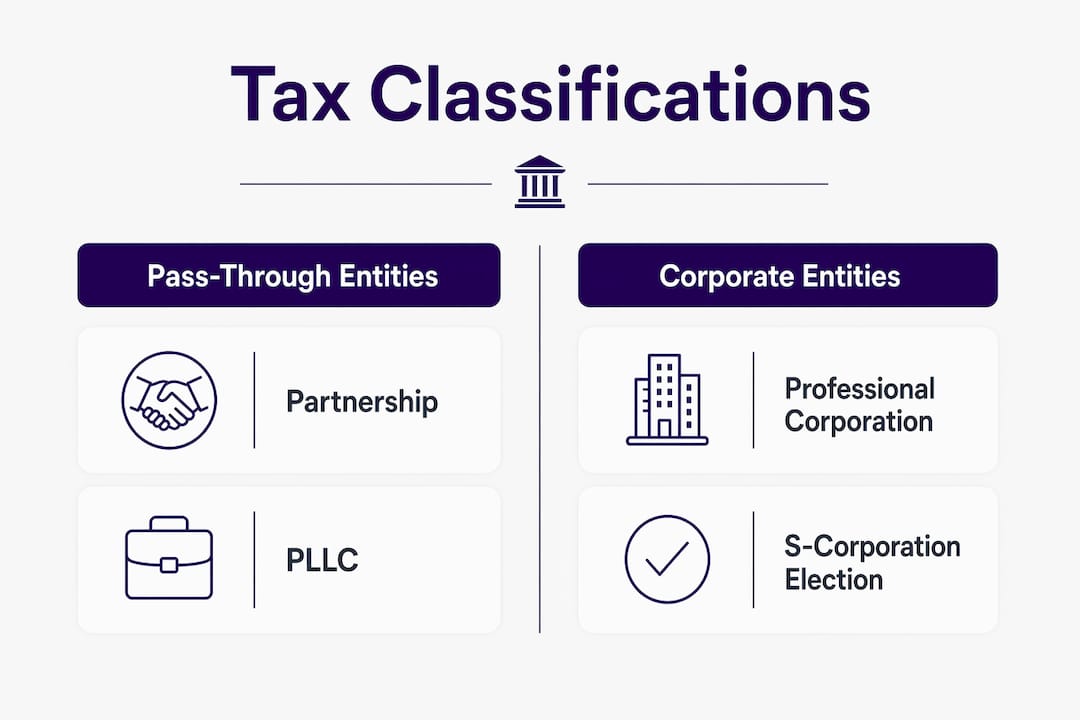
The partnership classification covers LLPs, general partnerships, and multi-member PLLCs. All income, losses, and deductions pass through to partners proportionally. The firm files Form 1065 annually, and each partner receives a Schedule K-1 showing their allocated share. Partners then report that income on their personal Form 1040 and pay self-employment tax on their net earnings.
A PC is a corporation formed specifically by licensed professionals. By default, a PC is taxed as a C-Corporation, meaning the firm pays corporate income tax and partners pay personal income tax on any dividends. This creates double taxation. Most law firm PCs avoid this by electing S-Corp status, which converts the PC to pass-through taxation while retaining the corporate legal structure.
PLLCs default to pass-through taxation and carry simpler compliance requirements than PCs. They have lower filing fees, fewer formalities, and avoid double taxation unless the firm elects C-Corp status. PLLCs can also elect S-Corp tax treatment by filing IRS Form 2553. This flexibility makes the PLLC a popular choice in states that permit it.
The S-Corp election allows law firms organized as PCs or PLLCs to split income into two buckets: a reasonable salary subject to payroll taxes, and distributions not subject to self-employment tax. This split reduces the total payroll tax burden for profitable firms. The firm must file IRS Form 2553 to make the election, and each shareholder-partner must take a salary that reflects fair market compensation for their services.
The table below summarizes the key differences across these classifications.
| Entity type | Default tax treatment | Key IRS form | Self-employment tax on distributions? |
|---|---|---|---|
| LLP / General partnership | Pass-through (Subchapter K) | Form 1065 | Yes |
| PLLC | Pass-through (Subchapter K) | Form 1065 | Yes |
| PC (no election) | C-Corp (double taxation) | Form 1120 | No (dividends taxed separately) |
| PC or PLLC with S-Corp election | Pass-through (Subchapter S) | Form 1120-S | No (on distributions above salary) |
Tax classification determines exactly how much each partner owes, when they owe it, and which forms they file. The differences are significant and affect every partner differently depending on their equity status.
Partners in LLPs and PLLCs taxed as partnerships receive a Schedule K-1 each year. That form reports their share of firm income, losses, deductions, and credits. Partners pay self-employment tax on 92.35% of their profit distributions reported on K-1s, regardless of when or whether cash is actually distributed. Guaranteed payments, reported in Box 4 of the K-1, are also fully subject to self-employment tax. This is a critical point: you owe tax on allocated income, not just on cash you received.
Guaranteed payments are fixed amounts a firm pays partners regardless of profitability. They function like salary for tax purposes. Profit distributions, by contrast, reflect each partner’s share of net firm income. Both are taxable to the partner. The distinction matters for planning because guaranteed payments are deductible by the firm, which reduces the taxable income allocated to other partners.
When a firm elects S-Corp status, partners become shareholder-employees. The firm must run payroll for each partner-shareholder and withhold FICA taxes on their salary. Distributions above the salary are not subject to payroll tax. This structure reduces the self-employment tax burden compared to a straight partnership, but it adds payroll compliance obligations. Firms must file quarterly payroll returns and issue W-2s in addition to Form 1120-S.
Pro Tip: Review each partner’s classification annually. A non-equity partner reclassified as a K-1 partner without genuine ownership rights is one of the most common law firm audit triggers the IRS pursues.
The most tax-efficient structure for a law firm depends on the state where it practices, the number of partners, and the firm’s profitability. No single structure works for every firm.
Some firms implement a hybrid structure combining an LLP at the firm level with individual S-Corporations owned by each partner. The LLP satisfies state bar requirements that prohibit LLCs. Each partner’s personal S-Corp receives their allocated share of firm profits. The partner then pays themselves a reasonable salary through their S-Corp and takes the remainder as a distribution, avoiding self-employment tax on the distribution portion.
This model works well in states like California that require LLPs or PCs. It gives partners the tax benefits of S-Corp status without requiring the entire firm to reorganize as a PC.
Key considerations for the hybrid model:
The S-Corp election provides meaningful tax savings by reducing self-employment taxes, but the administrative and payroll compliance costs can offset those benefits entirely for smaller or solo firms. If nearly all of a partner’s income comes from their own billable hours, the IRS requires a reasonable salary that captures most of that income anyway, leaving little room for tax-free distributions.
The math works in favor of S-Corp election when a firm generates significant net profit above what a reasonable salary would consume. For a firm with one partner billing $200,000 and a reasonable salary of $120,000, the S-Corp election saves payroll taxes on $80,000 of distributions. For a solo practitioner netting $90,000 with a reasonable salary of $85,000, the savings are minimal and the added compliance costs may exceed them.
Pro Tip: Run the numbers before electing S-Corp status. Calculate your reasonable salary, estimate payroll compliance costs, and compare the net savings. For most firms, the election becomes worthwhile when annual net profit exceeds $50,000 above a defensible salary.
Changing your firm’s tax classification requires specific IRS filings, and missing deadlines can delay the election by a full year. Follow these steps to identify your current classification and make a change correctly.
Check your last filed tax return. The form type tells you your current classification. Form 1065 means partnership. Form 1120-S means S-Corp. Form 1120 means C-Corp. If you are unsure, your CPA or the IRS transcript service can confirm it.
Confirm your state bar requirements. Before changing your entity type, verify which structures your state permits for law firms. California requires PCs or LLPs. Other states have their own restrictions. Changing your federal tax classification without adjusting your legal entity can create a mismatch that causes compliance problems.
File IRS Form 2553 to elect S-Corp status. This form must be filed no later than two months and 15 days after the start of the tax year in which you want the election to take effect. For a calendar-year firm, that deadline is March 15. Filing late defaults the election to the following tax year.
Request late election relief if you missed the deadline. The IRS allows late S-Corp elections under Revenue Procedure 2013-30 if the firm can show reasonable cause for the delay. Attach a statement explaining the circumstances when filing Form 2553 late.
Set up payroll immediately after election. Once the S-Corp election takes effect, each shareholder-partner must be on payroll. Failing to run payroll from day one is a common mistake that creates back-tax liability and penalties. Taxbowl’s law firm payroll compliance resources cover the specific setup steps for newly elected S-Corps.
File state-level elections where required. Some states do not automatically recognize a federal S-Corp election. California, for example, requires a separate state S-Corp election. Missing the state filing means you pay state corporate tax at the entity level despite the federal pass-through treatment.
Common pitfalls include failing to update the firm’s operating agreement after a classification change, neglecting to notify the state bar of an entity restructuring, and underestimating the ongoing payroll compliance burden. Work with a CPA who specializes in law firm tax structures to avoid these mistakes.
Law firm tax classification is the IRS-designated status that governs how firm income is taxed, which forms partners file, and what payroll obligations apply at both the firm and individual partner level.
| Point | Details |
|---|---|
| Default classification matters | Most law firms default to partnership taxation, meaning all income passes through to partners via Schedule K-1. |
| State bar rules limit options | States like California prohibit LLCs for law firms, restricting available tax classifications to LLPs or PCs. |
| S-Corp election reduces payroll tax | Firms can split income into salary and distributions, but must pay reasonable compensation and run payroll. |
| Non-equity partner classification carries audit risk | Reclassifying non-equity partners as K-1 partners without genuine ownership rights is a known IRS audit trigger. |
| Hybrid structures offer flexibility | The LLP plus individual partner S-Corp model can satisfy bar requirements while delivering S-Corp tax benefits. |
At Taxbowl, we see the same pattern repeatedly. A firm grows, profits rise, and someone suggests switching to S-Corp status to cut the tax bill. The partners agree, file Form 2553, and assume the work is done. Six months later, no payroll has been run, no W-2s have been issued, and the IRS is treating the firm as if the election never happened.
The classification decision is not a one-time filing. It is an ongoing operational commitment. S-Corp status requires quarterly payroll filings, reasonable compensation documentation, and state-level compliance that varies by jurisdiction. Firms that treat it as a checkbox exercise end up paying more in penalties and back taxes than they saved.
The non-equity partner issue is equally misunderstood. Reclassifying a senior associate as a K-1 partner to save payroll taxes sounds appealing. But if that person has no voting rights, no real profit participation, and no access to firm financials, the IRS will reclassify them as an employee and assess back payroll taxes with interest. The savings evaporate, and the audit relationship with the IRS becomes a long-term problem.
The firms that get this right treat classification as a living decision. They review it annually, model the tax impact of any changes, and keep their entity structure aligned with their actual practice structure. They also work with advisors who understand both the tax code and the state bar rules that constrain their options. That combination of legal and tax expertise is not optional. It is the baseline for getting this right.
— Taxbowl
Law firm tax classification touches bookkeeping, payroll, quarterly filings, and partner-level reporting all at once. Taxbowl’s team of dedicated accountants works directly with law firm partners and administrators to keep every layer of that compliance current and accurate.
Whether your firm needs help setting up payroll after an S-Corp election, documenting reasonable compensation, or reviewing your current entity structure against state bar requirements, Taxbowl provides real-time support through proactive communication. You can talk to a Taxbowl expert to get a clear picture of your firm’s current classification, identify gaps, and build a tax strategy that fits your firm’s size and goals. For firms that want ongoing support, Taxbowl’s law firm accounting services cover everything from bookkeeping to fractional CFO guidance.
Law firm tax classification is the IRS-designated status that determines how a firm’s income is taxed at the federal level. It is based on the firm’s legal entity type and any elections the firm has made, such as S-Corp status.
Most law firms default to partnership taxation, where income passes through to partners via Schedule K-1 and each partner pays self-employment tax on their allocated share. The firm itself pays no federal income tax under this structure.
Yes. A law firm organized as a PC or PLLC can elect S-Corp status by filing IRS Form 2553. The election must be filed by March 15 for calendar-year firms to take effect in the current tax year.
The IRS scrutinizes arrangements where partners receive K-1s but hold no real ownership rights. To withstand audit, reclassified partners must have genuine voting rights, profit participation, and access to firm financials.
No. California, for example, prohibits law firms from forming LLCs and requires PCs or LLPs instead. These state bar restrictions directly limit which federal tax classifications are available to firms in those states.