
Back to blog
Law Firm Payroll Compliance Guide for 2026
Master payroll obligations with our comprehensive law firm payroll compliance guide for 2026. Ensure your firm's financial health today!
Master payroll obligations with our comprehensive law firm payroll compliance guide for 2026. Ensure your firm's financial health today!
TL;DR:
- Law firms must comply with complex payroll tax laws, including partner salaries, multi-state withholding, and contractor reporting. Regular monthly payroll reviews and proper documentation are essential to avoid costly IRS penalties and audits. Using integrated payroll and accounting systems with oversight reduces errors and ensures ongoing compliance.
Law firm payroll compliance is the process of following all applicable federal, state, and local payroll tax laws, regulations, and reporting requirements specific to legal employers. Law firms face payroll obligations that most small businesses never encounter: S-Corp partner salary rules, trust account segregation, paralegal classification risks, and multi-state withholding triggered by remote staff. This law firm payroll compliance guide covers every layer of that complexity. The IRS, the Department of Labor, and state tax agencies each enforce distinct rules, and a mistake with any one of them can cost your firm far more than the original tax owed. Getting this right is not optional. It is the foundation of a financially healthy practice.
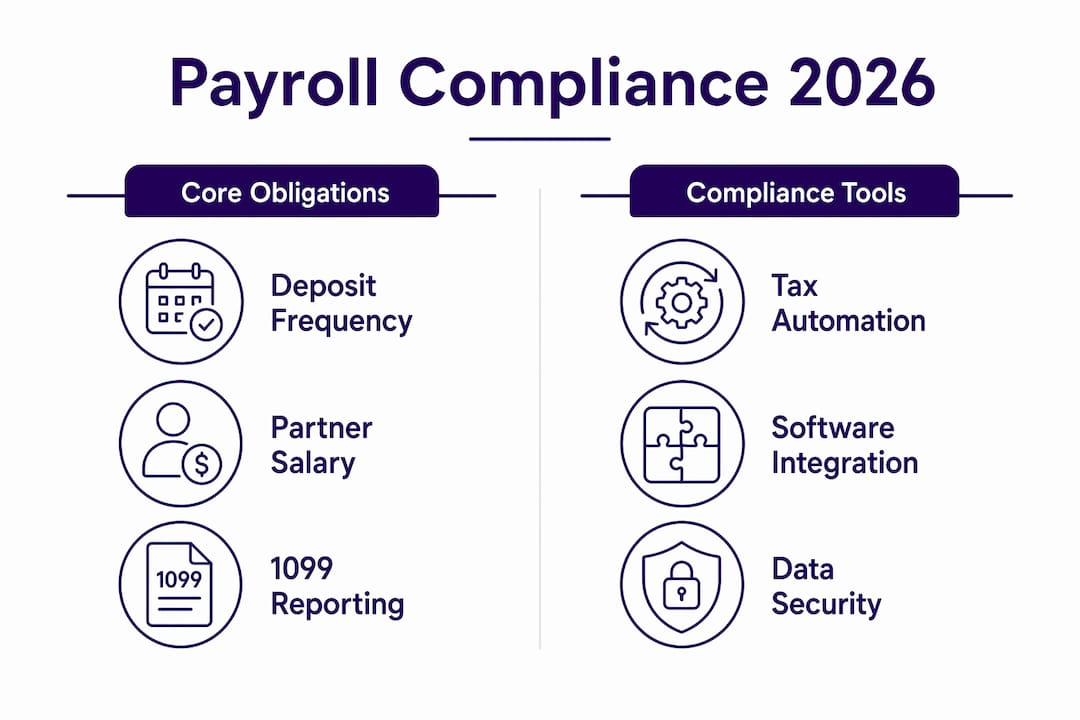
Law firm payroll compliance in 2026 centers on four core obligations: federal deposit schedules, S-Corp partner compensation, contractor reporting, and multi-state withholding.
The IRS assigns deposit frequency based on your look-back period. New employers start on a monthly deposit schedule. Firms whose look-back liability exceeds $50,000 must switch to a semi-weekly schedule. That means payroll taxes for wages paid on Wednesday through Friday are due the following Wednesday, and taxes for wages paid Saturday through Tuesday are due the following Friday. Missing these windows triggers penalties that compound quickly.
S-Corp law firm partners must receive a reasonable salary before distributions. Tax professionals commonly benchmark that salary at 40–60% of total distributions. The IRS scrutinizes firms that pay partners minimal salaries to avoid payroll taxes on the remainder. Underpaying a partner’s salary is one of the most common audit triggers for legal practices. You can find a deeper breakdown of the tax implications in this S-Corp election guide.
The 2026 IRS threshold for 1099 contractor reporting increased to $2,000 in annual payments. Any independent contractor your firm pays above that amount requires a Form 1099-NEC. This change demands tighter payment tracking throughout the year, not just at year-end.
| Obligation | Trigger | Action Required |
|---|---|---|
| State income tax withholding | Employee works in that state | Register and withhold per state rules |
| State unemployment insurance | Employee is based in that state | File and pay separately per state |
| Local payroll taxes | Employee works in a taxing municipality | Identify and remit local levies |
| Nexus registration | Payroll activity in a new state | Register before first paycheck |
Remote work creates payroll tax obligations in every state where an employee performs work. A paralegal working from home in a different state than your office creates a new tax registration requirement immediately. Ignoring that obligation does not eliminate it. It simply adds interest and penalties to the eventual bill.
Solid documentation is your first line of defense in any audit. Every pay period, your payroll records need to be complete, consistent, and stored securely.

Compliant pay stubs protect firms against wage claims and demonstrate regulatory adherence. At minimum, each pay stub must include:
State requirements vary. California, for example, mandates more detail than most states. Check your state labor agency’s requirements for every state where you have employees.
Linking payroll costs to specific client matters gives you two things at once: billing accuracy and a clear record of how labor costs align with revenue. When you can show that a paralegal’s hours map to specific matters, you also have documentation that supports their classification and compensation level. This matters during an audit.
Partner draws and distributions are not payroll. They must flow through separate accounts and appear on separate records. Mixing draws with W-2 wages creates accounting confusion and raises red flags with the IRS. Your bookkeeping system should treat these as entirely distinct transaction types.
Federal law requires you to keep payroll records for at least three years, and tax records for at least four years after the tax is due or paid. Many states require longer retention periods. Build a retention schedule into your document management system and apply it consistently.
Pro Tip: Set a calendar reminder each january to archive the prior year’s payroll records and confirm your retention schedule still meets current federal and state requirements.
Law firms run into the same compliance problems repeatedly. Knowing where the traps are makes them avoidable.
Misclassifying paralegals as exempt. Many firms misclassify paralegals under the learned professional exemption, but paralegals typically work under attorney supervision and do not qualify. The result is overtime liability and back pay exposure. Review every exempt classification against the Department of Labor’s duties test.
Relying on automated payroll software without oversight. Cheap automated payroll services frequently miss state-specific labor law variations and S-Corp compensation rules. The liability stays with your firm regardless of what the software did or did not do. Automation is a tool, not a guarantee.
Late payroll tax deposits. Penalties for late deposits escalate fast: 2% for deposits 1–5 days late, 5% for 6–15 days late, and 10% after 15 days. Those penalties are not deductible, so they hit your cash flow directly. A $50,000 payroll tax deposit that is three weeks late costs your firm $5,000 before interest.
Multi-state withholding errors. Firms with remote staff often fail to register in every state where employees work. Each unregistered state is a separate compliance failure with its own penalty structure.
S-Corp salary set too low. Partners who take minimal salaries and large distributions invite IRS reclassification. The IRS can recharacterize distributions as wages, assess back payroll taxes, and add penalties and interest. Benchmark salaries against comparable roles using Bureau of Labor Statistics data or industry surveys.
No monthly review cycle. Most small law firms skip monthly payroll reviews, which lets errors accumulate until they become expensive. A monthly reconciliation catches deposit timing errors, withholding miscalculations, and classification issues before they compound.
Payroll tax penalties are not deductible business expenses. Every dollar your firm pays in penalties is a dollar that reduces profit with no tax offset. The real cost of a $10,000 penalty is closer to $13,000–$15,000 when you factor in the lost deduction at typical law firm tax rates.
The right systems reduce manual errors and give you a clear audit trail. The wrong ones create a false sense of security.
Payroll systems that connect directly with legal practice management tools like Clio and accounting platforms like QuickBooks eliminate the manual data transfer that causes most reconciliation errors. When time entries flow from your practice management system into payroll, and payroll flows into your general ledger, you get accurate financial reporting without duplicate entry. Automated payroll systems integrated with legal accounting tools dramatically reduce reconciliation errors and improve reporting transparency.
| Feature | Basic payroll platforms | Full-service payroll with legal focus |
|---|---|---|
| State tax registration support | Limited or manual | Guided or handled for you |
| Multi-state withholding calculation | Partial | Automatic per work location |
| S-Corp salary benchmarking | Not included | Available with CPA oversight |
| Trust account segregation alerts | Not included | Built-in or configurable |
| Monthly reconciliation reports | Basic | Detailed, audit-ready |
Geolocation and tax nexus automation identify which states require registration based on where your employees actually work. This is not a feature you want to skip if any of your staff works remotely. The rise of remote work has made multi-state payroll expertise a baseline requirement, not a specialty.
Payroll data contains Social Security numbers, bank account details, and compensation information. Encrypt payroll files at rest and in transit. Require multi-factor authentication for anyone accessing payroll systems. Limit access to only the staff who need it. A data breach involving payroll records creates both legal liability and reputational damage.
Your payroll administrator and your CPA need to communicate regularly, not just at tax time. Monthly check-ins catch issues like deposit timing mismatches, new state obligations from recent hires, and changes in partner compensation structures. Review accountant communication best practices to build a consistent rhythm that keeps both sides aligned.
Pro Tip: Create a shared payroll compliance calendar that includes every federal and state deposit deadline, quarterly filing date, and annual reporting deadline. Share it with your CPA and update it whenever you hire in a new state.
An IRS payroll audit is not a random event. It follows specific triggers, and most of them are avoidable.
Respond within the deadline stated on the notice. Do not ignore it. Gather your payroll records, deposit confirmations, and filed returns for the period in question. Contact your CPA immediately. Many notices are routine information requests, not full audits. A timely, organized response often resolves them without escalation.
Legal firms must keep trust accounts completely separate from payroll accounts. Commingling client funds with operating or payroll funds is an ethical violation that can trigger bar complaints and disbarment proceedings, in addition to IRS scrutiny. Your payroll system should never have access to IOLTA or client trust accounts.
Monthly payroll audits and reconciliation help law firms avoid accidental underpayments and late filings. When you reconcile monthly, you catch deposit errors before the IRS does. You also build a clean paper trail that makes any future audit faster and less disruptive. Think of monthly reviews as the cheapest insurance your firm can buy. For a broader view of how an accountant supports this process, see this law firm compliance guide.
Effective law firm payroll compliance requires accurate deposit scheduling, documented partner compensation, correct worker classification, and monthly reconciliation to prevent IRS penalties and audits.
| Point | Details |
|---|---|
| Deposit schedule matters | Firms with look-back liability over $50,000 must use a semi-weekly deposit schedule or face escalating penalties. |
| S-Corp salaries need benchmarking | Partner salaries set at 40–60% of total distributions reduce IRS reclassification risk significantly. |
| Contractor threshold changed | The 2026 1099 reporting threshold is $2,000, requiring tighter payment tracking throughout the year. |
| Monthly reviews prevent audits | Reconciling payroll monthly catches errors before they trigger IRS notices or penalty assessments. |
| Trust accounts must stay separate | Commingling client trust funds with payroll accounts creates both ethical violations and audit exposure. |
The firms that get into the most trouble are not the ones that ignore payroll entirely. They are the ones that set it up once, hand it to a software platform, and assume it runs itself. That assumption is expensive.
The S-Corp salary issue is the clearest example. A managing partner takes $400,000 in distributions and pays themselves a $40,000 salary. On paper, it looks like a tax win. In practice, it is a red flag that the IRS has seen thousands of times. The back taxes, penalties, and interest on a reclassification can wipe out years of perceived savings in a single audit cycle. Proper partner tax planning is not a luxury. It is what keeps that strategy legal.
The other pattern I see constantly is firms that treat payroll compliance as a once-a-year task. They file their 941s, issue W-2s, and consider the job done. But compliance is a monthly discipline. Deposit timing errors, new state obligations from a remote hire, a paralegal reclassification: these are issues that surface mid-year and compound if no one is watching. A monthly review cycle is the single highest-return habit a firm administrator can build.
Cheap payroll software is not the villain here. The real problem is using it without human oversight. Automation handles the routine. A qualified accountant handles the judgment calls. You need both, and the accountant needs to be in the loop every month, not just in april.
— Taxbowl
Law firm payroll has more moving parts than most accounting firms are built to handle. Taxbowl is different.
Taxbowl combines dedicated accountants, real-time financial visibility, and direct communication through platforms like Slack to keep your payroll compliant and your partners informed. The team handles S-Corp salary benchmarking, multi-state withholding registration, monthly reconciliation, and audit-ready reporting, all in one place. You get bookkeeping and payroll support built for the specific demands of legal practices, not a generic small business template. If you want to see exactly where your firm stands and what needs to change, talk to a Taxbowl expert and get a clear picture of your compliance posture today.
Law firm payroll compliance is the process of meeting all federal, state, and local payroll tax obligations specific to legal employers, including deposit schedules, partner compensation rules, contractor reporting, and worker classification requirements.
Law firms should run a payroll reconciliation every month. Monthly reviews catch deposit timing errors, withholding miscalculations, and classification issues before they trigger IRS penalties.
Tax professionals commonly recommend that S-Corp partners receive a salary equal to 40–60% of their total distributions. Salaries set significantly below that range are a common IRS audit trigger.
Yes. Every state where an employee performs work creates a separate payroll tax registration, withholding, and filing obligation for the firm, regardless of where the firm’s office is located.
The IRS charges 2% for deposits 1–5 days late, 5% for deposits 6–15 days late, and 10% for deposits more than 15 days late. These penalties are not tax-deductible, so they directly reduce firm cash flow.