
Back to blog
Dental Practice Bookkeeping: A Complete 2025 Guide
Discover what dental practice bookkeeping is and why it's crucial for your practice. Learn how to track finances effectively in 2026.

Discover what dental practice bookkeeping is and why it's crucial for your practice. Learn how to track finances effectively in 2026.
Dental practice bookkeeping is the systematic process of recording, organizing, and categorizing every financial transaction that runs through your practice. That means patient payments, insurance reimbursements, lab fees, payroll, equipment purchases, and overhead costs, all tracked consistently so your numbers tell the truth.
It is worth separating this from dental practice accounting, because the two are not the same thing. Bookkeeping focuses on recording and reconciling financial data. Accounting takes that data and interprets it, preparing financial statements, analyzing profitability, and filing taxes. You need both, but bookkeeping is the foundation everything else rests on.
What makes dental bookkeeping distinct from general small business bookkeeping is the complexity of your revenue streams. You collect directly from patients, wait on insurance reimbursements from multiple payers, and manage write-offs and adjustments that general bookkeepers often misclassify. Add HIPAA obligations, because your financial records contain protected health information, and the stakes for getting it right are higher than in most industries.
The core tasks dental bookkeeping covers:
Clean books give you the visibility to spot revenue leaks, manage cash flow, and walk into a tax audit without anxiety. Without them, you are running a clinical operation on financial guesswork.
Dental bookkeeping has several moving parts that work together. Miss one, and the picture your financials paint becomes incomplete.
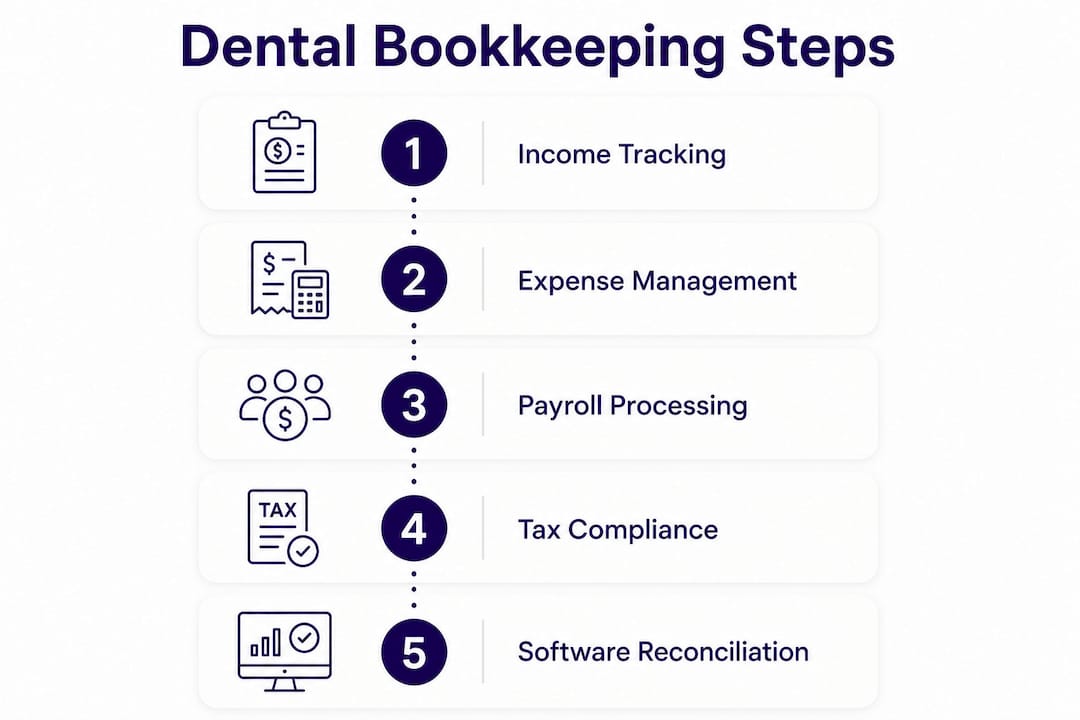
Income tracking
Your practice generates revenue from multiple sources simultaneously: patient co-pays, insurance reimbursements from carriers like Delta Dental or Cigna, and third-party financing. Each stream arrives on a different timeline and requires separate categorization. Insurance payments in particular come with adjustments and write-offs that must be recorded accurately, not lumped into a single income line.

Expense management
Dental practices carry a wider range of expenses than most small businesses. Clinical supplies, lab fees, equipment purchases, lease obligations, and staff compensation all need their own categories. Reconciling practice management systems like Dentrix or Eaglesoft with your accounting platform keeps these categories accurate and current.
Payroll processing
Dental payroll is genuinely complex. Associate dentists often work on production splits. Hygienists may have base-plus-production compensation. Owner compensation interacts directly with practice profitability. Each of these structures requires precise recording to avoid misclassification and payroll tax errors.

Tax compliance documentation
Your bookkeeper’s job includes maintaining the documentation your CPA needs to file accurately: organized expense records, depreciation schedules, payroll tax filings, and income summaries. Well-kept books let you spot revenue leaks and prepare for tax filings with confidence rather than scrambling at year-end.
Software integration and reconciliation
Most practices run two systems: a practice management platform for scheduling, production, and insurance claims, and an accounting platform for cash flow and financial statements. Getting them to talk to each other accurately is a core bookkeeping responsibility. When they do not sync, discrepancies slip through undetected, including missed charges, posting errors, and payments applied to the wrong accounts.
Getting the mechanics right is one thing. Building a system that stays accurate month after month is another. These practices separate practices with clear financial visibility from those constantly chasing discrepancies.
Build a dental-specific chart of accounts
A generic chart of accounts produces vague reports. A dental-specific one separates lab fees from clinical supplies, tracks equipment depreciation independently, and breaks out associate compensation from staff wages. Using a dental-specific chart of accounts and monthly financial reviews significantly reduces errors and improves oversight of collections, overhead, and profitability. That structure makes your P&L a management tool, not just a compliance document.
Reconcile monthly without exception
Every month, your practice management software reports and your bank deposits need to match. When they do not, the cause is usually a missed charge, a posting error, or, in more serious cases, internal theft. Embezzlement in dental practices often goes undetected for years precisely because no one cross-checks the numbers. Monthly reconciliation closes that gap.
Separate production from collections
Production is what you scheduled and delivered. Collections is what actually landed in your bank account. Tracking both separately gives you a real-time view of your collection rate. A collections rate below an optimal target is a warning sign worth investigating. Mixing the two figures obscures where revenue is leaking.
Maintain a consistent close schedule
Books that get closed quarterly instead of monthly create backlogs that are expensive to unwind. Set a monthly close date, stick to it, and review your P&L, cash flow, and accounts receivable aging before the next month opens.
Outsource to dental bookkeeping specialists when it makes sense
Specialist bookkeepers handle insurance write-offs, patient credits, and multi-stream revenue reconciliation accurately because they already understand how dental billing works. You stop paying someone to learn your industry on your time.
Track overhead against industry benchmarks
Overhead in a healthy dental practice typically falls within a moderate range of collections, with staff compensation as the largest single category. A significantly high overhead ratio signals a problem worth addressing. Regular monthly reviews against these benchmarks catch cost creep before it becomes a profitability crisis.
Pro Tip: Bridge the gap between your practice management software and accounting platform every month. Even a one-month lag in reconciliation can hide cash flow problems that compound quickly.
Dental bookkeeping carries specific risks that general small business bookkeeping does not. Understanding them helps you build a system that handles them proactively.
The production vs. collections gap
This is the most common financial blind spot in dental practices. The production vs. collections gap occurs when recorded patient and insurance production does not align with actual bank deposits, obscuring true cash flow. It happens because insurance payments arrive weeks after service delivery, adjustments get posted inconsistently, and patient balances age without follow-up. Monthly reconciliation between your practice management system and bank deposits is the only reliable way to understand your actual cash position.
HIPAA compliance in financial records
Your financial records are not just financial. They contain patient names, treatment codes, and insurance information, all of which qualify as protected health information under HIPAA. That means your bookkeeping system needs access controls, secure storage, and audit trails. A data breach tied to financial records carries the same regulatory exposure as a clinical one.
Multiple asynchronous payment streams
Insurance reimbursements from different carriers arrive on different timelines. Patient payments come in at the point of service, through payment plans, or after collections follow-up. Third-party financing adds another layer. Recording each stream accurately, without double-counting or misclassifying adjustments, requires a system built specifically for dental revenue cycles, not a generic accounts receivable setup.
Delayed bookkeeping compounds risk
When books fall behind, the consequences stack up fast. You lose visibility into cash flow, tax deadlines become stressful, and the window for catching errors or fraud closes. Practices that maintain accurate, organized bookkeeping are better positioned for tax filings, lender reviews, and practice valuations. Practices that do not are often surprised by both.
Running a dental practice means your attention belongs in the operatory, not in a spreadsheet. Taxbowl gives dental practice owners a dedicated team of accountants who understand the financial structure of a dental practice, from insurance write-offs and production splits to equipment depreciation and overhead benchmarking.
Unlike a traditional accounting firm, Taxbowl combines real-time financial visibility with proactive communication through platforms like Slack, so you get answers when you need them, not at the next quarterly meeting. Your books stay current, your cash flow is clear, and your team is never chasing down a backlog. Whether you are a solo practitioner or managing a multi-location group, Taxbowl’s dental practice accounting support is built around how your practice actually operates.
Ready to get clean, accurate books without the overhead of an in-house bookkeeper? Talk to a Taxbowl expert and see exactly what your practice’s financials could look like.
Dental practice bookkeeping is the foundation of every sound financial decision you make, from managing cash flow to preparing for tax filings and practice valuations.
| Point | Details |
|---|---|
| Bookkeeping vs. accounting | Bookkeeping records and reconciles transactions; accounting interprets them for strategy and tax filings. |
| Monthly reconciliation | Reconcile your practice management software against bank deposits every month to catch errors and prevent fraud. |
| Overhead benchmark | Healthy dental practices run overhead between 55–65% of collections; above 70% signals a problem. |
| Collections rate target | A collections rate below 98% indicates revenue leakage worth investigating immediately. |
| Taxbowl for dental practices | Taxbowl provides dedicated dental accounting support with real-time visibility and proactive communication. |
Most dental practices run a practice management system (such as Dentrix, Eaglesoft, or Open Dental) alongside an accounting platform. The bookkeeper’s job is to reconcile the two so production reports and bank deposits match.
Dental bookkeeping is more complex than general small business bookkeeping because of insurance reimbursements, production splits, and HIPAA compliance requirements. Most practice owners find it more cost-effective to outsource to a specialist than to manage it in-house.
The five fundamentals are accurate transaction recording, consistent monthly reconciliation, a dental-specific chart of accounts, separation of production from collections, and timely monthly close. Together, they give you a reliable picture of your practice’s financial health.
Clean books let you track overhead ratios, collections rates, and accounts receivable aging in real time. Without that visibility, cost creep and revenue leaks go undetected until they become serious cash flow problems.
Financial records in a dental practice contain protected health information, including patient names and treatment codes. HIPAA requires that this data be stored securely with access controls and audit trails, which means your bookkeeping system must meet the same data security standards as your clinical records.