
Back to blog
Trust Accounting in Law Firms: A 2026 Compliance Guide
Discover the role of trust accounting law firms in 2026. This guide covers compliance, regulations, and benefits for successful law practice.
Discover the role of trust accounting law firms in 2026. This guide covers compliance, regulations, and benefits for successful law practice.
TL;DR:
- Trust accounting involves law firms holding client funds separately in regulated accounts to ensure fiduciary responsibility. Proper compliance requires strict fund segregation, monthly reconciliations, attorney control, and accurate recordkeeping to avoid disciplinary actions. Implementing these practices protects clients, enhances firm reputation, and prepares firms for audits.
Trust accounting is defined as the practice where law firms hold client funds in separate, regulated accounts entirely apart from firm operating money. The role of trust accounting law firms play is a fiduciary one, governed by ABA Model Rule 1.15 and enforced by state bar authorities across the country. Mismanaging these accounts carries consequences that go beyond fines. Attorneys face disbarment, license suspension, and bar investigations. This guide walks you through the regulations, practical controls, common pitfalls, and real benefits of getting trust accounting right in 2026.
ABA Model Rule 1.15 requires attorneys to keep client funds in a separate trust account at approved financial institutions. That rule is the national baseline. Every state bar then layers its own specific requirements on top of it.
The foundational rules apply to every law firm, regardless of size or practice area:
Interest on Lawyers’ Trust Accounts (IOLTA) must be handled according to strict state board guidelines, with earned interest funding legal aid programs rather than going to the client or the firm. This applies specifically to small or short-term client funds that would not generate meaningful interest on their own. Larger client funds held for longer periods are typically placed in separate interest-bearing accounts where the client receives the interest directly.
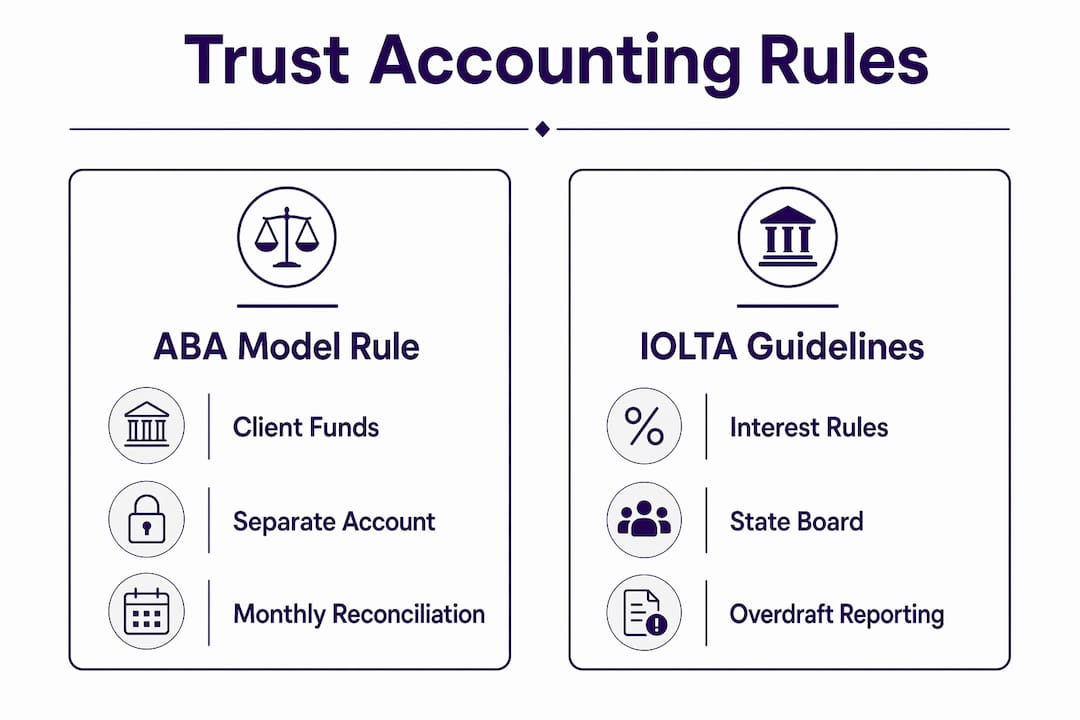
Trust accounts must be titled explicitly as attorney-client trust accounts, using language such as “Attorney-Client Trust Account / IOLTA,” to comply with state requirements. Incorrect titling causes banks to misclassify the funds, which creates a regulatory breach even if the money itself is handled correctly.

Pro Tip: Before opening a trust account, confirm in writing that your chosen bank reports overdrafts to your state bar. Many attorneys assume this is standard. It is not.
Most trust accounting compliance failures happen during the initial account setup and planning stage. Getting the foundation right prevents the majority of problems that follow.
| Record Type | Retention Requirement | Purpose |
|---|---|---|
| Deposit slips | Full retention period per state bar | Proves source of funds deposited |
| Bank statements | Full retention period per state bar | Supports monthly reconciliation |
| Client ledgers | Full retention period per state bar | Tracks individual client balances |
| Disbursement records | Full retention period per state bar | Documents authorized payments |
| Reconciliation reports | Full retention period per state bar | Demonstrates ongoing compliance |
Complete audit trails including deposit slips, bank statements, and client ledgers must be preserved to comply with regulations and facilitate dispute resolution. The retention period varies by state, so confirm your specific requirement with your state bar.
Pro Tip: Run your three-way reconciliation on the same date every month. Consistency makes it easier to spot anomalies and proves to regulators that your process is systematic, not reactive.
The violations that lead to disbarment are rarely the result of deliberate theft. Most arise from poor processes, misunderstandings, or careless shortcuts. Knowing the common failure points lets you build controls around them.
The role of accountants in law firm compliance has grown significantly as bar associations increase audit frequency. Having a qualified financial professional review your trust accounting processes is no longer optional for firms that want to stay clean.
Strong trust accounting practices do more than keep regulators satisfied. They create measurable advantages for the firm itself.
“The firms that treat trust accounting as a compliance checkbox are the ones that end up in front of the bar. The firms that treat it as a client service standard are the ones that never do.”
The importance of trust accounting extends to tax planning as well. Knowing exactly when funds are earned versus when they are received affects how partners report income, which has direct implications for quarterly estimated tax obligations.
Trust accounting is the area where I see the most preventable damage in legal practices. Attorneys spend years building a reputation and a book of business, then lose it over a recordkeeping failure that a consistent monthly process would have caught.
The most common misconception I encounter is that trust accounting is purely a compliance task. It is not. It is a financial management discipline. Firms that treat it that way maintain cleaner books, have fewer billing disputes, and close their fiscal year with far less stress.
The shift toward dedicated legal accounting software has changed the risk profile significantly. Automated ledger controls and real-time commingling alerts remove the human error factor from the most dangerous failure points. The technology is not expensive relative to the cost of a bar investigation.
Staff training is where most firms underinvest. The attorney responsible for trust compliance often understands the rules. The paralegal processing deposits often does not. That gap is where violations happen. A 90-minute annual training session for every person who touches the trust account is a reasonable minimum.
Looking ahead, state bars are increasing audit frequency and expanding electronic monitoring of trust account activity. Firms that build strong processes now will absorb those changes without disruption. Firms that rely on informal systems will find the new scrutiny very uncomfortable.
— Taxbowl
Law firms carry a financial compliance burden that most small businesses never face. Trust account rules, monthly reconciliations, matter-level ledgers, and attorney oversight requirements all demand consistent, expert attention.
Taxbowl works with law firms to maintain accurate books, perform monthly reconciliations, and keep financial records audit-ready year-round. Our team understands the specific requirements that govern law firm bookkeeping, from IOLTA compliance to disbursement documentation. We also provide real-time financial visibility so the responsible attorney always knows where the trust account stands. If you want expert support without the overhead of a full-time accounting hire, our bookkeeping services are built for exactly that. Reach out to a Taxbowl expert to see how we can support your firm’s compliance needs.
Effective trust accounting requires strict fund segregation, monthly three-way reconciliation, attorney-controlled disbursements, and complete recordkeeping to meet ABA Model Rule 1.15 and state bar standards.
| Point | Details |
|---|---|
| Segregate funds completely | Client funds must stay in a separate, approved trust account at all times. |
| Reconcile every month | Three-way reconciliation catches errors before regulators find them. |
| Attorney controls disbursements | Only a licensed attorney may authorize payments from the trust account. |
| Title the account correctly | Exact account titling per state bar requirements prevents automatic violations. |
| Preserve complete records | Deposit slips, ledgers, and reconciliation reports must be retained for the full state-mandated period. |
Trust accounting is the practice of holding client funds in a separate, regulated account apart from firm operating funds. ABA Model Rule 1.15 governs this obligation for attorneys across the United States.
Commingling client and firm funds is a serious violation that can result in disbarment, even when no financial loss occurs. State bar authorities treat the act itself as the violation, regardless of intent.
An IOLTA account is an Interest on Lawyers’ Trust Account used to hold small or short-term client funds, with the earned interest directed to legal aid programs. Most states require attorneys to use IOLTA accounts for funds that would not generate meaningful interest on their own.
Law firms must perform a three-way reconciliation of their trust accounts every month. This compares the bank statement, the internal trust ledger, and individual client ledgers to confirm all three records agree.
A paralegal cannot hold sole signature authority over a trust account. Only a licensed attorney may authorize disbursements, though staff may handle data entry and administrative tasks related to the account.